AI Custom Products: The Complete Guide to Creating Anything from Text

Custyle Lab
Research & Guides · Mar 27, 2026·20 min read
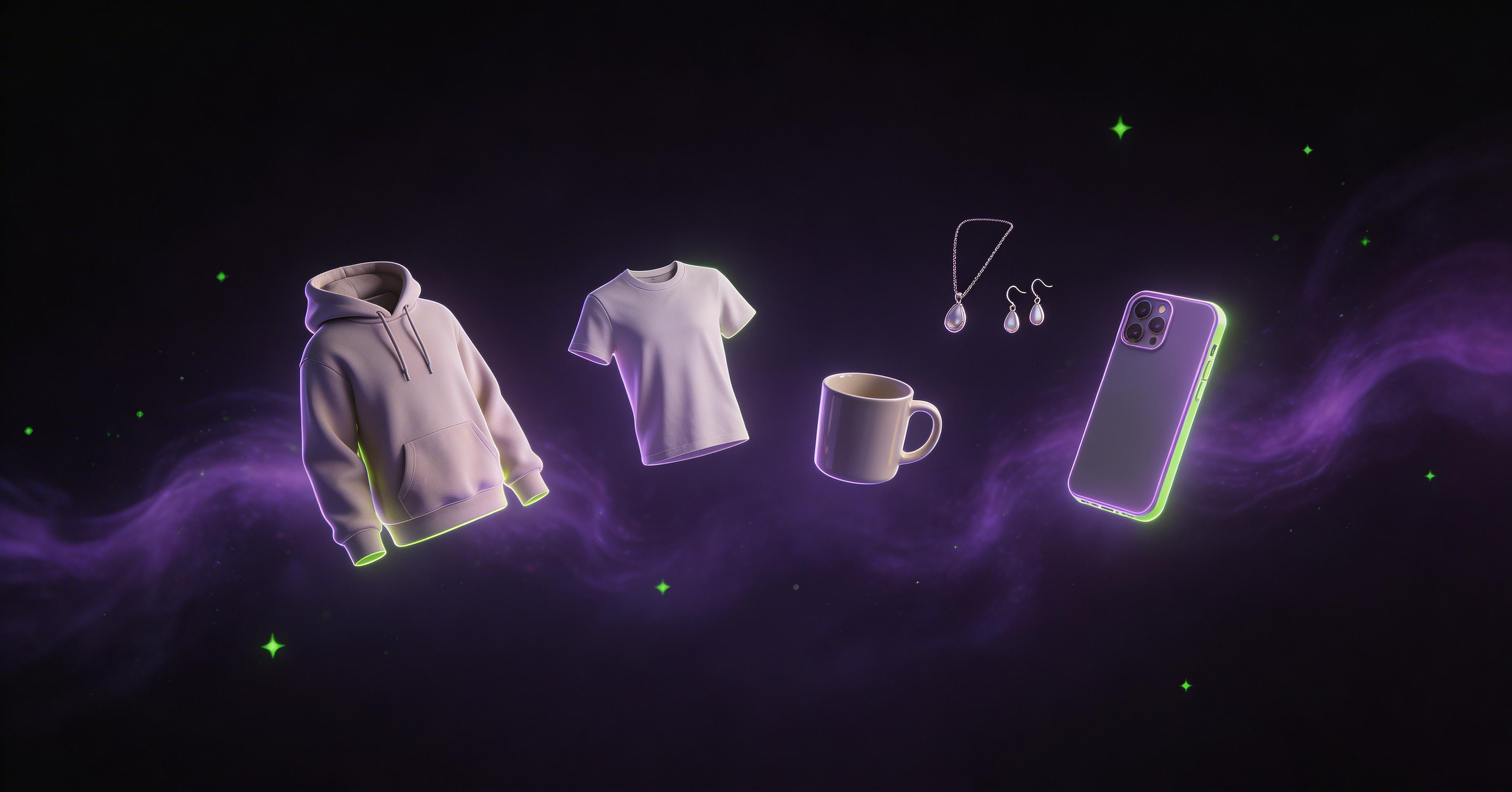
AI Custom Products
TL;DR: AI custom products are physical goods — apparel, accessories, jewelry, home décor — created from text descriptions or images using generative AI. The market sits at the intersection of a $33.7 billion personalized gifts industry, a $13 billion print-on-demand sector, and a $14 billion AI design market — all growing 20–35% annually. Three distinct models compete: AI-enhanced POD, AI marketplace with human makers, and fully autonomous AI agents. The technology is here. The question is which model wins.
Table of Contents
- What Are AI Custom Products?
- Market Size and Growth
- The Technology Stack
- Three Competing Models
- Product Categories and Capabilities
- Who's Buying and Why
- The Manufacturing Revolution
- What's Next: 2026–2028
- FAQ
What Are AI Custom Products?
AI custom products are physical goods designed, configured, or created with the help of artificial intelligence — based on individual user input rather than mass-market assumptions.
The spectrum is wide. At the simplest end: an AI generates a pattern you apply to a T-shirt template. At the most advanced end: you describe an idea in natural language, and an autonomous system designs the product, selects the manufacturing technique, routes production to the best supplier, and ships the finished item to your door.
What unites the spectrum is a shift in who does the creative work. Traditional custom products require you to bring a design — or hire someone who can. AI custom products require you to bring an idea. The AI handles execution.
This matters because it changes who can create products. When design is automated, the barrier drops from "can you use Photoshop?" to "can you describe what you want?" That's a difference of roughly 3 billion potential users — the gap between professional designers and everyone with internet access.
The term covers three layers of capability:
| Layer | What AI Does | Example |
|---|---|---|
| AI-assisted design | Generates images you apply to existing products | Midjourney + Printful template upload |
| AI-configured products | Recommends product types, colors, placements | Printify's built-in AI design generator |
| AI-created products | Handles the full chain: design → manufacturing → delivery | Custyle.ai's AI MerchAgent, Arcade's AI marketplace |
Most of the current market operates at Layers 1–2. Layer 3 — full autonomous creation — is the frontier where the most interesting competition is happening.
Market Size and Growth
AI custom products sit at the intersection of several large, fast-growing markets. No single market report captures the full picture, so here's how the pieces fit together.
The Personalized Products Market
The global personalized gifts market reached $33.7 billion in 2025 and is projected to hit $69.2 billion by 2033, growing at 9.4% CAGR (SkyQuest Technology). Technavio projects an additional $10.76 billion in incremental growth from 2024 to 2029 alone.
This isn't just gifts. The broader custom products category — including apparel, accessories, home goods, and corporate merchandise — is substantially larger but harder to size precisely because it crosses multiple traditional market definitions.
Key demand signals:
- 68% of online shoppers express interest in customized goods
- 54% of consumers are willing to pay a premium for personalized products
- 74% of personalized product distribution now happens through online channels
The Print-on-Demand Market
POD provides the manufacturing backbone for many AI custom products. The market reached $12.96 billion in 2025 and is projected to hit $39–103 billion by 2030–2034, depending on scope definition.
| Source | 2025 | Projection | CAGR |
|---|---|---|---|
| Grand View Research | $8.03B (2023) | $39B (2030) | 26.1% |
| Mordor Intelligence | $10.78B | $57.49B (2033) | 23.6% |
| Fortune Business Insights | $12.96B | $102.99B (2034) | 26% |
Apparel captures 37% of the POD market. Home décor takes 27%. Drinkware accounts for 19%.
The AI Design Tools Market
The global AI in design market exceeded $14 billion in 2025, growing at over 25% annually. This includes tools for UI/UX design, industrial design, and generative product design — of which custom consumer products is one application.
Within this, the generative AI in product design and engineering market is projected to reach $3.47 billion by 2032 at 28.1% CAGR (Fortune Business Insights).
The AI Personalization Market
The AI-based personalization market — covering all AI applications that tailor experiences to individuals — is expected to reach $629.64 billion by 2029 (The Business Research Company). Custom products are one slice of this market, sitting alongside personalized marketing, content recommendations, and dynamic pricing.
How These Markets Overlap
AI Personalization ($629B by 2029)
  └→ Personalized Products ($69B by 2033)
       └→ Print-on-Demand ($39-103B by 2030-2034)
            └→ AI Custom Products (emerging, fastest-growing slice)
AI custom products represent the convergence point. They use AI personalization for design generation, personalized product infrastructure for demand capture, and POD manufacturing for physical production. The total addressable market for AI-generated custom physical goods is conservatively $15–25 billion by 2030, based on POD market share projections and AI adoption rates in the category.
The Technology Stack
Creating a physical product from a text prompt requires five distinct technology layers. Most platforms excel at one or two. Very few integrate all five.
Layer 1: Natural Language Understanding
The prompt "a cozy winter scene with a cabin and northern lights for a blanket" contains explicit intent (winter scene, cabin, northern lights), product preference (blanket), and implicit aesthetic direction (cozy = warm colors, soft textures, inviting composition).
Modern LLMs parse these prompts with high accuracy. The challenge isn't understanding the words — it's understanding the taste behind them. "Cozy" means different things to different people. The best systems learn from user feedback to calibrate their interpretation over time.
Layer 2: Generative Design
Image generation models (Midjourney, DALL-E, Stable Diffusion, Flux, Seedream) create the visual artwork. But raw AI images are rarely production-ready. The gap between "looks good on screen" and "prints well on fabric" is substantial:
| Production Requirement | Why It Matters |
|---|---|
| Resolution | Screen images at 72 DPI look blurry at 300 DPI print |
| Color space | RGB screens display colors CMYK printers can't reproduce |
| Bleed area | Designs need extra margin for cutting and folding |
| Composition | T-shirt prints need different proportions than poster prints |
| Detail density | Fine lines work for UV printing but vanish in embroidery |
The platforms that perform best at Layer 2 don't just generate images — they generate merch-ready designs that account for these production constraints upfront. Image generation costs have dropped dramatically: from $0.04–0.17 per image (premium models) to as low as $0.005 (budget tier), making design generation nearly free at scale.
Layer 3: Product Intelligence
Given a design, which product types will display it best? A photorealistic landscape works on a poster but loses impact on a keychain. A bold graphic logo pops on a hoodie but overwhelms a subtle notebook.
Product intelligence matches design characteristics to product form factors:
| Design Feature | Best Product Matches | Worst Matches |
|---|---|---|
| Photorealistic, detailed | Canvas print, poster, blanket | Small keychain, badge |
| Bold graphic, few colors | T-shirt, hoodie, tote bag | Delicate jewelry |
| Text-heavy | Mug, sticker, notebook | All-over print apparel |
| Pattern/repeat | All-over shirt, phone case, wallpaper | Single-placement tee |
| Portrait/face | Canvas, pillow, photo necklace | Generic placement products |
This layer is where AI-native platforms differentiate from basic POD tools. Basic tools let you upload any image to any product. Intelligent platforms recommend the right match.
Layer 4: Manufacturing Selection
The most technically complex layer. Different manufacturing techniques produce dramatically different results from the same design:
| Technique | Best For | Limitations | Cost Range |
|---|---|---|---|
| DTG (Direct-to-Garment) | Full-color prints on cotton | Limited to natural fibers; colors fade faster | $3–8/print |
| DTF (Direct-to-Film) | Versatile, wide material compatibility | Transfer feel on fabric | $2–5/print |
| Sublimation | All-over prints, polyester products | Only works on polymer-coated or polyester surfaces | $4–10/print |
| Embroidery | Logos, text, textured designs | Limited color count; no gradients | $5–15/design |
| UV Printing | Phone cases, hard surfaces, detailed art | Limited to flat or slightly curved surfaces | $2–6/print |
| Engraving | Jewelry, wood, metal products | Monochrome only | $3–12/piece |
| 3D Printing | Custom figures, unique shapes | Slow, limited materials for consumer products | $10–50+/piece |
| Screen Printing | High-volume runs, bold colors | Not economical below 25+ units | $1–3/print at scale |
Most POD platforms offer 1–2 techniques (usually DTG). AI-native platforms with manufacturing intelligence select from the full range based on design characteristics, product type, and quality requirements.
Layer 5: Fulfillment Orchestration
The final layer: routing production to the right supplier, managing quality verification, and coordinating shipping. This layer determines delivery speed, cost, and reliability.
Fulfillment orchestration in AI custom products means:
- Supplier matching: Selecting the manufacturer with the best combination of technique capability, geographic proximity to the customer, quality ratings, and current capacity
- File preparation: Converting the AI-generated design into production-ready format for the specific technique and supplier
- Quality gates: Automated or human verification that the produced item matches the design intent
- Shipping optimization: Selecting carriers and routing for cost-speed balance
Three Competing Models
The AI custom products space is not monolithic. Three architecturally distinct models compete, each with different strengths and trade-offs.
Model 1: AI-Enhanced Print-on-Demand
What it is: Traditional POD platforms (Printful, Printify, Redbubble) adding AI design generation as a feature. You generate an image with built-in AI tools, then apply it to a product template using the platform's existing workflow.
How it works: AI generates the image → you manually select the product → you position the design → you configure the listing → the platform prints and ships.
Strengths:
- Mature fulfillment infrastructure (millions of orders processed)
- Established marketplace traffic (Redbubble, Merch by Amazon)
- Low cost per unit at scale
- Proven quality for standard products
Limitations:
- AI is limited to image generation — all other decisions are manual
- Product range is fixed to existing catalog
- Design isn't optimized for specific manufacturing techniques
- No manufacturing intelligence — you pick DTG or nothing
Key players: Printify (built-in AI generator), Printful (integration with external AI tools), Kittl (AI typography and design), MyDesigns (AI + bulk automation)
Best for: Sellers who want to add AI-generated designs to an existing POD business.
Model 2: AI Marketplace with Human Makers
What it is: Platforms where AI generates product designs, which are then reviewed and manufactured by human artisans or makers. The AI handles design; humans handle everything from manufacturing decision to production.
How it works: AI generates design with specs → order sent to human maker → maker reviews feasibility → maker produces manually → maker ships.
Strengths:
- Handcraft quality for artisan products (jewelry, ceramics, leather)
- Human judgment on complex manufacturing decisions
- Unique, one-of-a-kind results
- Premium positioning and pricing
Limitations:
- Human review adds days to the timeline
- Makers can reject orders they can't produce
- Quality varies by individual maker
- Scale requires recruiting and vetting more makers
- Product range limited to existing maker capabilities
Key players: Arcade (AI + global artisan network; backed by Karlie Kloss), Off/Script (AI-designed items funded by artists)
Best for: Premium, artisan-quality products where human craftsmanship adds value — custom jewelry, hand-made furniture, bespoke leather goods.
Model 3: Fully Autonomous AI Agent
What it is: End-to-end AI systems that handle the entire chain — from intent parsing through design, manufacturing selection, production routing, quality verification, and fulfillment — without human intervention in the production loop.
How it works: You describe intent → AI generates merch-ready design → AI selects manufacturing technique → AI routes to optimal supplier → AI verifies quality → product ships.
Strengths:
- Fastest turnaround (no human review delay)
- Consistent quality (AI-standardized verification)
- Broadest product range (limited by supply network, not individual maker skills)
- Manufacturing intelligence (AI selects the right technique for each design)
- Scales with supply network capacity, not human headcount
Limitations:
- Less suitable for products where handcraft is the value proposition
- Manufacturing relationships required (supply network is the moat)
- Newer, less proven at massive scale
Key players: Custyle.ai (AI MerchAgent with 9-agent architecture, hundreds of product types across 14+ categories)
Best for: Fast, consistent, scalable custom products — merch drops, creator collections, gifts, team gear, personal expression.
Model Comparison
| Dimension | AI-Enhanced POD | AI Marketplace | AI Agent |
|---|---|---|---|
| AI scope | Design only | Design + specs | Full pipeline |
| Human involvement | You select everything | Maker reviews + produces | None in production loop |
| Timeline | Hours (your time) + days (shipping) | Days (maker review) + days (production) | Minutes (design) + days (shipping) |
| Product range | Fixed catalog | Limited by maker skills | Expanding with supply network |
| Manufacturing intelligence | None — you choose | Maker decides | AI selects optimal technique |
| Scale model | Platform infrastructure | Maker recruitment | Supply network expansion |
| Quality consistency | Platform-standardized | Varies by maker | AI-standardized |
| Best category | Apparel basics | Artisan goods | Broad custom products |
→ Related: Prompt to Product — How It Works
Product Categories and Capabilities
The range of AI custom products has expanded dramatically. Here's what's currently possible across major categories.
Apparel (Largest Category — 37% of Market)
| Product Type | AI Capability | Manufacturing Method |
|---|---|---|
| T-shirts, hoodies | Full-color prints from any prompt | DTG, DTF, sublimation |
| All-over pattern clothing | Seamless repeat patterns generated by AI | Sublimation on polyester |
| Embroidered caps, polos | AI converts designs to stitch-ready files | Machine embroidery |
| Dresses, swimwear, activewear | Full-garment custom prints | Sublimation, cut-and-sew |
Jewelry & Accessories
| Product Type | AI Capability | Manufacturing Method |
|---|---|---|
| Photo necklaces, lockets | AI processes and optimizes photos for miniature display | UV printing, engraving |
| Custom charms, bracelets | AI generates unique motifs from descriptions | Metal casting, 3D printing |
| Phone cases | AI creates detailed case-specific artwork | UV printing |
| Bags, wallets | AI generates prints or monogram designs | DTF transfer, embroidery |
Home & Living
| Product Type | AI Capability | Manufacturing Method |
|---|---|---|
| Canvas prints, posters | AI generates wall-art-optimized compositions | Giclée printing, large-format digital |
| Blankets, pillows | AI creates cozy patterns and personalized designs | Sublimation, DTF |
| Mugs, tumblers | AI generates wrap-around designs for cylindrical surfaces | Sublimation, UV printing |
| Candles, décor items | AI designs labels and packaging graphics | UV printing, DTF |
Stationery & Paper Goods
| Product Type | AI Capability | Manufacturing Method |
|---|---|---|
| Notebooks, journals | AI creates cover art from themes or moods | UV printing, digital print |
| Sticker packs | AI generates themed sticker sets | Die-cut digital printing |
| Greeting cards, postcards | AI creates occasion-specific illustrations | Digital offset printing |
The total product range across all categories now exceeds hundreds of distinct product types — and grows continuously as new manufacturing connections come online.
Who's Buying and Why
Consumer demand for AI custom products follows clear patterns by demographic, use case, and product category.
The Demographic Picture
| Segment | Key Behavior | Data |
|---|---|---|
| Gen Z (18–27) | Highest AI adoption; demand for self-expression products | 47% desire personalized recommendations (highest of all generations); 75% interested in AI shopping |
| Millennials (28–43) | Time-pressed parents; gifting and home décor demand | 80% more likely to buy from brands offering personalization |
| Gen X (44–59) | Corporate merch, team gear, quality-focused gifts | Growing AI comfort; prefer premium quality |
| Boomers (60+) | Personalized gifts for grandchildren; memorial/nostalgia items | Lower AI adoption but high spending per order |
The Five Use Cases
1. Self-Expression (Largest Segment) "I want something that reflects who I am." Gen Z drives this — they want merch that captures a vibe, an identity, an aesthetic that mass-produced goods can't match. The shirt doesn't come from a brand. It comes from them.
2. Gifting ($33.7B Market) "I want something meaningful, not generic." Personalized gifts outperform generic alternatives in recipient satisfaction. A mug with an inside joke. A canvas print of a shared memory. AI makes these products possible without commissioning a designer.
3. Creator Merch "I want to monetize my audience with products, not ads." Over 50 million creators globally. Only 24% plan to launch merch — because the process is too complex. AI removes the barrier. Describe the vibe, share the link, earn from every sale.
4. Team & Community Gear "We need matching stuff for our group." Startups, sports teams, Discord communities, school clubs. Group identity needs physical expression. AI generates consistent branding across multiple product types from a single description.
5. Corporate & Event Merchandise "We need branded items for our conference." Companies spend billions annually on promotional products. AI accelerates the design-to-delivery timeline from weeks to days, and enables smaller runs that traditional promo suppliers won't handle.
What Drives Purchase Decisions
| Factor | Impact | Data |
|---|---|---|
| Uniqueness | Primary driver for Gen Z | 50% want products no one else has |
| Speed | "I want it now" expectation | AI design in minutes vs. days with human designers |
| Price | Must compete with mass-produced | 54% willing to pay a premium, but the premium must be justified |
| Quality | Non-negotiable | Products must match or exceed mass-market quality |
| Sustainability | Growing factor | Zero-inventory model eliminates waste from overproduction |
The Manufacturing Revolution
The AI custom products industry depends on a parallel revolution in manufacturing. Without changes in how physical goods are produced, AI-generated designs would remain digital files.
From Mass Production to On-Demand
The manufacturing paradigm is shifting:
Mass Production (1900s–2000s)
  → Make thousands, hope they sell
  → 10–40% unsold inventory
  → $500B annual waste

Mass Customization (2000s–2010s)
  → "Pick your color" from preset options
  → Still inventory-based
  → Limited personalization

On-Demand Manufacturing (2020s)
  → Make one, only when ordered
  → Zero inventory
  → Enabled by digital printing

AI-Driven On-Demand (2025+)
  → AI designs the product
  → AI selects the technique
  → AI routes to best supplier
  → Zero human coordination
72% of manufacturing leaders now report using on-demand manufacturing to overcome barriers to innovation and scale (Protolabs). By 2026, over 40% of manufacturers with production scheduling systems will upgrade to AI-driven capabilities (IDC).
C2M: Consumer-to-Manufacturer
The C2M (Consumer-to-Manufacturer) model establishes a direct connection between the person who wants a product and the factory that builds it — eliminating layers of intermediaries, inventory risk, and guesswork.
SHEIN proved C2M at scale with 300,000 new items per month and 5–7 day production cycles. But SHEIN's C2M is still brand-driven — the company decides what to produce based on trend data.
AI custom products take C2M one step further: the consumer decides what to produce. Not based on trends. Based on their own taste.
| C2M Model | Who Decides What to Make | Inventory |
|---|---|---|
| Traditional retail | Brand/buyer forecasts demand | Months of stock |
| SHEIN-style C2M | AI trend detection decides | Days of stock |
| AI custom products | Individual consumer decides | Zero — made after purchase |
The AI Manufacturing Market
AI in manufacturing is projected to reach $155 billion by 2030, growing at 35.3% CAGR (Fortune Business Insights). Currently, only 6% of manufacturers use AI and generative AI systems, but 24% expect to adopt within two years (Deloitte).
This adoption curve creates the infrastructure that AI custom products require. As more manufacturers integrate AI into their production workflows, the supply network for custom products expands — more techniques, more materials, more geographic coverage, faster turnaround.
What's Next: 2026–2028
AI Agents Become the Commerce Interface
The shift from websites to AI agents as the primary shopping interface accelerates. McKinsey projects $3–5 trillion in agent-mediated commerce by 2030. For custom products, this means consumers won't visit a website to create — they'll describe what they want to an AI agent that handles everything.
Commerce protocols (UCP, ACP, MCP) enable this transition. When a consumer tells ChatGPT "make me a hoodie with a mountain landscape," the agent calls a manufacturing protocol — routing the request to whichever system can fulfill it. The winning platforms become callable services, not browsable websites.
→ Related: Agentic Commerce in 2026
Taste Memory and Personalization Depth
Current AI custom products treat each request as independent. Future systems maintain a taste profile — learning from your past creations, style preferences, color tendencies, and product choices to improve results over time.
This creates a flywheel: better results → more usage → better understanding → even better results. The platform that builds the deepest taste understanding creates the strongest user retention.
Multi-Product Collections from Single Prompts
Today: one prompt → one product. Tomorrow: one prompt → a coordinated collection. "Beach trip merch for our group of 6" generates matching tees, a tote bag, sticker packs, and phone cases — all in a cohesive visual language.
This shifts AI custom products from individual items to capsule collections — a concept borrowed from fashion that becomes accessible to anyone with a prompt.
Physical-Digital Integration
AI custom products will integrate with digital assets. The same design that appears on your hoodie lives as your social media avatar, your phone wallpaper, and your digital identity. Physical and digital expression merge.
FAQ
What are AI custom products?
AI custom products are physical goods — apparel, accessories, jewelry, home décor, and more — designed or created using artificial intelligence based on individual user input. You describe what you want in natural language or upload a reference image. AI handles the design, and the product is manufactured on demand and shipped to you.
How much do AI custom products cost?
Prices vary by product type and manufacturing technique. T-shirts typically range from $18–35. Mugs from $12–20. Canvas prints from $25–60. Phone cases from $15–30. Jewelry from $25–150. Prices are comparable to premium retail because each item is uniquely made. The design step adds minimal cost — AI image generation costs as little as $0.005 per image.
Are AI custom products good quality?
Quality depends on the platform and manufacturing method. The best platforms select the optimal manufacturing technique for each design — DTG for cotton, sublimation for polyester, embroidery for textured logos. The physical manufacturing uses the same commercial equipment as professional custom shops. Quality matches or exceeds mass-market products for equivalent categories.
Can I sell AI custom products?
Yes. Many platforms enable creator storefronts where you design products and earn from each sale. The creator economy increasingly uses AI custom products as a monetization channel. Over 50 million creators globally represent potential merch sellers, and AI removes the design skill barrier that previously limited participation.
What's the difference between AI custom products and print-on-demand?
Print-on-demand requires you to bring a finished design. AI custom products start from your raw idea — a text description, a mood, a reference image. The AI generates the design, selects the right product form, picks the manufacturing technique, and handles fulfillment. POD is a printing service. AI custom products are a creation system.
Ready to make something?
Turn your ideas into real merch with AI. No design skills needed.
Start with a vibeCustyle Lab
Research & Guides · Mar 27, 2026·20 min read
Further Reading
Explore all →
Inside Moxy & Lumi: How Custyle Stages Your Product Before You See It
Moxy and Lumi are the presentation layer of the Custyle Crew — Moxy shows how your merch lands on a real person; Lumi builds the mood, context, and atmosphere around what you made.
Read more →
Creator Merch Case Study: How to Build a Merch Line in One Afternoon
A creator merch case study you can copy: real benchmarks (0.5–2% conversion, $68 AOV), an hour-by-hour afternoon build, and a fill-in template for your first drop.
Read more →
Inside Axis & Grid: Custyle's Form-and-Composition Crew
Axis and Grid are the structure layer of the Custyle Crew — Grid gets composition, spacing, and placement right; Axis finds the right product form your idea should live on.
Read more →
Inside Bolt: The Production Brain That Picks Materials Without Asking
Bolt is the AI production brain of the Custyle Crew — the agent that picks the process, material, and build quality for every design. Here is how.
Read more →