Agentic Commerce: How AI Is Rebuilding Online Retail

Custyle Lab
Research & Guides · Mar 25, 2026·17 min read

Agentic Commerce: How AI Is Rebuilding Online Retail
Agentic commerce is a model where AI agents research, decide, and buy on your behalf — turning shopping from a series of steps into a single, intent-driven flow. McKinsey projects it will generate $3–5 trillion globally by 2030. During Cyber Week 2025, 1 in 5 orders were already AI-assisted, driving $67 billion in sales.
This isn't a future prediction. It's happening now.
Key Takeaways
- Agentic commerce is projected to reach $3–5 trillion globally by 2030 (McKinsey), with $1.7 trillion in direct market size (Edgar, Dunn & Co)
- During the 2025 holiday season, AI referral traffic to retail sites grew 4,700% year-over-year (Adobe)
- Three competing protocols — OpenAI's ACP, Google/Shopify's UCP, and Anthropic's MCP — are racing to become the rails of AI commerce
- The shift goes beyond buying existing products — agentic commerce also creates new products on demand, from custom merch to AI-designed luxury goods
This guide breaks down what agentic commerce is, who's building it, what's already live, and where it's heading — with data from McKinsey, Morgan Stanley, Adobe, Gartner, IBM, and Forrester.
Table of Contents
- What Is Agentic Commerce?
- The Numbers: How Big Is This Shift?
- Three Phases of Commerce
- Who's Building It: The Major Players
- The Protocol Wars: ACP vs UCP vs MCP
- Holiday 2025: The Proof Point
- Beyond Buying: Agentic Commerce Creates, Not Just Finds
- The Trust Gap: Adoption vs Comfort
- What This Means for Brands
- FAQ
What Is Agentic Commerce?
Agentic commerce is an approach to buying and selling where AI agents act on behalf of consumers or businesses — researching, comparing, negotiating, and purchasing with minimal human intervention.
The definitions from the biggest names in tech converge on the same idea:
"Agentic commerce is a seismic shift that will transform shopping from a series of discrete steps — searching, browsing, comparing and buying — into a continuous, intent-driven flow powered by autonomous AI systems." — McKinsey, The Agentic Commerce Opportunity
"AI agents act on behalf of consumers or businesses to research, negotiate and complete purchases, often without direct human intervention." — IBM, What Is Agentic Commerce?
The word "agent" is what makes this different from AI-assisted search or AI-powered recommendations. An agent doesn't just suggest — it acts. It doesn't wait for step-by-step instructions. It takes your intent, makes decisions, and delivers a result.
Think of the difference this way:
| Model | What Happens | Example |
|---|---|---|
| Traditional e-commerce | You search → browse → compare → buy | Scrolling Amazon for 30 minutes |
| AI-assisted shopping | AI suggests options, you still decide | "You might also like..." |
| Agentic commerce | You describe intent → AI handles everything | "Find me a birthday gift for my sister who likes hiking, under $50" → purchased, shipped |
The Numbers: How Big Is This Shift?
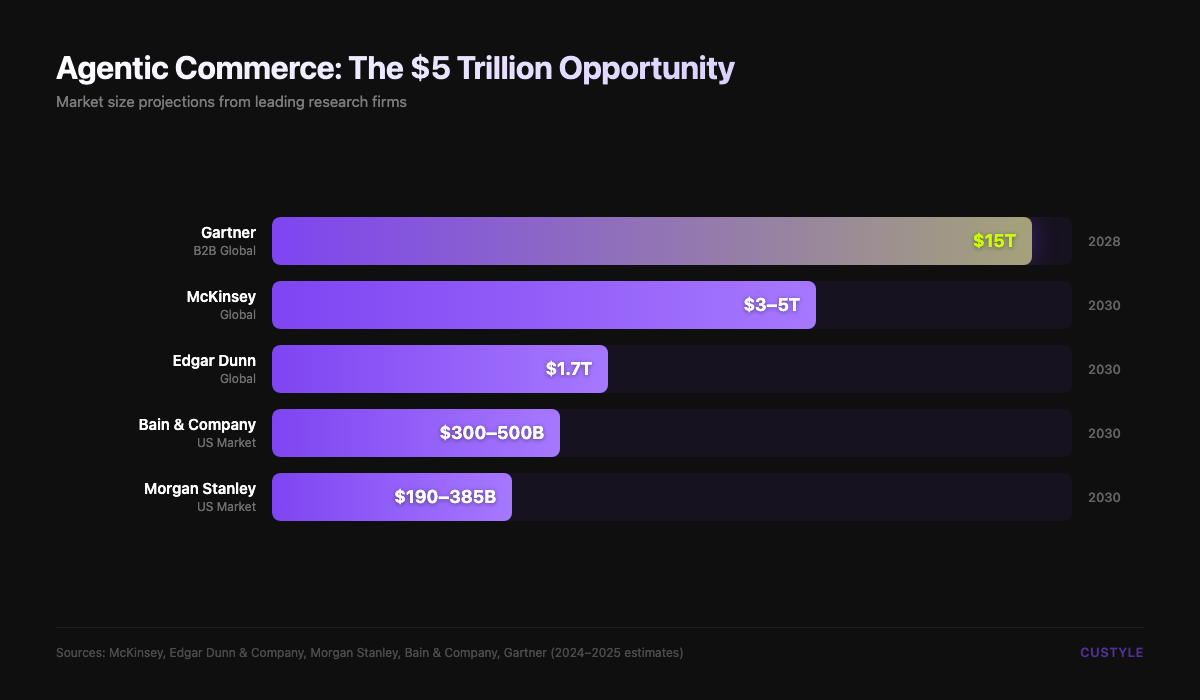
Every major financial and consulting firm has published projections. The numbers are staggering:
| Source | 2030 Projection | Scope |
|---|---|---|
| McKinsey | $3–5 trillion | Global agentic commerce |
| Edgar, Dunn & Co | $1.7 trillion | Global TAM (67% CAGR from $135B in 2025) |
| Morgan Stanley | $190–385 billion | US e-commerce share |
| Bain | $300–500 billion | US online retail (15–25% market share) |
| Gartner | $15 trillion | B2B agent-intermediated spending by 2028 |
For context: total US e-commerce in 2025 is roughly $1.2 trillion. Morgan Stanley projects AI agents will handle 10–20% of that by 2030. And the B2B side is even larger — Gartner forecasts 90% of B2B buying will be agent-intermediated by 2028.
Adoption is already underway
| Metric | Figure | Source |
|---|---|---|
| Consumers who've used GenAI for shopping | 61% | Envive AI |
| Americans who made AI-assisted purchases last month | 23% | Morgan Stanley |
| IBM: consumers using AI in buying journey | 45% | IBM Institute for Business Value |
| Daily purchase-related prompts on ChatGPT | 50 million | FTI Consulting |
This isn't early-adopter territory anymore. Nearly half of consumers have already used AI somewhere in their buying process.
Three Phases of Commerce
Retail has evolved through three distinct phases. Agentic commerce is the third.
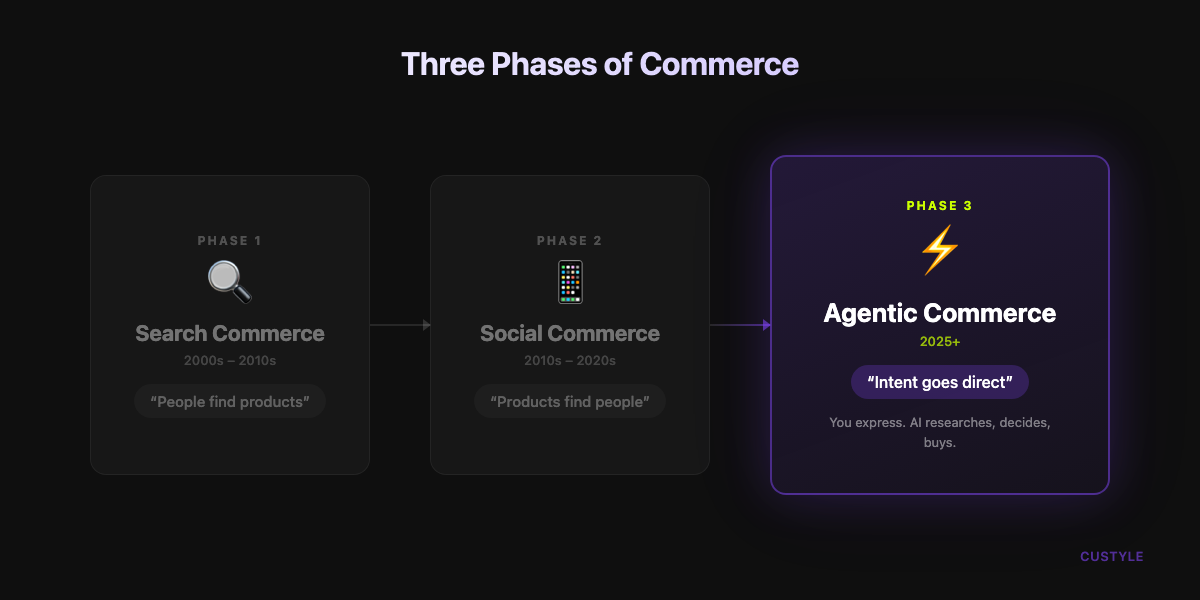
Phase 1: Search Commerce (2000s–2010s)
People find products. You search for what you want, compare options, and buy. The consumer does all the work. Google, Amazon, and eBay dominated this era.
Phase 2: Social & Discovery Commerce (2010s–2020s)
Products find people. Algorithms surface products through feeds, recommendations, and content. TikTok Shop, Instagram Shopping, and Pinterest drove this shift. US social commerce hit $87 billion in 2025.
Phase 3: Agentic Commerce (2025+)
Intent goes direct. You express what you want — in natural language, images, or context — and AI agents handle the rest. No searching. No browsing. No comparing. The agent researches, negotiates, purchases, and tracks delivery.
"This is not just an evolution of ecommerce. It's a rethinking of shopping itself." — Becca Coggins, McKinsey Senior Partner
The purchase funnel is collapsing. As FTI Consulting put it: "The middle of the funnel — research and evaluation — is rapidly disappearing." AI turns multi-stage processes into a single interaction connecting intent directly to products.
Who's Building It: The Major Players
Agentic commerce isn't theoretical. Five major platforms are already shipping it.
OpenAI / ChatGPT
Launched "Buy it in ChatGPT" with Instant Checkout on February 16, 2026. 900 million weekly users can now shop and purchase inside the chat interface.
- Early partners: Glossier, SKIMS, Spanx, Vuori, Walmart (~200K products)
- Payment infrastructure: Stripe-powered, 4% merchant fee
- Already pivoting: moving from in-chat checkout toward retailer-hosted mini-apps inside ChatGPT
Source: OpenAI — Buy it in ChatGPT
Shopify — Agentic Storefronts
Shopify launched Agentic Storefronts — a system that syndicates product data and brand identity to every AI surface where conversations happen.
- Merchants appear in ChatGPT, Google AI Mode, Gemini, Microsoft Copilot
- Co-developed the Universal Commerce Protocol (UCP) with Google
- 1 million+ merchants getting access
Source: Shopify — Agentic Storefronts
Amazon — Rufus
Amazon's AI assistant Rufus reached 250–300 million users (149% YoY growth) and drove $12 billion in sales in 2025. Rufus evolved from a Q&A bot into an autonomous shopping agent with memory, price tracking, and auto-purchasing capabilities.
Meanwhile, Amazon blocked 47 AI bots from crawling its site and sued Perplexity over unauthorized purchases — showing the tension between defending the walled garden and adapting to the agentic era.
Source: CNBC
Google — AI Mode Shopping
Google is rolling out native shopping inside AI Mode in Google Search and the Gemini app, backed by the Universal Commerce Protocol with 20+ partners including Walmart, Target, Visa, and Mastercard.
Source: Google Blog
Perplexity AI — Shopping Agent
Perplexity expanded its shopping agent to free for all US users with PayPal integration, connecting to 5,000+ merchants. Users can research and purchase products directly inside the search conversation.
Source: Perplexity — Shop Like a Pro
The Protocol Wars: ACP vs UCP vs MCP
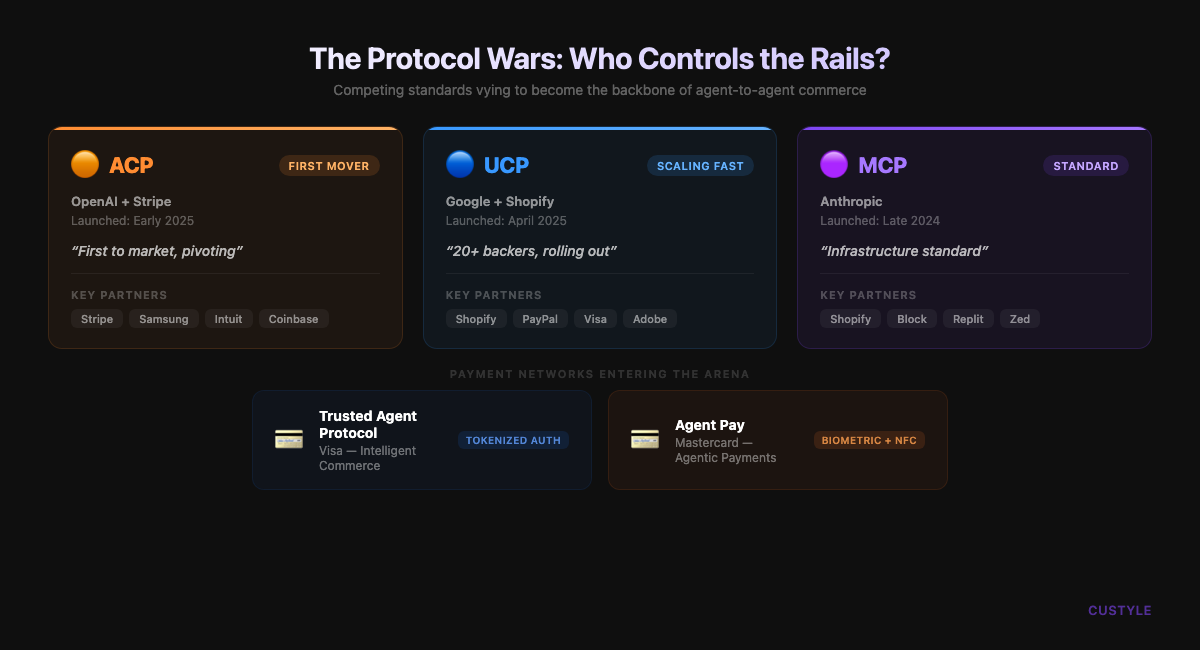
Three competing protocols are racing to become the infrastructure layer of agentic commerce — the equivalent of what TCP/IP did for the internet or what Visa/Mastercard did for payments.
| Protocol | Owner | Launched | Partners | Status |
|---|---|---|---|---|
| ACP (Agentic Commerce Protocol) | OpenAI + Stripe | Sep 2025 | Glossier, SKIMS, Walmart | Live, pivoting to retailer apps |
| UCP (Universal Commerce Protocol) | Google + Shopify | Jan 2026 | 20+ (Visa, Mastercard, Target, Etsy, Wayfair) | Rolling out |
| MCP (Model Context Protocol) | Anthropic | Nov 2024 | Google, Microsoft, OpenAI adopt | Infrastructure standard |
| Trusted Agent Protocol | Visa | Oct 2025 | 100+ partners, 30+ in sandbox | AI payments |
| Agent Pay | Mastercard | Apr 2025 | Agentic Tokens on tokenization | US rollout holiday 2026 |
What's at stake
Whoever controls the protocol layer controls the rails. If your brand isn't accessible through these protocols, AI agents can't find you, can't buy from you, and can't recommend you. The 2026 version of "not being on Google" is not being callable by AI agents.
PayPal is playing the abstraction layer — supporting both ACP and UCP, making existing merchants instantly AI-agent-ready. Stripe is powering OpenAI's payments. Visa and Mastercard are building their own agent payment rails. The infrastructure race is as important as the consumer-facing products.
Holiday 2025: The Proof Point
The 2025 holiday season was the first large-scale proof that agentic commerce works — not in theory, but in revenue.
| Metric | Figure | Source |
|---|---|---|
| AI traffic to retail sites (YoY, July 2025) | +4,700% | Adobe |
| AI referral traffic during holiday season (YoY) | +693% | Adobe Analytics |
| Black Friday AI traffic surge (YoY) | +805% | Adobe Analytics |
| AI referral conversion rate vs traditional | +31% | Adobe Holiday Report |
| Cyber Week orders involving an AI agent | 1 in 5 (~$67B) | Salesforce |
| AI-engaged shoppers: cart conversion rate | 49.3% (vs 26.3% without) | Alhena AI |
| Revenue per visit from AI traffic (YoY) | +254% | Adobe Analytics |
Two numbers stand out:
49.3% cart conversion for AI-engaged shoppers vs 26.3% for everyone else. That's nearly double.
And the disproportionate revenue impact: 1% of site visitors from AI sources drove 10% of revenue (Alhena AI). AI-referred shoppers don't just browse — they buy, and they buy more.
Beyond Buying: Agentic Commerce Creates, Not Just Finds
Most coverage of agentic commerce focuses on buying existing products. But the bigger story is what happens when the agent can't find what you want — and creates it instead.
This is where agentic commerce meets manufacturing. Instead of:
- Search for a product → find the closest match → settle
The new flow becomes:
- Describe what you want → agent creates it → built and shipped
This is already happening in three categories:
Custom Merchandise
AI merch agents like Custyle turn a text description into a finished product — designed, built the right way, and shipped. You describe a vibe, and a crew of AI specialists handles creative direction, design, manufacturing technique selection, and delivery. No design skills. No minimum orders.
This is agentic commerce applied to creation, not just consumption. The agent doesn't find you the best existing hoodie — it builds one that didn't exist before, based on your expression.
Luxury AI-Designed Goods
Arcade.ai connects AI-generated designs with artisan manufacturers for jewelry, rugs, and home goods. $42 million in funding, products from $100–$1,000+.
Fashion Design
Platforms like The New Black offer AI fashion design tools — sketch-to-garment, virtual try-on, tech pack generation — that compress weeks of fashion design into hours.
The thread connecting all three: agentic commerce doesn't just distribute existing products. It creates new ones at the point of intent. This is the difference between "products that find people" and "products that are built for people."
The Trust Gap: Adoption vs Comfort
There's a paradox in the data. Consumers are using agentic commerce, but many aren't fully comfortable with it.
| Signal | Percentage |
|---|---|
| Have used GenAI for shopping | 61% |
| Planning to use GenAI to shop in 2026 | 52% |
| Uncomfortable sharing data with AI for shopping | 54% |
| Reject AI for shopping entirely | 13% |
Source: Envive AI, Forrester
61% have tried it. But 54% are uncomfortable sharing personal data. Only 13% reject it outright — meaning the vast majority are curious but cautious.
Forrester warns that predictions of fully autonomous shopping are overstated in the near term. The evolution is "assistive first" — agents that help you shop, not agents that shop without you. The companies winning trust today are those with clear approval gates: you see what the agent recommends, you confirm before it buys, and you can override any decision.
The Trust Builders
Three design patterns are emerging for building trust in agentic commerce:
- Preview before purchase — show exactly what will happen before committing
- Human-in-the-loop approval — the agent proposes, you approve
- Transparent reasoning — explain why the agent made each decision
Brands that skip these steps in pursuit of "fully autonomous" shopping will hit the trust wall. The ones that build trust incrementally will capture the market.
What This Means for Brands
Agentic commerce changes the rules for how brands get discovered, evaluated, and chosen.
1. "Share of Model" Replaces Share of Voice
Harvard Business Review (March 2026) introduced the concept of "share of model" — how often and favorably your brand appears in AI agent results. If AI agents can't find your brand in their training data, knowledge bases, or protocol connections, you don't exist in the agentic era.
2. Agentic Engine Optimization (AEO) Is the New SEO
The World Economic Forum (January 2026) declared that AEO is replacing SEO. Brands must define their "AI identity" — structured data, clear value propositions, protocol accessibility — or algorithms will define it for them.
3. Protocol Readiness Is Non-Negotiable
If your products aren't accessible through ACP, UCP, or MCP, AI agents can't buy from you. Shopify's Agentic Storefronts solve this for their 1M+ merchants. Everyone else needs to build protocol interfaces or risk becoming invisible.
4. Creation Beats Curation
The brands that thrive in the agentic era won't just sell existing products better. They'll create new products on demand. AI merch agents, configurable products, and intent-driven manufacturing are the tools of this shift.
"We aren't just watching the shift, we are driving it." — John Furner, Walmart President & CEO
FAQ
What is agentic commerce?
Agentic commerce is a model where AI agents act on behalf of consumers or businesses to research, compare, negotiate, and purchase products — often with minimal human intervention. Instead of you searching for products, an AI agent interprets your intent and handles the entire buying process.
How big is the agentic commerce market?
McKinsey projects $3–5 trillion globally by 2030. Morgan Stanley estimates $190–385 billion in US e-commerce. Gartner forecasts $15 trillion in B2B agent-intermediated spending by 2028. The agentic commerce market itself is valued at $5.71 billion in 2025, growing at 35.7% CAGR.
Is agentic commerce already happening?
Yes. During Cyber Week 2025, 1 in 5 orders were AI-assisted ($67B in GMV). ChatGPT launched in-chat purchasing in February 2026. Amazon Rufus drove $12 billion in sales. AI referral traffic to retail grew 4,700% year-over-year.
What's the difference between AI-assisted shopping and agentic commerce?
AI-assisted shopping suggests products — you still make all the decisions. Agentic commerce delegates decisions to the AI agent. The agent researches, evaluates, and can execute the purchase on your behalf, based on your expressed preferences and constraints.
What are the main agentic commerce protocols?
Three protocols are competing: OpenAI's Agentic Commerce Protocol (ACP), Google/Shopify's Universal Commerce Protocol (UCP), and Anthropic's Model Context Protocol (MCP). Visa and Mastercard are building separate payment protocols for AI agents.
Can agentic commerce create new products, not just find existing ones?
Yes. AI merch agents like Custyle create custom products on demand — turning a text description into a designed, manufactured, and shipped product. This extends agentic commerce from "finding the best match" to "building exactly what you want."
What is "share of model"?
A concept from Harvard Business Review (2026) describing how often and favorably a brand appears in AI agent results. It's the agentic-era equivalent of "share of voice" — if agents don't know your brand, they can't recommend or buy from you.
What is AEO (Agentic Engine Optimization)?
AEO is the practice of making your brand discoverable and purchasable by AI agents — through structured data, protocol compatibility (ACP/UCP/MCP), and clear machine-readable value propositions. The World Economic Forum (2026) described it as the successor to traditional SEO.
How does agentic commerce affect small brands?
Small brands face both risk and opportunity. The risk: if you're not protocol-ready, AI agents can't find you. The opportunity: agentic commerce levels the playing field — a well-structured small brand can be recommended by AI agents as easily as a major retailer.
Is agentic commerce safe? Can I trust an AI agent to buy for me?
The trust is being built incrementally. Leading platforms use preview-before-purchase, human approval gates, and transparent reasoning. Only 13% of consumers reject AI shopping entirely. The key: agents that propose and you approve, not agents that buy without asking.
The Shift Is Here
Commerce has evolved three times: from shelves to search, from search to feeds, and now from feeds to agents. Each shift was bigger than the last. Agentic commerce isn't replacing online shopping — it's rebuilding it around intent instead of inventory.
The brands that adapt will thrive. The ones that wait will wonder why AI agents never recommend them.
See agentic commerce in action — start with a vibe → custyle.ai
{
  "@context": "https://schema.org",
  "@type": "FAQPage",
  "mainEntity": [
    {
      "@type": "Question",
      "name": "What is agentic commerce?",
      "acceptedAnswer": {
        "@type": "Answer",
        "text": "Agentic commerce is a model where AI agents act on behalf of consumers or businesses to research, compare, negotiate, and purchase products — often with minimal human intervention. Instead of you searching for products, an AI agent interprets your intent and handles the entire buying process."
      }
    },
    {
      "@type": "Question",
      "name": "How big is the agentic commerce market?",
      "acceptedAnswer": {
        "@type": "Answer",
        "text": "McKinsey projects $3-5 trillion globally by 2030. Morgan Stanley estimates $190-385 billion in US e-commerce. Gartner forecasts $15 trillion in B2B agent-intermediated spending by 2028."
      }
    },
    {
      "@type": "Question",
      "name": "Is agentic commerce already happening?",
      "acceptedAnswer": {
        "@type": "Answer",
        "text": "Yes. During Cyber Week 2025, 1 in 5 orders were AI-assisted ($67B in GMV). ChatGPT launched in-chat purchasing in February 2026. Amazon Rufus drove $12 billion in sales. AI referral traffic to retail grew 4,700% year-over-year."
      }
    },
    {
      "@type": "Question",
      "name": "What are the main agentic commerce protocols?",
      "acceptedAnswer": {
        "@type": "Answer",
        "text": "Three protocols are competing: OpenAI's Agentic Commerce Protocol (ACP), Google/Shopify's Universal Commerce Protocol (UCP), and Anthropic's Model Context Protocol (MCP). Visa and Mastercard are building separate payment protocols for AI agents."
      }
    },
    {
      "@type": "Question",
      "name": "Can agentic commerce create new products, not just find existing ones?",
      "acceptedAnswer": {
        "@type": "Answer",
        "text": "Yes. AI merch agents like Custyle create custom products on demand — turning a text description into a designed, manufactured, and shipped product. This extends agentic commerce from finding the best match to building exactly what you want."
      }
    },
    {
      "@type": "Question",
      "name": "What is share of model?",
      "acceptedAnswer": {
        "@type": "Answer",
        "text": "A concept from Harvard Business Review (2026) describing how often and favorably a brand appears in AI agent results. It's the agentic-era equivalent of share of voice — if agents don't know your brand, they can't recommend or buy from you."
      }
    },
    {
      "@type": "Question",
      "name": "What is AEO (Agentic Engine Optimization)?",
      "acceptedAnswer": {
        "@type": "Answer",
        "text": "AEO is the practice of making your brand discoverable and purchasable by AI agents — through structured data, protocol compatibility, and clear machine-readable value propositions. The World Economic Forum (2026) described it as the successor to traditional SEO."
      }
    },
    {
      "@type": "Question",
      "name": "Is agentic commerce safe?",
      "acceptedAnswer": {
        "@type": "Answer",
        "text": "The trust is being built incrementally. Leading platforms use preview-before-purchase, human approval gates, and transparent reasoning. Only 13% of consumers reject AI shopping entirely. The key is agents that propose and you approve, not agents that buy without asking."
      }
    }
  ]
}
Ready to make something?
Turn your ideas into real merch with AI. No design skills needed.
Start with a vibeCustyle Lab
Research & Guides · Mar 25, 2026·17 min read
Further Reading
Explore all →
Inside Moxy & Lumi: How Custyle Stages Your Product Before You See It
Moxy and Lumi are the presentation layer of the Custyle Crew — Moxy shows how your merch lands on a real person; Lumi builds the mood, context, and atmosphere around what you made.
Read more →
Creator Merch Case Study: How to Build a Merch Line in One Afternoon
A creator merch case study you can copy: real benchmarks (0.5–2% conversion, $68 AOV), an hour-by-hour afternoon build, and a fill-in template for your first drop.
Read more →
Inside Axis & Grid: Custyle's Form-and-Composition Crew
Axis and Grid are the structure layer of the Custyle Crew — Grid gets composition, spacing, and placement right; Axis finds the right product form your idea should live on.
Read more →
Inside Bolt: The Production Brain That Picks Materials Without Asking
Bolt is the AI production brain of the Custyle Crew — the agent that picks the process, material, and build quality for every design. Here is how.
Read more →