The Post-POD Era: What Comes After Print on Demand

Arron Young
Founder, Custyle · Oct 29, 2026·12 min read
The Post-POD Era: What Comes After Print on Demand
TL;DR: The post-POD era doesn't mean print on demand is dead. The market still grows 22–26% a year. What died is the POD model: sellers upload designs, list them on marketplaces, and ship duty-free from far-away print hubs. Between 2024 and 2026, five shifts broke every part of that model. What replaces it is intent-first merch. You describe what you want. AI designs it. A nearby printer makes it. POD solved inventory. The next era solves intent.
I've spent the last two years building in the space right after print on demand. So I get asked one question a lot: "Is POD over?"
My honest answer: the infrastructure won. The model didn't.
This piece is for creators, small brands, and operators who sell merch, or are about to. I'll walk through what the POD era actually was, the five shifts that ended it, and what the post-POD era looks like from the inside.
If you want the narrower question first, start with → Related: is print on demand dying?. This article picks up where that one stops.
Table of Contents
- What the POD Era Was
- The Market Is Still Growing
- Five Shifts That Ended the Model
- What the Post-POD Era Looks Like
- Who Wins, Who Fades
- The Honest Counterarguments
- Your Post-POD Checklist
- FAQ
What the POD Era Was
Print on demand made one big promise: no inventory. You didn't buy 500 shirts and pray. A shirt got printed only after someone paid for it.
That promise was real. It still is. But the business built on top of it had five load-bearing walls:
- You were the designer. Your edge was uploading more designs, faster, into the right niches.
- Marketplaces were the front door. Etsy, Amazon Merch, and Redbubble brought the traffic.
- The buyer browsed a catalog. They picked from designs times blanks. They never wrote the brief.
- Big hubs shipped everything. A few large print facilities, often in another country, mailed single parcels.
- Parcels crossed borders for free. Low-value orders slipped under duty thresholds.
From roughly 2017 to 2022, that stack printed money for early movers. Then it filled up. Etsy alone hosts over 4 million active sellers. Industry commentators estimate about 90% of today's POD competition is noise: sellers running five-year-old tactics.
Every wall in that list has now cracked. Not slowly. All at once.
The Market Is Still Growing
Here's what makes this moment weird. The model is breaking while the market booms.
According to Grand View Research, the global print-on-demand market grew from $10.8 billion in 2025 to $13.1 billion in 2026. It projects $57.5 billion by 2033, a 23.6% CAGR. Mordor Intelligence puts 2026 at $15.19 billion, rising to $46.43 billion by 2031.
| Source | 2026 estimate | Growth |
|---|---|---|
| Grand View Research | $13.1B | 23.6% CAGR to 2033 |
| Mordor Intelligence | $15.19B | to $46.43B by 2031 |
| Persistence Market Research | $9.3B | 25.3% CAGR to 2033 |
| GII Research | $11B | 22% CAGR to 2033 |
The firms disagree on size. They agree on speed: roughly 22–26% a year.
A market that grows 20%+ a year while its main business model breaks is not dying. It's changing platforms.
That's the post-POD era in one line. The demand stays. The way you meet it changes.
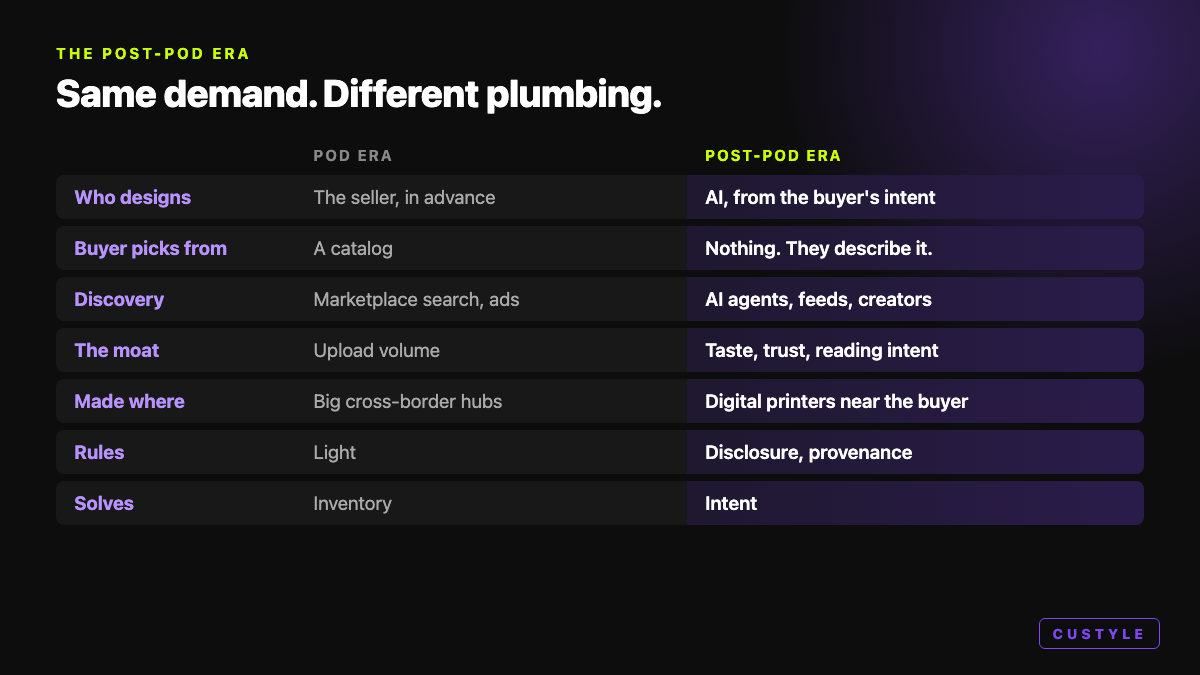 The old POD stack vs the post-POD stack. Same demand, different plumbing.
Five Shifts That Ended the Model
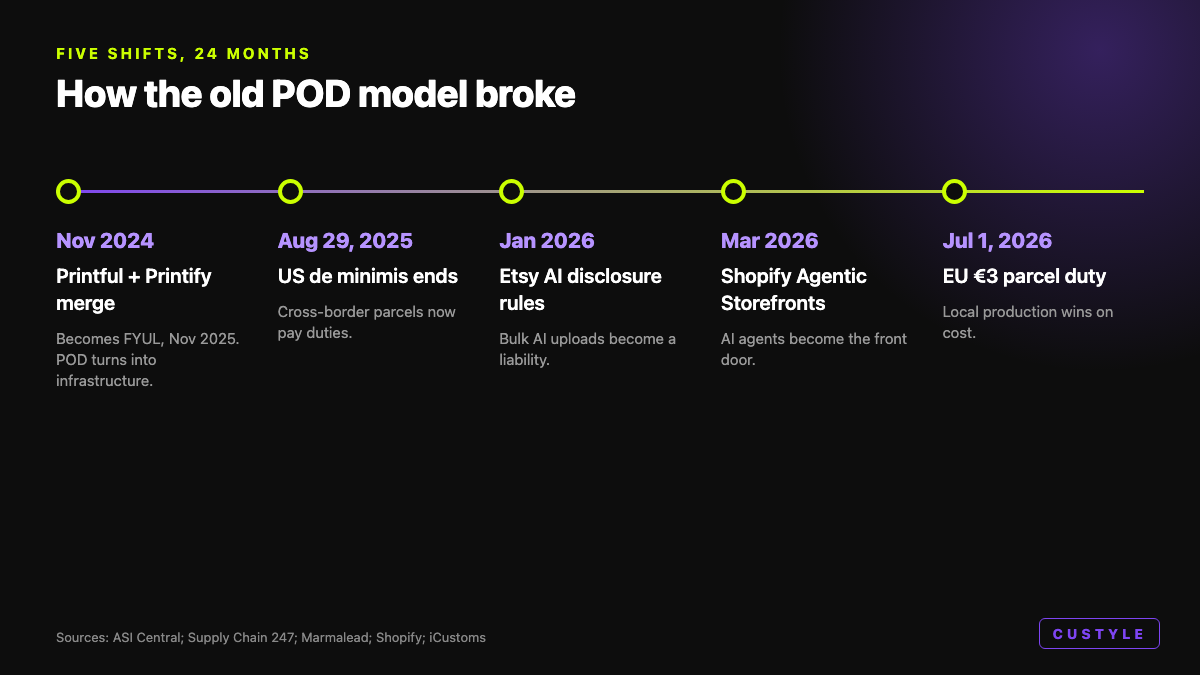 Five shifts in 24 months. Each one knocked out a wall of the old model.
1. POD Became Infrastructure
In November 2024, Printful and Printify announced a merger as equal partners. Their combined network covers about 10 million sellers. On November 25, 2025, the parent company launched a new brand: FYUL, a holding company over Printful, Printify, and Snow Commerce.
FYUL then partnered with TrusTrace, a supply-chain traceability platform. That tells you where the fight moved: compliance and provenance, not catalogs.
Mature industries consolidate. Frontier industries fragment. When the two biggest POD platforms merge under one roof, POD stops being a frontier. It becomes a utility, the way payments became Stripe.
Utilities are great. You just don't build your edge on one. Your edge moves up the stack, to whoever owns the buyer's intent.
2. A Design Became Free
Generative AI took the cost of a graphic to near zero. Anyone can make a unique design in minutes.
That killed two things at once. It erased the barrier to becoming a seller. And it erased the value of a generic design. If everyone can make it, nobody pays extra for it.
The tooling world noticed fast. POD tool vendors like Customily now pitch AI co-creation at the point of sale. The buyer shapes the product, not the seller in advance. Industry analyses report hyper-niche stores convert 3–5x better than broad ones.
Follow that logic to the end. The most specific niche is one person. The most specific design is the one they asked for.
3. The Mass-Upload Playbook Became a Liability
Etsy's 2026 Seller Policy treats AI involvement as a disclosure event. AI-generated designs on physical products must be disclosed in the listing. POD sellers must name every production partner in their shop settings. Designs must be original, and sellers may need source files to prove it.
Coverage from Marmalead and others shows the direction clearly. Etsy keeps tightening, not loosening.
The 2023–2025 wave of bulk AI listings is getting squeezed off the biggest custom-goods marketplace. What survives is provable, buyer-specific creation.
4. The Free Parcel Ended
On August 29, 2025, the US suspended its $800 de minimis exemption. Low-value parcels from abroad now pay duties. Dropshippers and POD sellers were among the hardest hit. Printful's own help center warns that orders shipped from outside the US may now carry extra customs charges.
The EU followed its own path. From July 1, 2026, parcels under €150 face a temporary €3 duty per tariff heading.
US rates have swung around since, and I won't quote a number that may be stale by the time you read this. The direction is what matters. Shipping one shirt across an ocean is no longer free. Making it near the buyer is the hedge.
5. The Front Door Moved to AI Agents
In March 2026, Shopify switched on Agentic Storefronts by default for eligible merchants. According to Shopify, products become discoverable in ChatGPT with no extra apps and no fees beyond standard processing. Copilot, Gemini, and Perplexity are in the mix too.
Not every experiment worked. OpenAI launched Instant Checkout in September 2025, then pulled back that March. Reports say only about 30 merchants ever went live.
Here's my read. Checkout wobbled. Discovery didn't. Agents are great at understanding what someone wants. They're bad at forcing that want into a catalog-shaped transaction.
For custom goods, that's the whole point. An agent that finds a pre-made listing helps a little. An agent that makes the product from your sentence changes the category. More on that in → Related: what is agentic commerce.
What the Post-POD Era Looks Like
Put the five shifts together and a new shape appears. I'd describe it in one sentence:
The post-POD era is intent-first merch: a buyer describes what they want, AI designs it, and a nearby printer makes it, with no catalog in between.
Here's how the stack changes:
| POD era | Post-POD era | |
|---|---|---|
| Who designs | The seller, in advance | AI, from the buyer's intent |
| What you pick from | A catalog | Nothing. You describe it. |
| Where buyers find it | Marketplace search, ads | AI agents, feeds, creators |
| The moat | Upload volume, keywords | Taste, trust, reading intent |
| Where it's made | Big cross-border hubs | Digital printers near the buyer |
| Rules | Light | Disclosure, provenance |
| What it solves | Inventory | Intent |
The physical side is ready for this. Kornit Digital, the biggest maker of industrial digital textile printers, reported Q1 2026 revenue of $48.5 million. Its trailing-12-month print impressions rose about 12% year over year. On its Q2 2026 call, management said traditional print shops face demand for shorter runs, faster turnaround, and more local production.
Vendor data points the same way. Average textile print runs reportedly fell from about 2,500 units in 2018 to about 900 in 2025. Treat that one as directional. But the trend is hard to miss: making exactly one, close to the buyer, is now normal.
So the hard part isn't making the thing anymore. It's deciding what to make. That's an intent problem, not a printing problem.
This is the exact gap we built Custyle.ai, the AI Merch Agent, to fill. You describe a vibe in plain words. A crew of specialized AI agents handles the design, picks the right product and technique, and routes it to production. POD-style fulfillment still runs underneath. It's just not the product anymore. → Related: what is an AI merch agent
POD gave everyone a factory. AI gives everyone a designer. The post-POD era is when you stop needing to be either.
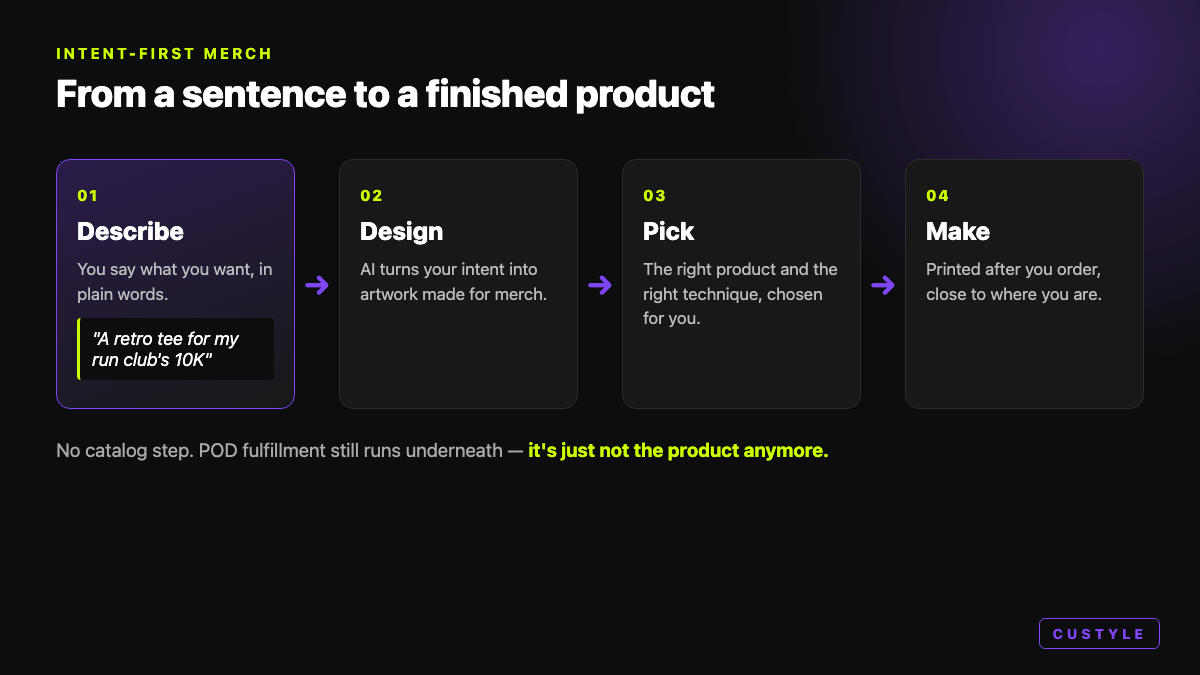 Intent-first merch: from a sentence to a finished product, with no catalog step.
Who Wins, Who Fades
Fading:
- Mass-upload stores living on one marketplace
- "Seller as designer" volume plays
- Undisclosed AI art listings
- Single cross-border hubs shipping into the US and EU
- Catalog-only stores that AI agents can't make sense of
Winning:
- Creators and brands with their own audiences
- Platforms that turn a sentence into a finished product
- Local digital print shops with fast turnaround
- Stores with clean, structured product data agents can read
- Anyone who owns the design decision, not just the print job
Notice the pattern. Every winner sits closer to the buyer's intent. Every loser sits closer to the old catalog.
The Honest Counterarguments
I'd be selling you something if I skipped these.
"Isn't this just POD 2.0? Platforms are adding AI." Partly, yes. But bolting a generator onto a catalog still asks you to browse, then edit. The real shift is who drives. Intent goes in, a product comes out, and there's no catalog step.
"Agentic checkout flopped." Checkout did. Discovery didn't. And retrieval-style agent shopping is the weakest fit for custom goods. Custom is where agents add the most value, because they generate rather than search.
"Made-for-me surveys overstate demand." True. A 2020 Dassault Systèmes study found shoppers would pay 25.3% more for products made for them, and stated intent always runs hot. But shrinking print runs and the tooling pivot to co-creation are what people do, not what they say.
"Tariffs could reverse." Maybe the US rate changes. The EU duty, the end of US de minimis, and the push for local production all point one way. Local production is a hedge either way.
Your Post-POD Checklist
If you sell merch today, here's what I'd do this quarter:
- Own your audience. Don't let one marketplace be your only front door.
- Sell specificity. Stop uploading generic designs. Make things for a person, a moment, an inside joke.
- Disclose AI use wherever a platform asks. Treat provenance as a feature.
- Check where your orders ship from. Favor production close to your buyers.
- Make your products agent-readable. Clean titles, real attributes, honest descriptions.
- Test intent-first tools. Try describing a product instead of designing one, and compare the result.
- Measure taste, not volume. Ten products people love beat 500 listings nobody clicks.
For the long-horizon view of where all this lands, read → Related: the future of custom merchandise. For the dated 2025–2026 changes, see → Related: AI merch trends in 2026.
FAQ
What is the post-POD era?
The post-POD era is the phase of custom merchandise after the classic print-on-demand model. Print on demand still handles production. But design, discovery, and buying move to intent: a buyer describes what they want, AI designs it, and a nearby printer makes it. No seller pre-designs a catalog first.
Is print on demand dead in 2026?
No. Grand View Research puts the global print-on-demand market at $13.1 billion in 2026, growing 23.6% a year to 2033. What's ending is the old seller model: bulk generic uploads, marketplace dependence, and duty-free cross-border shipping. The infrastructure is thriving. The 2017 playbook isn't.
What replaces print on demand?
Print on demand doesn't get replaced. It becomes a utility layer underneath intent-first merch. On top of it, AI turns a plain-language description into a finished design, picks the right product, and sends it to production. The value shifts from printing to understanding what each buyer actually wants.
How did the end of de minimis affect POD sellers?
The US suspended its $800 de minimis exemption on August 29, 2025. Low-value parcels from abroad now pay duties, which hit dropshippers and POD sellers hard. The EU adds a €3 duty per tariff heading on parcels under €150 from July 1, 2026. Both favor production closer to the buyer.
What is FYUL?
FYUL is the holding company formed when Printful and Printify merged. The merger was announced in November 2024. The FYUL brand launched on November 25, 2025, covering Printful, Printify, and Snow Commerce. The individual brands still operate for sellers. It's the clearest sign POD has matured into infrastructure.
The Takeaway
The post-POD era isn't the end of print on demand. It's print on demand moving underground, becoming the plumbing instead of the product.
For ten years, POD answered one question: how do I sell merch without inventory? That question is solved.
The next question is harder and more interesting: how do I make the exact thing this person wants? Whoever answers that owns the next decade of merch.
Describe it. We'll make it real.
Ready to make something?
Turn your ideas into real merch with AI. No design skills needed.
Start with a vibeArron Young
Founder, Custyle · Oct 29, 2026·12 min read
Further Reading
Explore all →
AI Christmas Gifts: 15 Custom Merch Ideas Made in Minutes
15 AI Christmas gift ideas for family, partners, friends and coworkers. Each one shows the detail you start with and the custom merch it becomes, in minutes.
Read more →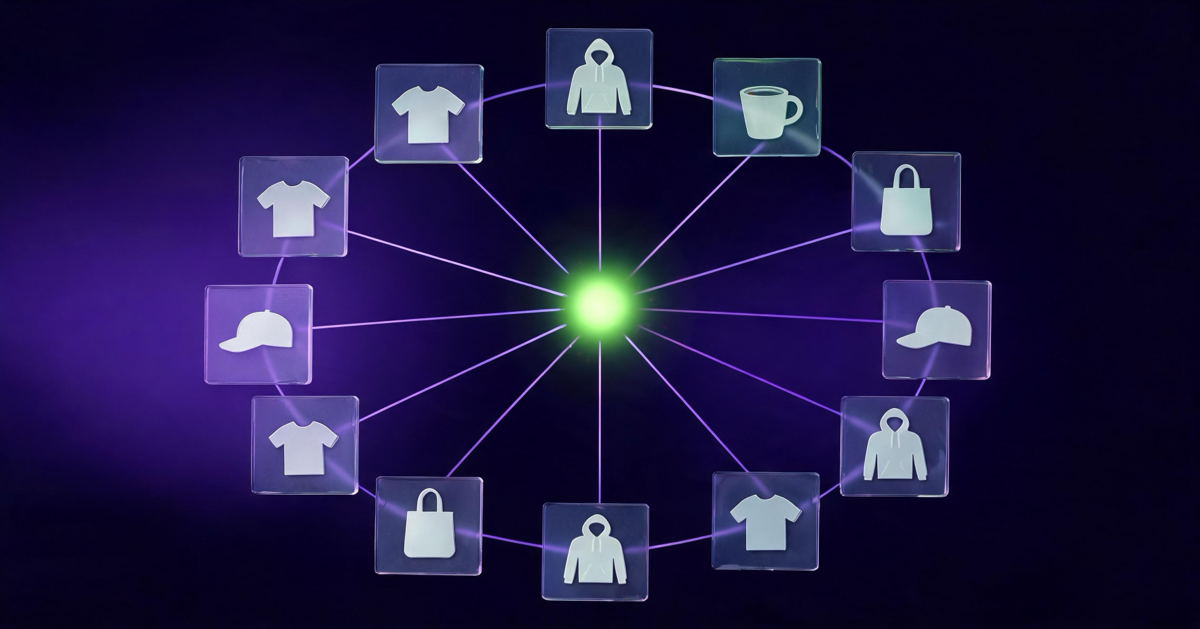
AI Merch Trends in 2026: 12 Shifts Creators Should Know
AI merch trends in 2026, by the numbers: shopping agents, social checkout, the end of de minimis, new copyright rules, and zero-inventory drops. 12 shifts for creators.
Read more →
From Meme to Merch in 60 Seconds: How Custyle Reads the Internet
A good AI meme merch generator doesn't copy the meme. It reads it — format, joke, rights — then redraws the joke as original art. Here's how that read works.
Read more →
AI Band Merch Design: From Demo Track to Drop in a Weekend
Turn a demo track into a full merch drop in one weekend. The AI workflow, print specs, pricing math, and drop plan indie bands actually use in 2026.
Read more →