Creator Economy AI Tools 2026: AI Merch Agents Rise

Arron Young
Founder, Custyle · May 19, 2026·12 min read

Creator Economy AI Tools 2026
TL;DR — The creator economy AI tools 2026 picture has one big shift: a new category — AI Merch Agents — is taking the layer between creators and traditional print-on-demand. The creator economy hit $248–323B with 207M+ creators worldwide. Custyle.ai is the prototype. Agentic commerce protocols are live. AI-attributed orders on Shopify grew 11x since January 2025. This isn't "another tool." It's a new layer in the stack.
Table of Contents
- The Stack Just Got a New Layer
- Agentic Commerce Just Went Live
- Where the Money Is Flowing
- What Creators Actually Use
- The POD Reckoning
- What to Do in 2026
- FAQ
The Stack Just Got a New Layer {#new-layer}
For a decade, the creator merch stack looked the same. You opened Photoshop. You exported to Placeit for a mockup. You connected Shopify or Etsy. You linked Printful or Printify for fulfillment. Four tools. Two days. One creator burning a Saturday to push a single t-shirt.
That stack is splitting open in 2026.
A new category — AI Merch Agents — has appeared in the middle of it. Not a tool. A layer. One conversational surface that handles design, product selection, listing, and routing to fulfillment in a single pass. You describe the vibe. The agent makes it real.
Custyle.ai is the prototype. Creators apply, get access to a crew of AI specialists handling each part of the pipeline — taste reading, concept shaping, artwork, production decisions, layout, try-on, scene styling — and ship merch with up to 30% revenue share and zero inventory risk. The private creator community already has 500+ members moving through a tiered system (Rising → Verified → Featured → Elite). (Shirts, Mugs & Merch)
This is what Vibbi, Custyle's design lead, calls "from taste to tangible" — and it's not just a brand line. It's a structural shift. Where 2024 needed four tools, 2026 needs one layer.
The collision dynamics matter. AI Merch Agents don't own fulfillment. They route orders. Which means Printful and Printify — historically the relationship owners — slide upstream. The creator's loyalty shifts to the agent. The printer becomes a backend selected by quality and price, not brand.
If you build merch, that's the meta-trend of the year.
Agentic Commerce Just Went Live {#agentic-commerce}
The infrastructure under all of this crystallized in 2025-2026 through three protocols that went live faster than most operators noticed.
OpenAI and Stripe co-developed the Agentic Commerce Protocol (ACP). It started as checkout in ChatGPT and expanded in April 2026 to cover catalog reading, cart management, order tracking, and authentication. (No Hacks) Google and Shopify announced the Universal Commerce Protocol (UCP) at NRF 2026. AI agents can now query merchant catalogs with product data staying on the merchant side. (Shopify) Anthropic's Model Context Protocol (MCP) was donated to a neutral foundation and adopted by Shopify for its Storefront MCP. (Ekamoira)
| Protocol | Built By | Status | Function |
|---|---|---|---|
| ACP | OpenAI + Stripe | Live (US), expanding Apr 2026 | Checkout, catalog, cart, orders |
| UCP | Google + Shopify | Live (US), rolling globally | Real-time catalog queries |
| MCP | Anthropic (foundation-donated) | GA early 2026 | Agent-merchant data exchange |
| A2A | Google + SAP + others | In development | Cross-agent negotiation |
| AP2 | Visa + Mastercard | Rolling out 2026 | Agent payment authorization |
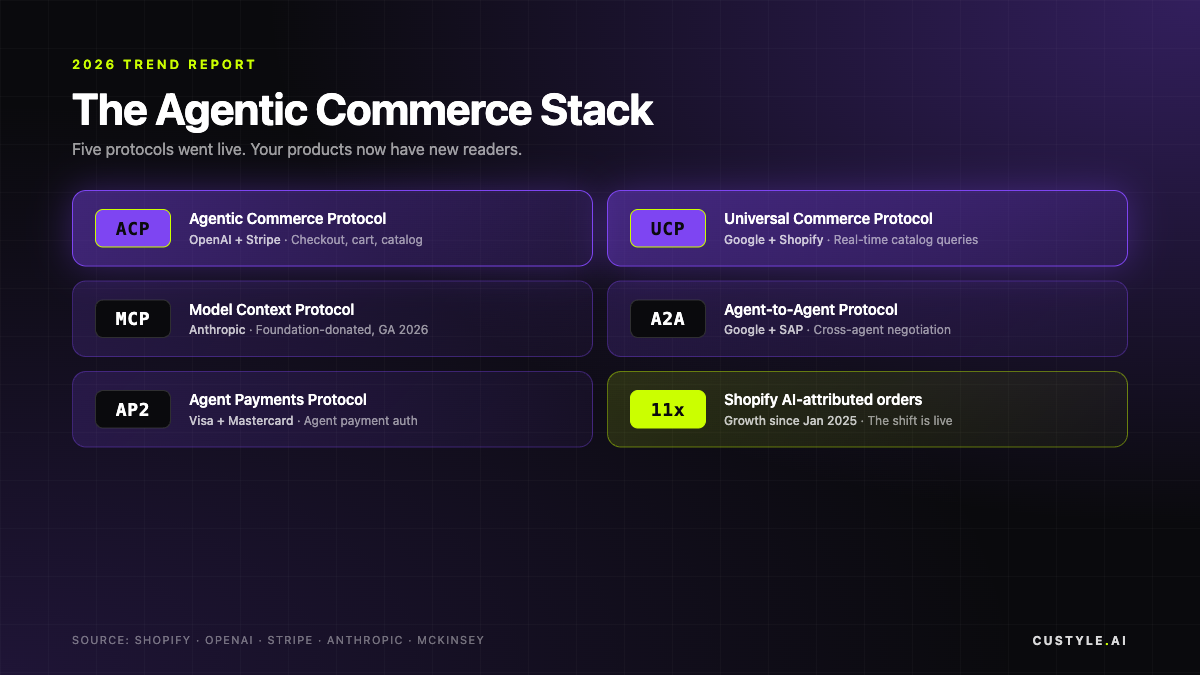
The numbers tell the story. AI-attributed orders on Shopify grew 11x since January 2025. (digitalapplied.com) Walmart reported approximately 36% of its referral traffic from ChatGPT in early 2026 after enabling AI channel integrations. (Evolve Media Agency) Amazon's Rufus AI generated $12 billion in incremental sales in 2025 with 3.5x higher conversion than standard Amazon search. (AI Visibility Agency) Perplexity Shopping launched free agentic shopping for all US users in February 2026, triggering a 5x increase in shopping intent queries. (Verity Score)
eMarketer projects $20.9 billion in AI-driven retail spending in 2026 — roughly 4x 2025 figures. (Ekamoira) McKinsey projects $3–5 trillion in global agentic commerce sales by 2030, with $1 trillion in orchestrated US retail revenue alone. (Digital Commerce 360)
"Agents don't just change who's at the checkout. They change who's doing the searching, the deciding, the trusting. All of it." — Emily Glassberg Sands, Stripe Head of Information and Data Science (No Hacks)
The Stripe team put it more bluntly in its guide: "The parts of commerce that used to be user experience problems are becoming protocol problems." That's what live means here. The plumbing shipped. The agents are now reading your catalog.
Where the Money Is Flowing {#money}
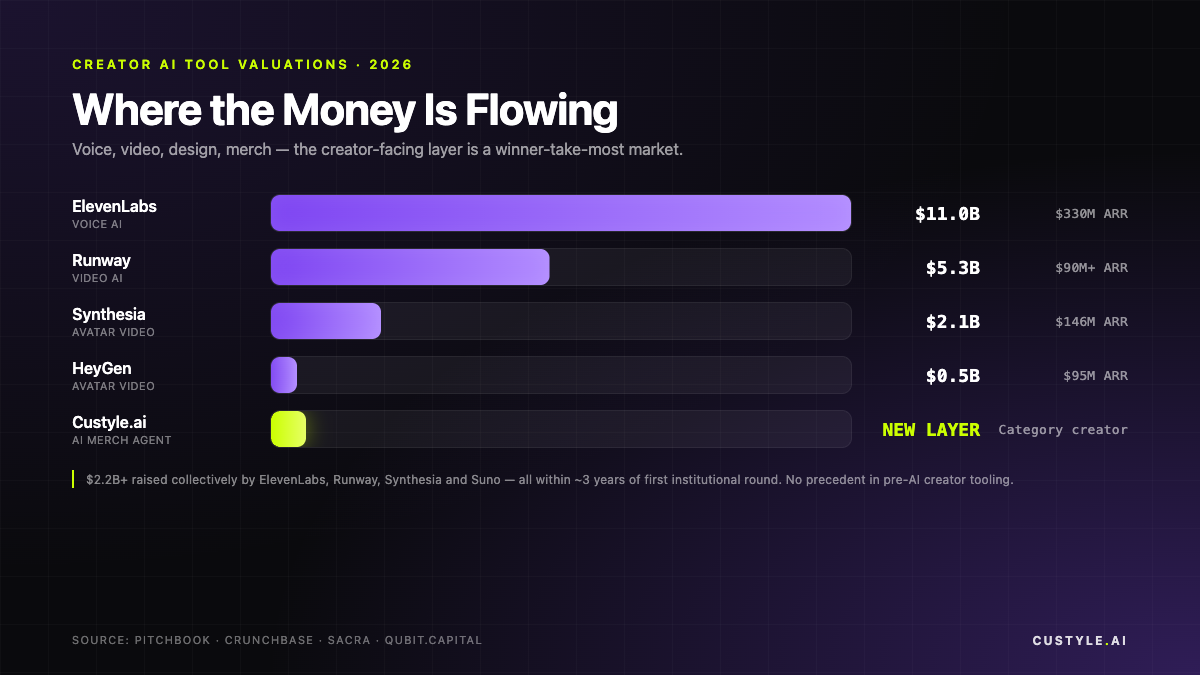
AI captured roughly $131.5 billion in venture funding in the most recent cycle — up about 52% while non-AI funding fell almost 10%. (qubit.capital) AI now absorbs close to a third of global VC.
The creator-facing layer is doing especially well.
| Company | Category | Valuation | ARR | Funding | Notable |
|---|---|---|---|---|---|
| ElevenLabs | Voice AI | $11.0B | $330M+ | $850M+ | Series D Feb 2026, Sequoia-led (PitchBook) |
| Runway | Video AI | $5.3B | $90M+ | $1.05B | Series E Feb 2026, General Atlantic (Crunchbase News) |
| Synthesia | Avatar Video | $2.1B | $146M | $250M+ | Serves 70% of Fortune 100 (Sacra) |
| HeyGen | Avatar Video | $0.5B | $95M | $74M | Series A led by Benchmark (Sacra) |
| Spline | 3D Design | Undisclosed | — | $32.4M | Gradient Ventures (PitchBook) |
| Custyle.ai | AI Merch Agent | Undisclosed | — | Undisclosed | New category creator (Shirts, Mugs & Merch) |
ElevenLabs, Runway, Synthesia, and Suno collectively raised over $2.2 billion — all hitting that scale within roughly three years of their first institutional round. (New Market Pitch) That pace has no precedent in pre-AI creator tooling.
The signal: capital is treating creator-facing AI as a winner-take-most category — not just because the tools work, but because the protocols underneath them will reward whoever owns the relationship with the creator.
What Creators Actually Use {#actually-use}
Adoption stats matter less than abandonment patterns. The data shows a clear hierarchy of survivors.
ChatGPT dominates as the entry point — 82% of developers using out-of-the-box AI assistance choose it. (stackoverflow.co) For design, creators gravitate toward Canva (240M+ MAU) for speed, Midjourney for artistic quality, Kittl for POD templates, and Adobe Firefly for commercial safety (IP-indemnified outputs). (sqmagazine.co.uk) Video is Runway and HeyGen for creators, Synthesia for enterprise training.
Now the abandonment list. The average lifespan of an AI startup in 2024-2025 was just 14 months from launch to pivot or shutdown. (Frank Yao) Jasper lost 60% of subscribers to native AI in Google Docs. Copy.ai got squeezed by free-tier ChatGPT. Lensa AI lasted three months as a fad. Anything that was a thin wrapper on a foundation model got absorbed.
78% of companies now use AI in at least one business function, up from 55% the year before. 71% regularly use generative AI, up from 33% in 2023. (Hostinger) Among Gen Z: 70% use generative AI, and 80% of Gen Z professionals use AI for more than half their daily duties. (masterofcode.com)
The signal is simple. Survivors add value beyond the foundation model — unique data, proprietary workflows, network effects, or deep integration with the user's actual job. Wrappers die. Layers live.
That's why the AI Merch Agent category matters. It's not a model wrapper. It's a layer over fulfillment, design, and intent — three things foundation models don't do on their own.
The POD Reckoning {#pod-reckoning}
Printful generates $700 million in annual revenue and fulfills over 1 million items monthly. Printify generates $300 million and connects 4 million+ merchants to 800+ print providers. (BrandHistories) These are not small businesses. They're the backbone of creator merch for a decade.
They are also exposed.
Their moats rested on three pillars: fulfillment network scale, ecommerce integrations (Shopify, Etsy, Amazon connectors), and design-tool workflow (mockup generators, template libraries). AI Merch Agents are systematically attacking pillar three and beginning to erode pillar two.
The pattern: An AI Merch Agent like Custyle.ai doesn't need to own fulfillment. It routes orders to existing print providers based on real-time pricing, quality, and speed. As agentic commerce protocols mature, the agent's selection logic becomes the new moat — not the printer's brand. The creator now relates to the agent. The printer becomes a backend supplier.
This is the Bolt problem, in Custyle's framing. Bolt — the production brain in Custyle's crew — figures out the right process, the right material, the right finish for each design. If the agent makes that decision, the printer's role compresses. They print. They ship. They don't decide.
| Strategic Response | What It Looks Like | Timing |
|---|---|---|
| Build a generative design layer | Natural-language to print-ready output, not just mockup tools | Immediate |
| Own the creator community | Custyle's 500+ Discord shows community is defensible | 2026 H2 |
| Agentic protocol compliance | All product data ACP/UCP-readable in real time | Immediate |
| Vertical specialization | Niche capabilities — sustainability, local production, heritage craft | 2027 |
| API-first partnerships | Become the preferred backend for AI Merch Agents | Ongoing |
Printful's workflow AI (design-rule checking, auto-cropping) and Printify's bundled AI Image Generator are first steps. Neither yet matches the integrated natural-language experience of a dedicated AI Merch Agent. (PodVector)
The window to build or acquire the missing layer is narrowing.
What to Do in 2026 {#what-to-do}
The strategic plays separate cleanly by audience.
If you're a creator
Now (Q2 2026): Evaluate the AI Merch Agent layer. Start with a vibe on Custyle.ai if you want integrated design-to-fulfillment. If you prefer your own storefront, activate Shopify's Agentic Storefronts (Plus plan) to be discoverable across ChatGPT, Perplexity, Copilot, and Google AI Mode. (Shopify)
H2 2026: Build product data quality. Product titles, descriptions, images, and metadata are now the sales interface. AI agents read this data to make matching decisions. Use AI product photography tools (Claid.ai, Pebblely, Photoroom) to produce lifestyle and catalog images at 80–95% lower cost than traditional studio shoots. (WearView)
2027: Diversify across agentic commerce channels. ChatGPT rewards organic relevance. Perplexity rewards citation-worthy content (Reddit presence matters — Perplexity sources 46.7% of its top citations from Reddit). Google AI Mode requires Merchant Center connectivity and schema markup.
If you run a merch brand
- Implement Schema.org structured data (Product, Offer, Review). Structured data makes products 3-5x more likely to appear in AI recommendations. (AI Visibility Agency)
- Enrich product attributes — material, dimensions, weight, intended use. AI agents won't guess.
- Enable Agentic Storefronts on Shopify or the equivalent on your platform.
- Monitor AI visibility — search for your products in ChatGPT, Perplexity, Gemini the way a customer would. Verify accuracy.
- Build Reddit/community presence. Citation share, not ad spend, drives Perplexity visibility.
If you run a POD platform
The choice is binary. Either you become a commodity fulfillment backend, or you build the AI layer on top before someone else owns the creator relationship. There is no middle path.
FAQ {#faq}
What is an AI Merch Agent?
An AI Merch Agent is a single conversational interface that handles the full pipeline from creator intent to physical merchandise — design generation, product selection, mockup creation, listing copy, and fulfillment routing. Custyle.ai is the prototype of the category. The agent replaces the traditional multi-tool workflow (design app → mockup tool → storefront → POD provider) with one layer.
What AI tools should creators use in 2026?
The survivor stack for 2026: an AI Merch Agent like Custyle.ai for integrated design-to-fulfillment, Canva for fast marketing assets, Midjourney or Adobe Firefly for standalone artwork, Runway or HeyGen for video, ElevenLabs for voice, and Shopify with Agentic Storefronts enabled for cross-AI-channel discoverability. Wrapper tools that only restyle a foundation model output are dying — average lifespan was 14 months in 2024-2025.
Will AI replace Printful and Printify?
Not directly. But AI Merch Agents are compressing the layer where Printful and Printify made their margin — the creator relationship and design workflow. Both companies are now upstream-of-AI suppliers unless they build or acquire generative design and protocol compliance. McKinsey projects $3–5 trillion in global agentic commerce sales by 2030, and most of that flows through agent-selected fulfillment partners, not branded ones.
How big is the creator economy in 2026?
The creator economy reached $248–323 billion in 2026 depending on the research firm, with 207 million+ active creators worldwide. Goldman Sachs projects the market approaching $480 billion by 2027. Long-term projections range from $1.05 trillion (Coherent Market Insights, by 2033) to $2.08 trillion (Precedence Research, by 2035) at 22-26% CAGR.
What's agentic commerce?
Agentic commerce is the shift from human shoppers browsing storefronts to AI agents discovering, deciding, and transacting on behalf of users. Protocols like ACP (OpenAI+Stripe), UCP (Google+Shopify), MCP (Anthropic), and AP2 (Visa+Mastercard) are the rails. The Stripe team's framing: "The parts of commerce that used to be user experience problems are becoming protocol problems."
Where This Leaves You
The creator economy is at an inflection point. A $248-323 billion market with 207 million creators is being restructured by a layer that compresses weeks of work into minutes of conversation.
AI Merch Agents are the new layer. Custyle.ai is the prototype. The protocols are live. The capital is flowing. The POD reckoning has started.
If you make merch — or you build the tools that make it — the question for 2026 isn't whether the stack is shifting. It's whether you're shifting with it.
Describe your vibe. Custyle's AI crew will make it real. Start here.
Ready to make something?
Turn your ideas into real merch with AI. No design skills needed.
Start with a vibeArron Young
Founder, Custyle · May 19, 2026·12 min read
Further Reading
Explore all →
AI Band Merch Design: From Demo Track to Drop in a Weekend
Turn a demo track into a full merch drop in one weekend. The AI workflow, print specs, pricing math, and drop plan indie bands actually use in 2026.
Read more →
AI Concert Tour Merch: Designed in Minutes, Printed in Days
Concert merch is a $16.3B-by-2030 business, and the average buying fan drops $64 per show. AI design in minutes plus on-demand printing in days — here's the full playbook for your next tour.
Read more →
AI Birthday Gift Custom Merch: 9 Variants From One Photo + One Memory
An AI birthday gift works best when it starts from a memory, not a prompt. One photo + one sentence, and Custyle's AI crew turns them into 9 gift-ready designs on real merch.
Read more →
Is Print on Demand Dying? What the Data Actually Says
Print on demand isn't dying — the market hits $13–15B in 2026 with 21–26% annual growth. What's dying is the 2017 playbook. Here's what the data says, and who wins next.
Read more →