AI Custom Merchandise in 2026: Market Data, Trends & What Creators Should Know

Custyle Lab
Research & Guides · Mar 24, 2026·18 min read

AI Custom Merchandise: 2026
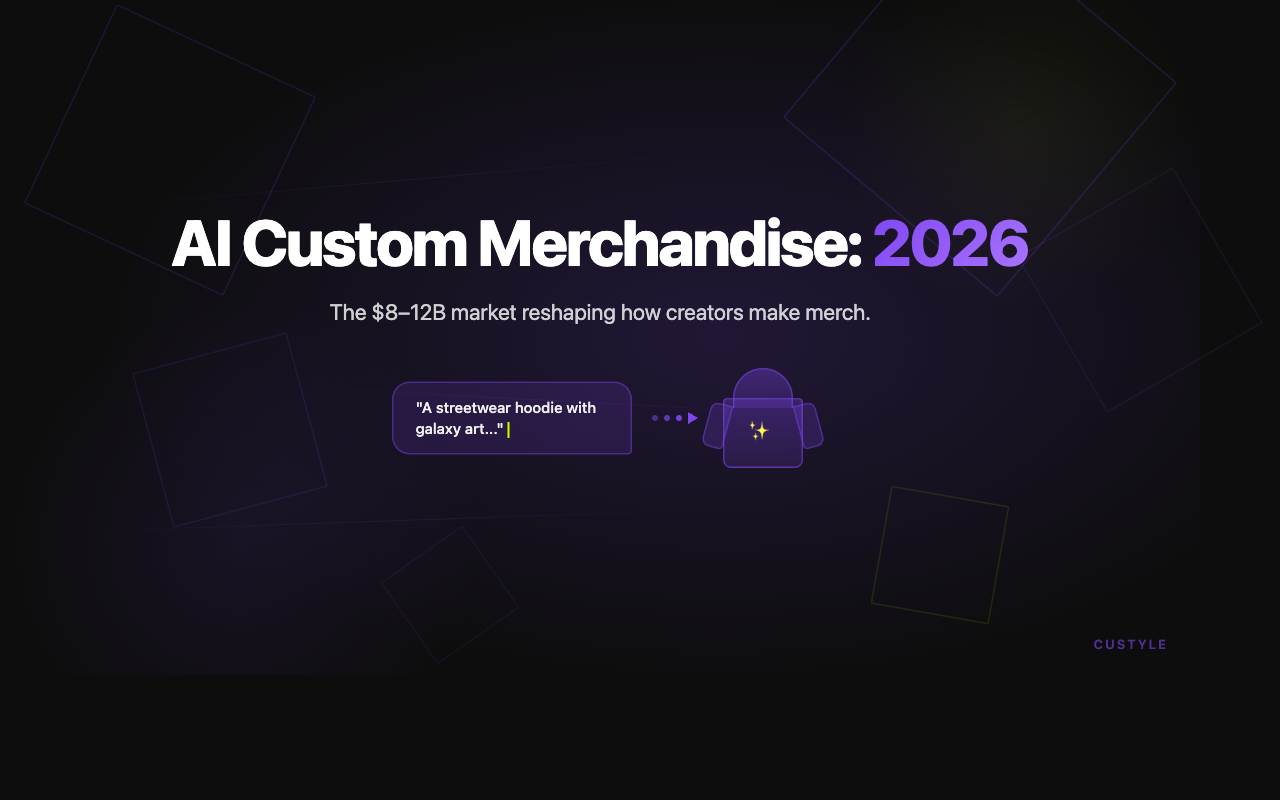 The merch creation process in 2026: describe your vibe, get a finished product. No design tools required.
TL;DR: The AI custom merchandise market reached $8-12 billion in 2026. AI agents now handle everything from design to delivery. For creators, that means you can turn any idea into real merch without design skills, inventory, or guesswork. This report breaks down the market data, the tools, and what it all means for your next drop.
Table of Contents
- The Market Right Now
- Who Builds Your Merch
- How AI Changes Making
- What Buyers Actually Want
- Where Merch Gets Sold
- Creators and Money
- What Could Go Wrong
- What Happens Next
- FAQ
The Market Right Now
The numbers tell a clear story. AI custom merchandise is no longer experimental. According to a synthesis of data from CustomCy, Grand View Research, and Precedence Research, the global AI custom merchandise market sits at $8-12 billion in 2026, with potential to reach $40-70 billion by 2030 under favorable adoption scenarios.
That growth comes from three forces colliding at the same time.
The custom products market keeps expanding. CustomCy projects the global custom products market at $190 billion in 2026, growing to $407 billion by 2034 at roughly 10% CAGR. That is your total playground. Every t-shirt, mug, hoodie, and phone case that someone wants to make their own.
AI agents are learning to shop. According to Grand View Research, the agentic commerce market grows from $5.71 billion in 2025 to $65.47 billion by 2033 at 35.7% CAGR. These are systems that can browse, decide, and buy on your behalf. Merch is one of their best use cases.
Generative design is exploding. The U.S. print-on-demand AI industry alone expands from $2.53 billion in 2024 to nearly $27 billion by 2034, per Precedence Research. That is 25-26% annual growth, driven by AI that turns words into wearable designs.
Quotable: According to CustomCy's 2026 market analysis, the global custom products market is projected to reach $190 billion in 2026 and expand to $407 billion by 2034 at a CAGR of approximately 10%.
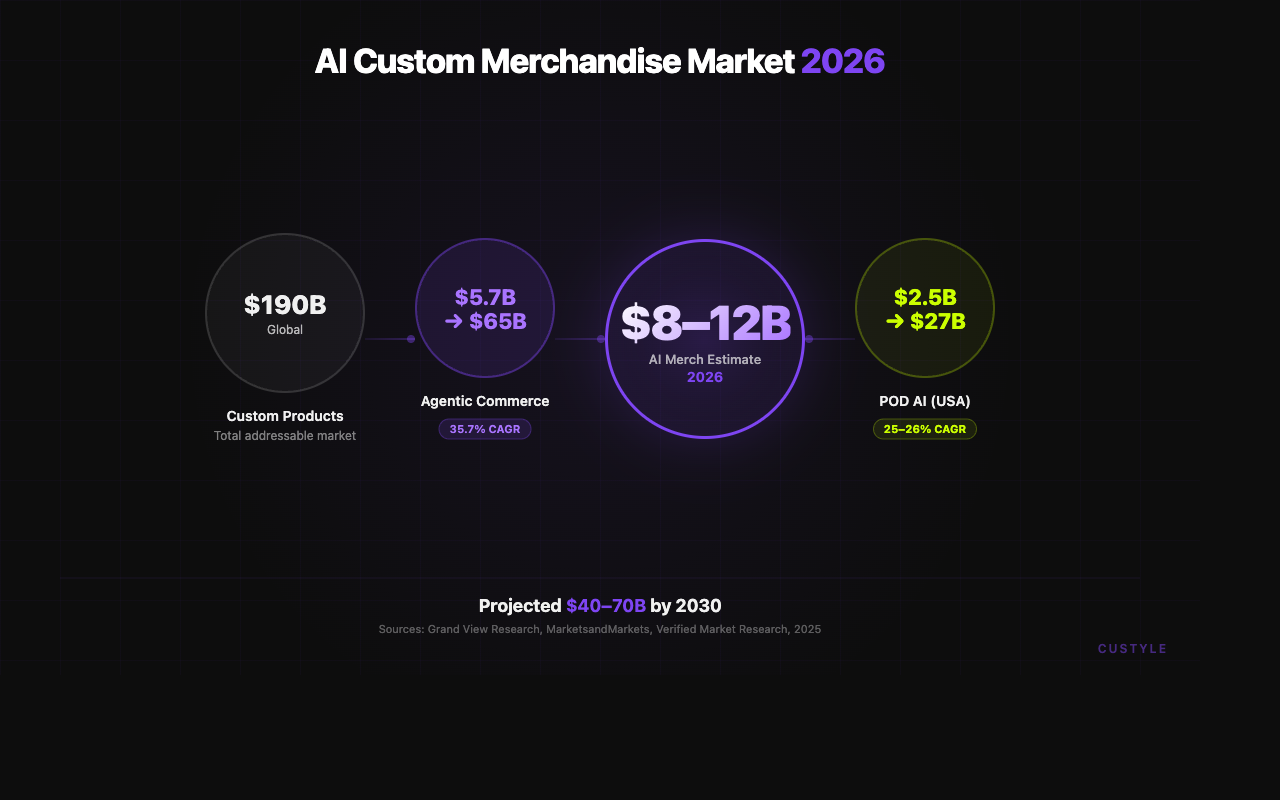 Three market segments converging to create the AI custom merchandise opportunity. Data from CustomCy, Grand View Research, and Precedence Research.
The Three Scenarios for 2030
Not everyone agrees on the pace. Here is how analysts see it:
| Scenario | 2030 Projection | What Drives It |
|---|---|---|
| Conservative | $15-25B | Gradual AI adoption, mostly backend gains |
| Base case | $30-45B | Mainstream AI design tools, growing trust |
| Optimistic | $60-100B | Breakthroughs in multimodal AI, voice commerce |
The base case assumes you get comfortable letting AI make creative decisions. The optimistic case assumes AI merch agents become as trusted as a personal shopper. According to Bain & Company, agentic commerce could represent $300-500 billion of U.S. online retail by 2030, covering 15-25% of total e-commerce volume.
Regional Breakdown
Your geography matters. North America leads with 36-41% of global revenue share, according to multiple analyst reports. The U.S. AI shopping assistant market alone was valued at $1.27 billion in 2025, reaching a projected $7.55 billion by 2033 at 24.9% CAGR, per Grand View Research.
The UK shows strong signals too. Worldpay research finds UK shoppers expect 7% of total online purchases to go through AI agents by 2030. That could mean 29 billion pounds of AI-mediated spending. Among 18-34 year-olds, 45% are willing to let AI assistants browse for them.
In the EU, France committed 20 billion euros to AI development. Germany reports 22% of retailers prefer building their own AI systems. Australia's AI retail market jumps from $310.9 million in 2024 to a projected $1,990.6 million by 2030. That is a 6.4x expansion.
Quotable: Bain & Company projects agentic commerce could represent $300-500 billion of U.S. online retail by 2030, constituting 15-25% of total e-commerce volume.
Who Builds Your Merch
The landscape splits into two camps. Traditional print-on-demand platforms. And AI-native merch agents. They work differently. They think differently. And they serve you differently.
The Old Guard
Printful, Printify, Redbubble, and Spring (formerly TeeSpring) built the first generation of on-demand merch. They still move volume. Printful runs its own production facilities. Printify connects you to 300+ suppliers. Redbubble hosts a marketplace of artists. Spring ties into social platforms.
But all of them share the same friction. You need a design. You need to upload it. You need to browse products manually. You need to set everything up yourself.
According to industry data, manual design takes 2-5 hours. AI generation takes 5-15 minutes. That gap matters when trends move in hours, not weeks.
The New Players: AI Merch Agents
AI Merch Agents represent something different. You describe what you want. The AI handles everything else: design, product matching, production routing, and fulfillment.
Custyle.ai, the AI Merch Agent platform, pioneered this text-to-merch workflow. Describe a vibe, drop an image, or share a mood. The AI crew handles creative direction, design generation, product matching, and fulfillment. No design skills needed. No minimums.
The difference is not just speed. It is the relationship. Traditional platforms end at checkout. An AI Merch Agent remembers your taste, learns your preferences, and suggests ideas for upcoming occasions. According to research analysis, this transforms transactional economics into ongoing relationship value.
Quotable: AI Merch Agents accept high-level intent descriptions and execute all subsequent steps with minimal human intervention, representing a shift from transaction facilitation to relationship management.
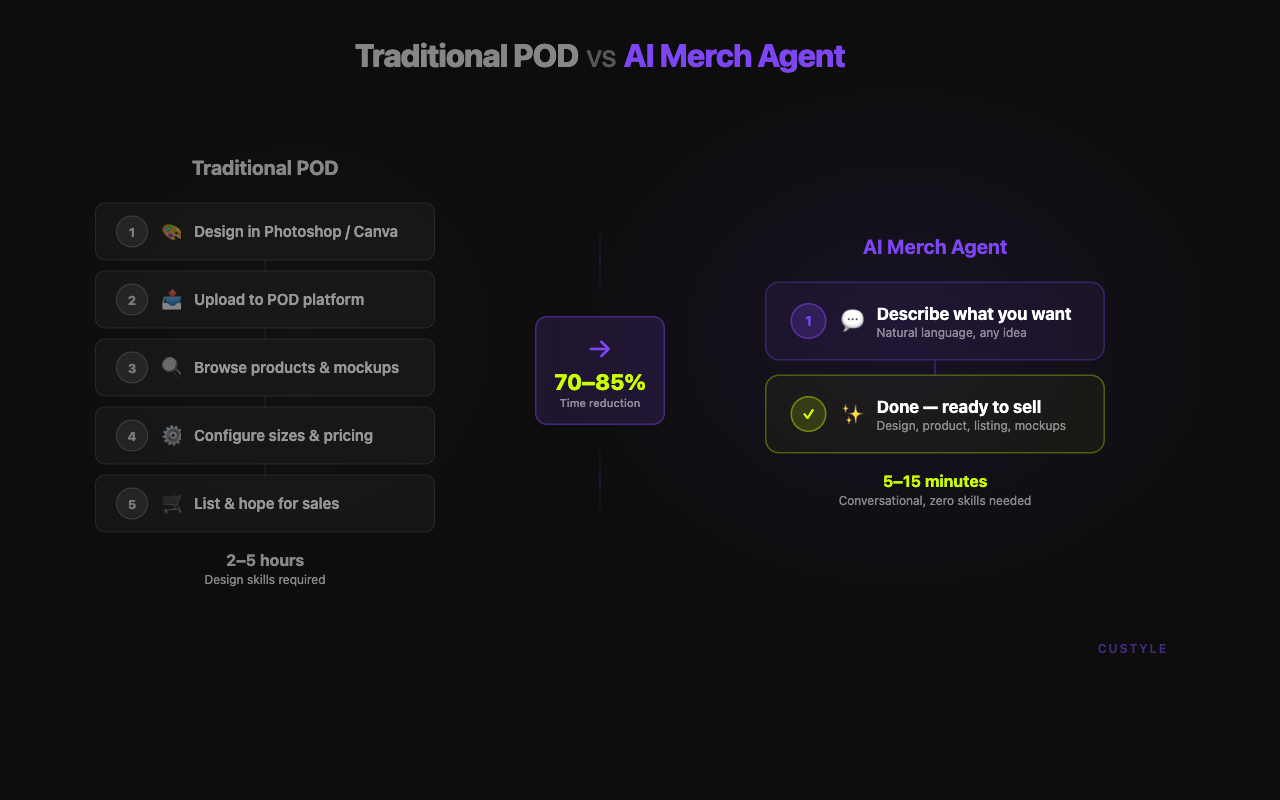 Traditional POD requires 5 manual steps and design skills. AI Merch Agents collapse the process into a conversation.
How They Compare
| Factor | Traditional POD | AI Merch Agent |
|---|---|---|
| Design input | Upload a file or use templates | Describe it in words |
| Skill needed | Graphic design basics | Conversational ability |
| Selection time | 5-15 minutes browsing | 1-3 minutes chatting |
| Reorder friction | Start from scratch | Agent remembers you |
| Scale advantage | Supplier network size | Data that improves over time |
The competitive question: can incumbents add AI faster than AI-native platforms can build fulfillment reliability? By 2026-2028, market share sits roughly 80/20 by volume favoring traditional platforms. But by revenue, the split narrows to 60/40 because AI-native platforms command higher order values.
How AI Changes Making
The technology stack behind AI custom merchandise has matured fast. Here is what actually works in 2026.
Text-to-Design Is Real
You type a description. AI generates a design shaped for physical products. Not just a pretty image, but something built to look right when printed, worn, or held. Current systems combine large language models for intent understanding with specialized image generators for visual output.
Design time drops by 70-85% with AI tools, according to industry analysis. That is the structural shift. The creator base expands from millions of trained designers to billions of people who can describe what they want.
 Five technology layers turn a text description into a print-ready, preview-able product. Each layer adds production intelligence.
The Design Stack
| Layer | What It Does | Why It Matters |
|---|---|---|
| Foundation models | Generate images from text | The core creative engine |
| Fine-tuning | Shape output for merch | Designs that work on products |
| Control mechanisms | Place logos, manage text | Precision when you need it |
| Technical prep | Make files print-ready | No surprises at production |
| Preview and AR | Show the product before buying | Confidence before commitment |
According to research data, 43% of consumers prefer seeing designs on products in 3D before buying. That number drives real investment in visualization tools.
Smart Production
AI does not stop at design. It routes your order to the right printer. It checks quality with computer vision. It predicts demand so materials are ready before you order.
According to industry analysis, print-on-demand already reduces inventory waste to near zero compared to 13 million tons of annual textile waste in traditional retail. AI makes that zero-waste model faster and smarter.
-> Related: How AI Design Tools Work
Agentic Commerce Infrastructure
The OpenAI-Stripe partnership for Instant Checkout, launched September 2025, shows where this heads. You chat with an AI. You decide on a product. You buy it without leaving the conversation. Stripe handles payment. The agent handles everything else.
The Model Context Protocol (MCP) and Agent Communication Protocol (ACP) are building the technical standards for AI agents to communicate across platforms. Your merch agent could operate in WhatsApp, a smart speaker, or inside a social media app. Same agent. Same taste memory. Different touchpoints.
Quotable: The OpenAI-Stripe partnership for Instant Checkout in ChatGPT, launched September 2025, enables secure transaction completion within conversational interfaces, eliminating the friction of redirect to separate payment systems.
What Buyers Actually Want
Market data reveals clear patterns about who buys AI custom merchandise and what drives them.
Gen-Z Sets the Pace
Gen-Z is 1.5 times more likely to buy custom-made items than Baby Boomers, according to industry statistics. That is not a small gap. It reflects a generational preference for individual expression over mass-market products.
Social sharing is part of the product. 42% of millennials create user-generated content for brands, per research data. Gen-Z rates likely run higher. Your merch is not just something you wear. It is something you post. AI platforms that make the creation process shareable capture organic marketing that money cannot buy.
Values matter as much as vibes. Sustainability, ethical production, transparency. Gen-Z evaluates these alongside design quality. The zero-inventory, on-demand production model directly supports this. No overproduction. No warehouse waste. Every item made because someone wanted it.
Mobile-first, always. 54% of custom apparel sales happen on mobile devices, per industry data. Complex desktop design tools fail here. Conversational AI interfaces built for messaging work.
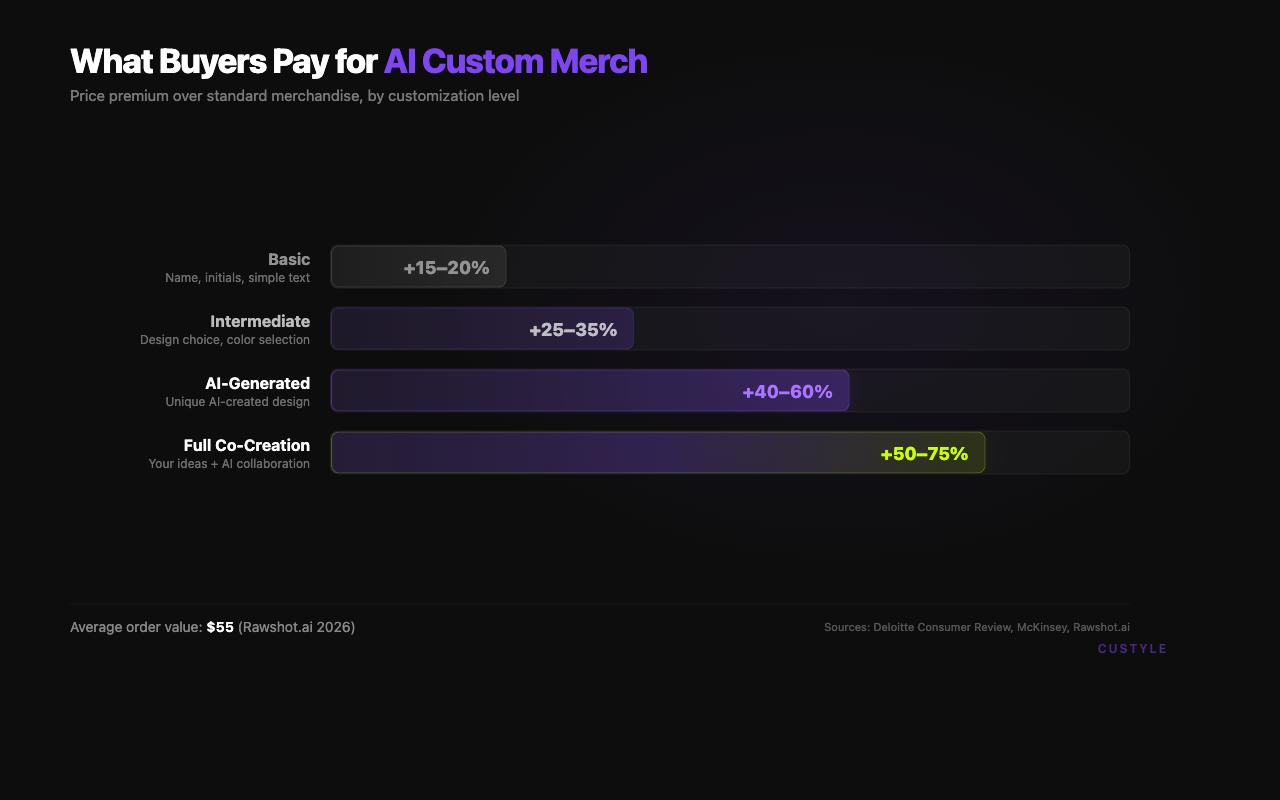 The deeper the creative involvement, the higher the price buyers accept. Full AI co-creation commands 50-75% premiums over standard products.
What People Pay
Here is what research reveals about willingness to invest in AI custom merchandise:
| Type of Creation | Price Boost Accepted |
|---|---|
| Basic (name, initials) | 15-20% above standard |
| Intermediate (design choice, color) | 25-35% above standard |
| Advanced (AI-generated unique design) | 40-60% above standard |
| Full co-creation (your ideas + AI) | 50-75% above standard |
The average order value for custom apparel stores reaches $55, per Rawshot.ai industry data. That exceeds general fast fashion benchmarks. People pay more when the product feels like theirs.
90% of consumers believe custom items make better gifts, according to research analysis. 48% will wait longer for something made for them specifically. 70% will pay more if it says "Made in USA."
Quotable: According to industry research, Gen-Z consumers are 1.5 times more likely to purchase custom-made items than Baby Boomers, reflecting a generational shift toward individual expression over mass-market conformity.
The Trust Question
Here is the tension. People want AI to help. But they want to check. Worldpay research shows 31% of UK consumers would delegate browsing to AI assistants. But only 6% trust AI to buy automatically without review.
60% want to review every transaction. 58% want a 24-hour cancellation window. The pattern is clear: assist me, show me, but let me decide.
That is actually perfect for merch. You describe the vibe. AI generates options. You pick the one that sparks. You approve before anything ships. The human stays in the loop where it matters.
-> Related: Can You Trust AI With Your Merch?
Where Merch Gets Sold
Distribution shapes everything. The right channel finds your buyers before they even search.
TikTok Shop Changes the Game
TikTok Shop moved $500 million in U.S. sales from Black Friday to Cyber Monday 2025 alone. UK purchases jumped 28% with 50% year-over-year growth during Cyber Week 2025.
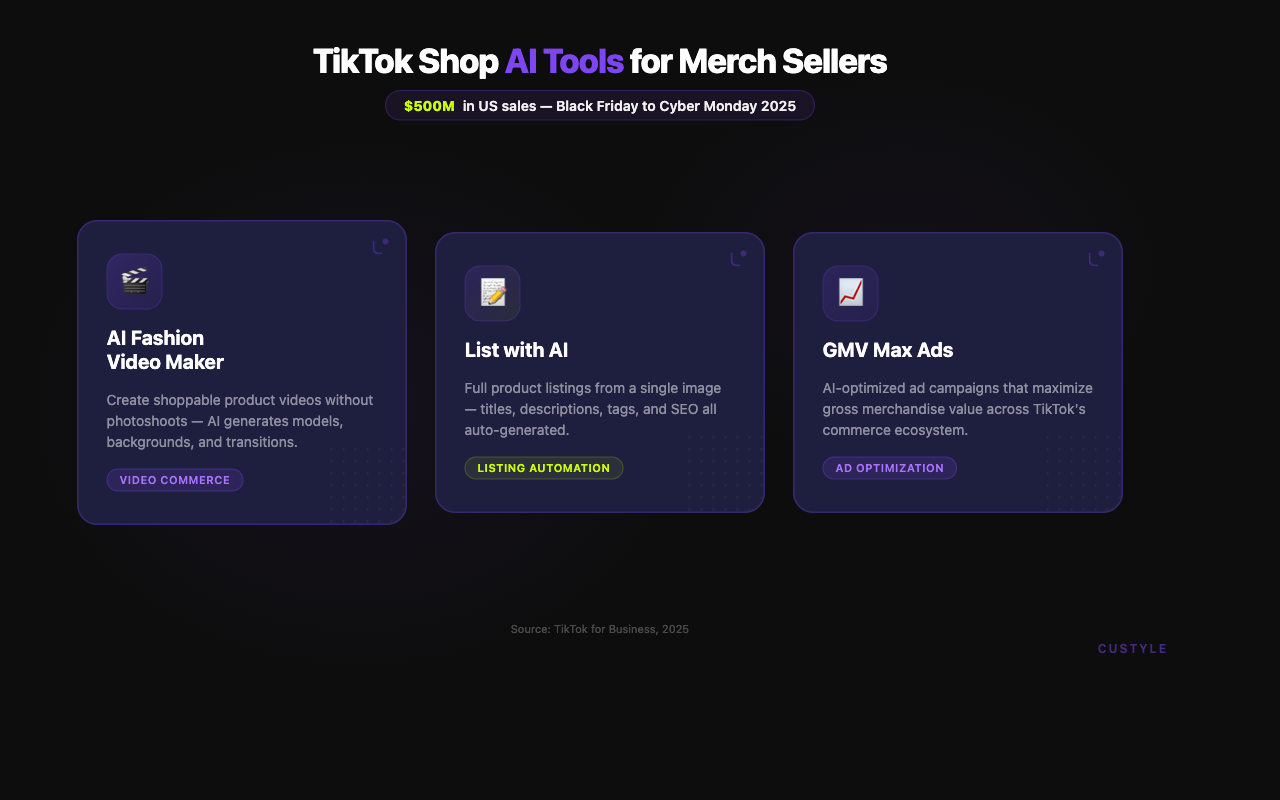 TikTok's January 2026 AI tools let merch sellers create shoppable videos, auto-generate listings, and optimize ads — all without leaving the platform.
In January 2026, TikTok launched AI tools built for merch sellers:
| Tool | What It Does | Why It Matters |
|---|---|---|
| AI Fashion Video Maker | Creates shoppable videos without photoshoots | Rapid content for AI-generated designs |
| List with AI | Builds full product listings from images | Automated catalog at scale |
| GMV Max Ads | AI-tuned campaign performance | Efficient acquisition for custom products |
The fit is natural. Trend windows compress to hours. AI generation matches that speed. Visual distinctiveness gets rewarded by the algorithm. Creator authenticity drives trust. Impulse purchases happen inside the app.
Instagram and Facebook Still Matter
40% of custom apparel merchants use Meta platforms as their primary sales channel, according to industry data. Instagram Shopping, Facebook Shops, and Messenger create a full funnel from discovery to purchase.
Retargeting works especially well for custom items. Research shows personalized item retargeting achieves 10x higher click-through rates. When someone designs something but does not buy, that intent signal is strong.
Emerging Channels
WhatsApp Business reaches 2+ billion users globally. SMS works without any app. Voice commerce through smart speakers captures hands-free moments. Live shopping lets audiences co-create designs in real time.
AI merch agents work across all of them. Same agent, same memory of your taste, different entry points. The idea of merch as a destination site fades. Merch becomes something available wherever you already are.
Quotable: TikTok Shop achieved $500 million in U.S. sales from Black Friday to Cyber Monday 2025, with UK purchases up 28% and 50% year-over-year growth during Cyber Week, demonstrating the scale of short-form video commerce.
Creators and Money
If you create content, AI custom merchandise changes your math.
The Problem AI Solves for Creators
You face platform algorithm risk. Sponsorship volatility. Revenue that depends on someone else's rules. Merch offers diversification with better margins and a direct relationship with fans.
But traditional merch was painful. Design costs. Inventory risk. Operational headaches. Time stolen from the work your audience actually follows you for.
AI eliminates those barriers. According to research analysis, design skill requirements, operational complexity, and inventory risk were the three forces that historically limited creator merch programs. AI addresses all three.
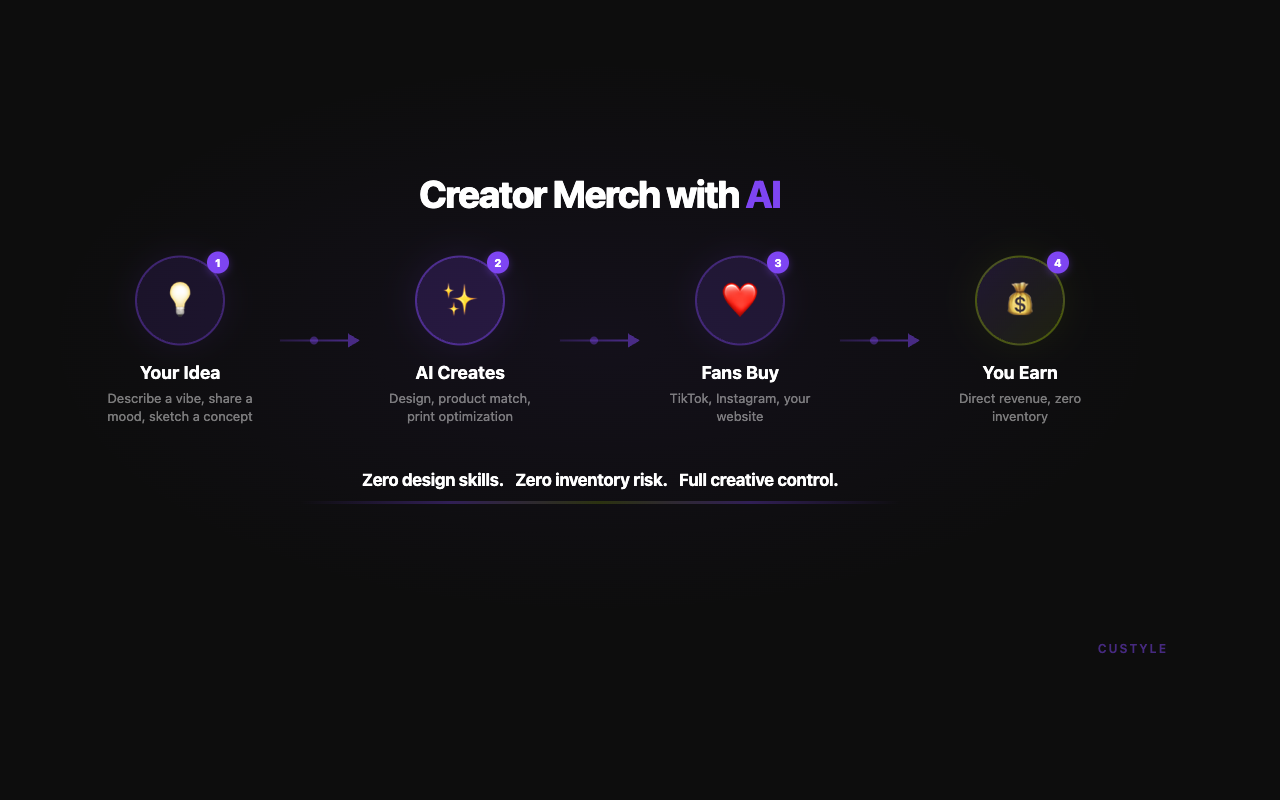 AI handles the operational weight of a merch program. You handle the creative vision and audience relationship.
What AI Creator Tools Actually Do
| Tool | What Changes | Your Gain |
|---|---|---|
| Design generation | Words become professional designs | Create without Photoshop |
| Product line management | AI refreshes your catalog | Stay relevant without the work |
| Performance analytics | See what sells and why | Make smarter decisions |
| Promotion timing | AI picks the right moment to launch | Bigger impact per drop |
| Customer service | AI handles routine questions | Professional support, zero staff |
Fan Engagement Gets Deeper
Custom merch builds something digital content cannot: physical connection. Your fan wears your design. Holds your mug. Gifts your art to someone they care about.
AI takes this further with tiered engagement:
- Basic: Name or number on a product. Quick recognition.
- Intermediate: Choose design elements and colors. Creative participation.
- Advanced: AI generates a unique design from fan input. True collaboration.
- Program-level: An agent manages ongoing drops, predicts what fans want next.
Limited edition runs become easy. Numbered series with verified authenticity. Community votes on next designs, with AI handling rapid prototyping and visualization.
This is where a platform like Custyle.ai fits naturally. The AI crew handles the operational weight. Ink generates designs shaped for real products. You focus on your audience and your content. The merch program runs alongside, not on top of your creative work.
-> Related: Start Your Creator Merch Program
What Could Go Wrong
Honest assessment matters. The AI custom merchandise market faces real challenges.
Quality Is Not Solved Yet
AI-generated designs can miss. Hallucination produces unexpected or inappropriate output. Brand guidelines get interpreted loosely. Color accuracy from screen to print remains tricky.
According to research analysis, 80% of AI projects fail to deliver expected value due to data quality issues, integration difficulties, and lack of technical expertise. Merch platforms investing in automated quality inspection, human oversight, and production partner management have an edge.
Return rates in print-on-demand run below 5%, compared to 20% in traditional retail. That low rate reflects commitment. People who describe their vision and see it made do not return it lightly. But quality failures erode that advantage fast.
IP Questions Remain Open
Who owns an AI-generated design? Training data copyright cases remain in courts. Trademark detection at scale stays difficult. The legal framework is still forming.
Platforms that use licensed training data, build content filtering systems, and clarify usage rights in their terms of service position themselves better. But uncertainty persists.
Infrastructure Has Limits
GPU supply concentration is real. According to industry data, NVIDIA holds 85.2% market share in AI accelerators. Datacenter power supply bottlenecks delay deployment. IDC projects $758 billion in AI infrastructure spending by 2029. The capacity is coming, but demand runs ahead of supply right now.
Trust Takes Time
Only 6% of UK consumers trust AI to buy automatically without checking, per Worldpay research. That number needs to rise for full agentic commerce to work. It will rise through accumulated positive experiences, transparent system operation, and graduated autonomy that respects human judgment.
Quotable: According to Worldpay research, while 31% of UK consumers would delegate browsing to AI assistants, only 6% trust AI to buy automatically without review, indicating a substantial trust gap that must narrow for agentic commerce to reach full potential.
What Happens Next
Three forces shape the next 24 months for AI custom merchandise.
Investment Keeps Flowing
Custom apparel startup investment grew 15% year-over-year across the last decade, per industry data. AI now accelerates that. In 2025, AI startups raised $76 billion through mega-rounds, with 17 companies securing $100 million or more. AI captured 44% of all venture capital invested.
According to IDC, AI infrastructure spending reaches $758 billion by 2029. That capacity supports every merch platform building on generative models and agent architectures.
Technology Gets Better
Multimodal AI expands what you can describe. Video, 3D objects, audio references, emotional states. Your input gets richer. Output gets more precise.
AR preview becomes standard. Try before you buy, in your own space. According to research, 43% of consumers already want 3D visualization before purchase. That percentage only grows.
Agentic protocols like MCP and ACP standardize how AI agents communicate across platforms. Your merch agent works everywhere you do. One conversation. Many touchpoints.
The Market Restructures
B2B corporate merchandise represents a massive expansion vector. The custom promotional products market reaches $98 billion, per research estimates. Corporate buyers want consistent, on-brand merch without design agencies. AI delivers that. Larger orders, repeat purchasing, higher lifetime value.
Subscription models emerge. Corporate apparel refresh programs. Creator merchandise line updates. Team uniform replacement cycles. AI agents manage these automatically, turning one-time transactions into recurring revenue.
The competitive landscape consolidates. Traditional platforms that successfully integrate AI survive. Those that delay face displacement. AI-native platforms with strong fulfillment networks win. Open-source agent frameworks lower barriers, expanding the total market while intensifying competition.
-> Related: The Future of Merch Technology
FAQ
What is AI custom merchandise?
AI custom merchandise refers to physical products (apparel, accessories, home goods) designed and produced using artificial intelligence. You describe what you want in plain language. AI generates the design, matches it to the right product, and handles production and shipping. No design software or inventory needed.
How big is the AI custom merchandise market in 2026?
According to a synthesis of data from CustomCy, Grand View Research, and Precedence Research, the AI custom merchandise market represents approximately $8-12 billion globally in 2026. The broader custom products market reaches $190 billion. Growth projections suggest $40-70 billion for AI-powered segments by 2030 under favorable conditions.
Do I need design skills to create AI merch?
No. AI merch agents accept natural language descriptions, reference images, or mood descriptions. According to industry data, AI tools reduce design time by 70-85% and shift the required skill from graphic design proficiency to conversational ability. You describe the vibe. AI makes it real.
How do AI merch agents differ from Printful or Printify?
Traditional platforms like Printful and Printify require you to create or upload designs, browse product catalogs manually, and manage orders yourself. AI merch agents handle the entire process from a text or image prompt through to delivery. They learn your preferences over time and can proactively suggest designs for upcoming occasions.
Is AI-generated merchandise legal to sell?
The legal landscape is still developing. Training data copyright cases remain in litigation. However, platforms that use licensed training data, implement content filtering, and provide clear usage rights in their terms of service reduce legal risk. The EU AI Act, fully enforceable in 2026, creates structured compliance requirements that responsible platforms are already meeting.
Ready to make something?
Turn your ideas into real merch with AI. No design skills needed.
Start with a vibeCustyle Lab
Research & Guides · Mar 24, 2026·18 min read
Further Reading
Explore all →
Inside Moxy & Lumi: How Custyle Stages Your Product Before You See It
Moxy and Lumi are the presentation layer of the Custyle Crew — Moxy shows how your merch lands on a real person; Lumi builds the mood, context, and atmosphere around what you made.
Read more →
Creator Merch Case Study: How to Build a Merch Line in One Afternoon
A creator merch case study you can copy: real benchmarks (0.5–2% conversion, $68 AOV), an hour-by-hour afternoon build, and a fill-in template for your first drop.
Read more →
Inside Axis & Grid: Custyle's Form-and-Composition Crew
Axis and Grid are the structure layer of the Custyle Crew — Grid gets composition, spacing, and placement right; Axis finds the right product form your idea should live on.
Read more →
Inside Bolt: The Production Brain That Picks Materials Without Asking
Bolt is the AI production brain of the Custyle Crew — the agent that picks the process, material, and build quality for every design. Here is how.
Read more →