Creator Merch Trends 2027: 7 Predictions and the Evidence Behind Them

Arron Young
Founder, Custyle · Nov 25, 2026·11 min read

TL;DR: Creator merch trends for 2027 point to smaller, faster, moment-tied drops. They're sold through searchable storefronts and AI shopping assistants and made only after someone orders. Every prediction below is tied to a published 2025–2026 data point, plus the signal that would prove it wrong.
Contents
- How to read these predictions
- 1. Moment merch beats logo merch
- 2. Conversation becomes the design tool
- 3. AI shopping assistants reach apparel first
- 4. Storefront search outsells live hype
- 5. Made-to-order becomes the default
- 6. Printing moves closer to fans
- 7. Your own touch becomes the IP strategy
- What this means for your 2027 plan
- FAQ
How to read these predictions
This piece is for creators, streamers and podcasters planning merch for 2027. It's also for anyone building tools for them.
Here's the short answer. The creator merch trends for 2027 favor speed over stock. They favor specific moments over generic logos, and searchable listings over one-off hype. Most of the shift is already visible in 2026 data.
Custyle publishes this outlook and is one of the products discussed. So each prediction follows a simple rule. It states the evidence, names the source, and says what would prove it wrong. None of it comes from internal Custyle sales data. This is a reading of public numbers, not a forecast for your store.
The backdrop is big but fuzzy. Goldman Sachs projected in 2023 that the creator economy could reach about $480 billion by 2027. Analyst estimates for print-on-demand cluster around $10–14 billion in 2026, growing roughly 20–25% a year. Grand View Research, for example, projects $57.49 billion by 2033 at a 23.6% CAGR.
Treat these as scope-dependent estimates, not targets. Our market-scope guide explains why the numbers disagree.
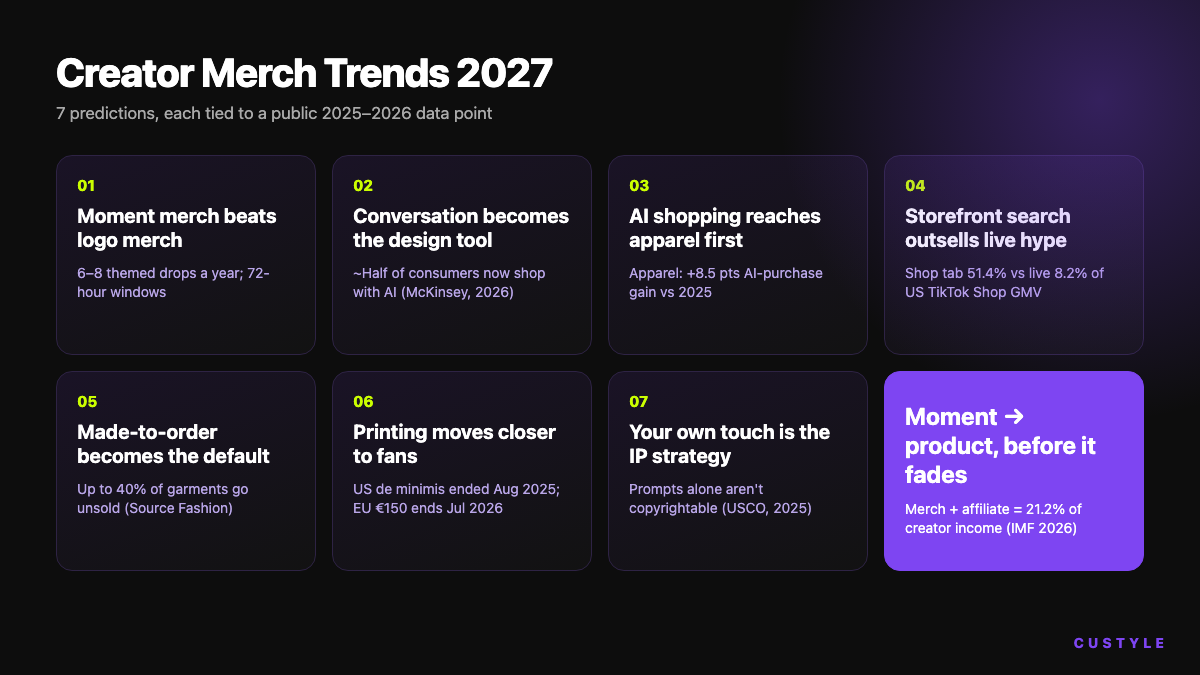 The seven predictions at a glance, each with the public number behind it.
1. Moment merch beats logo merch
Prediction: In 2027, your best-selling piece is more likely to quote a clip than to carry your logo.
The channel-name hoodie is the default first drop. It's also the easiest to ignore. Fans buy merch to prove they were there. That means the in-joke, the catchphrase, the stream that went sideways.
Industry guides in 2026 point the same way:
- Small, themed, time-limited drops sell through faster than always-on stores.
- A common cadence is six to eight drops a year, each with one clear theme.
- Micro-runs, like 100-piece editions or 72-hour windows, add urgency without overstock.
- Podcast merch increasingly sells around a single viral clip or guest moment.
These guides are practitioner blogs, not audited studies. So read them as direction, not proof.
What makes this a 2027 trend and not a 2020 one is speed. A moment has a half-life of days. If design takes three weeks, the moment is gone. Faster design tools shrink that gap, so moment merch stops being a stunt and becomes a habit.
What would prove it wrong: logo staples keep outselling themed drops across platforms, even when the drops ship fast.
2. Conversation becomes the design tool
Prediction: Describing a design in plain words becomes a normal way to start merch. Template editors don't vanish, but they stop being the only door.
The evidence is about behavior, not merch. A 2026 McKinsey survey of about 21,000 consumers in 11 markets found that about half now shop with AI. Gen Z and millennials lead.
When people already describe what they want to an assistant, describing a shirt feels natural. "A retro arcade tee for the Thursday stream crew, purple and lime, no logo" is a real brief. It carries intent, mood and audience in one line.
This is the idea behind the AI Merch Agent category. You start from an idea or a reference image. Then you develop artwork and apply it to a real product. In Custyle, that starts in Create. Creation runs on credits, and you review the artwork and the product base before any order.
The open question is quality control. A conversation is fast, but you still need to judge the result. The winners in 2027 will make the review step easy, not invisible.
What would prove it wrong: described designs need so many correction rounds that creators drift back to templates.
3. AI shopping assistants reach apparel first
Prediction: Merch gets bought through AI assistants in 2027, and apparel leads the way.
The adoption curve is real but early. In the same McKinsey research, 7–18% of US AI users completed purchases through AI, depending on category. Apparel posted the largest year-over-year gain, up 8.5 percentage points from 2025. eMarketer expects AI platforms to drive about 1.5% of US retail ecommerce in 2026, roughly $20.57 billion.
The plumbing is being built in public:
- OpenAI launched Instant Checkout and the Agentic Commerce Protocol in September 2025.
- In early 2026 it shifted toward merchant-controlled checkout, per Digital Commerce 360.
- Shopify told merchants its "agentic storefronts" would make eligible products discoverable inside ChatGPT.
- Google backs its own Universal Commerce Protocol.
McKinsey also stresses that this is a curve, not a leap. Its automation-curve framework describes six levels between "human shops" and "agent shops."
For 2027 that means AI assistants mostly help fans find and compare. Fewer of them buy on their own. For your merch, the practical move is simple. Clear product names, honest descriptions and clean photos are what an assistant can read.
What would prove it wrong: AI-assisted purchase rates in apparel stall at 2026 levels.
4. Storefront search outsells live hype
Prediction: Searchable, always-findable listings matter more than live-stream sales spikes.
This one is in the TikTok Shop numbers:
- Momentum Works estimates TikTok Shop's US gross merchandise value hit about $11.8 billion in the first half of 2026. That's more than double the year before.
- The Shop tab now closes 51.4% of attributed US sales, up from 36%.
- Live's share fell to 8.2%.
- eMarketer forecasts US TikTok Shop sales of about $23.4 billion in 2026.
Those are modeled third-party estimates, not company-reported figures. But the direction is clear. Fans increasingly search, browse and buy later. They don't only buy in the heat of a live stream.
YouTube points the same way. Its product shelf can show up to 12 items under videos, in lives and on a store tab. Shop builders like Fourthwall and Spring plug into it.
So the drop still creates the spark. The searchable listing catches the fan who finds the clip three weeks later.
What would prove it wrong: live commerce regains share in 2027 and storefront conversion flattens.
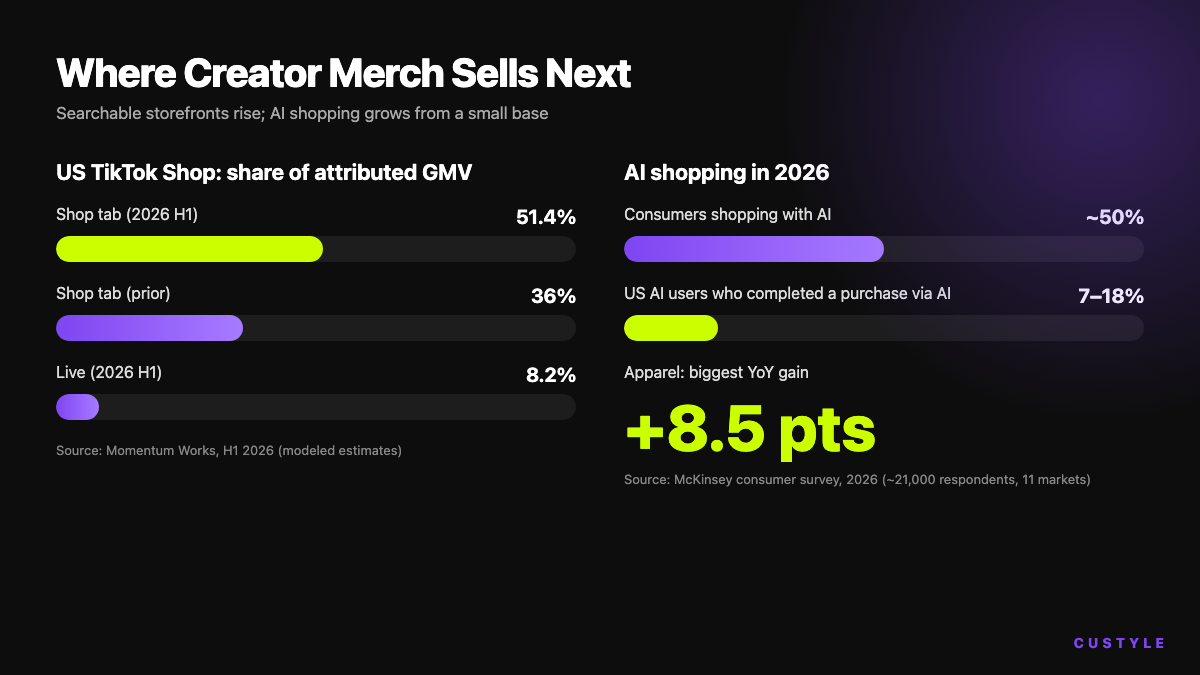 Shop-tab share rose to 51.4% of attributed US TikTok Shop sales while live fell to 8.2% (Momentum Works, H1 2026).
5. Made-to-order becomes the default
Prediction: Holding stock becomes the exception for creators, not the starting point.
Inventory is a forecast you pay for upfront. Most creators can't forecast. Fashion's own numbers show the cost of guessing. A 2025 Source Fashion report estimates 80–150 billion garments are made each year, with up to 40% unsold. Other estimates sit near 30%. Minimum order quantities are a big reason brands overproduce.
Made-to-order flips the risk. Nothing gets made until someone buys. There's no garage full of mediums after the hype fades. It also pairs well with prediction 1, because a 72-hour moment drop doesn't need a warehouse.
The trade-off is real. Per-unit cost is usually higher, and production takes days, not hours. Our deep dive on zero-inventory brands walks through those costs.
What would prove it wrong: per-unit costs rise enough that creators return to bulk runs for core items.
6. Printing moves closer to fans
Prediction: Where your merch gets made starts to matter as much as how it looks.
Cross-border shipping got more expensive:
- The US ended its $800 de minimis duty-free exemption on August 29, 2025, ahead of the statutory repeal set for July 2027.
- Printful paused some EU-to-US shipments before resuming them on September 11, 2025.
- The EU's €150 duty-free threshold for small parcels ends July 1, 2026.
- Printify has responded by adding EU print providers.
For creators with fans in several countries, the math changes. A hoodie made near the buyer can avoid duties and delays. Regional production used to be a speed perk. In 2027 it becomes a cost line.
What would prove it wrong: duty rules relax again and cross-border costs fall back to 2024 levels.
7. Your own touch becomes the IP strategy
Prediction: The most defensible creator merch in 2027 mixes AI help with something only you made.
The US Copyright Office set the frame in its January 2025 report, Copyright and Artificial Intelligence, Part 2. AI output is protectable only where a human contributes enough expressive elements. Prompts alone don't count. Picking one output from several doesn't count either. Human arrangement or changes to AI output, or your own work visible in it, can qualify. Each case is judged on its own.
That points to a practical 2027 habit. Start with something that's yours. Use your own sketch, your catchphrase, a photo you took or your layout. Let AI help develop it, then make real edits. That's better merch, and it's a stronger position if someone copies you. This is a trend reading, not legal advice.
It also links back to trust. A Tubefilter survey in August 2026 found only 15% of creators fully trust sponsored content from other creators. Fans can tell what's authentic. Merch that carries your actual voice reads that way.
What would prove it wrong: new rules or court decisions grant protection to prompt-only outputs.
What this means for your 2027 plan
One more number ties these together. In The Influencer Marketing Factory's 2026 survey of 1,000 US creators, product/merch sales plus affiliate made up 21.2% of income. Brand partnerships made up 12.7%.
CreatorIQ's 2026 compensation report puts average creator income near $44,293. Only 11% of creators earn six figures, and inconsistent brand deals rank among the top complaints.
Merch is one of the few income lines you own. Algorithms and sponsors don't control it. That's why these trends matter. They make owned income cheaper to test.
Use this checklist to plan your first 2027 drop:
- Pick a moment, not a logo. Choose one clip, phrase or in-joke from the last 30 days.
- Add your own element. Start from your sketch, words or photo before any AI help.
- Write the brief in one line. Name the vibe, the audience and two colors.
- Review before you order. Check the artwork on the real product base. Check print size and placement.
- Set a short window. Try 72 hours or a fixed small run.
- Make it findable. Use a clear product name and a plain description for search and AI assistants.
- Check where it ships from. Look up regional production options for your biggest fan countries.
- Decide your proof. Write down what result would make you repeat the drop.
For the bigger picture behind these shifts, read The Future of Custom Merchandise. It turns longer-range ideas into questions you can test.
The creator merch trends for 2027 aren't about bigger catalogs. They're about turning a real moment into a real product before it fades. Then they make sure fans can still find it later.
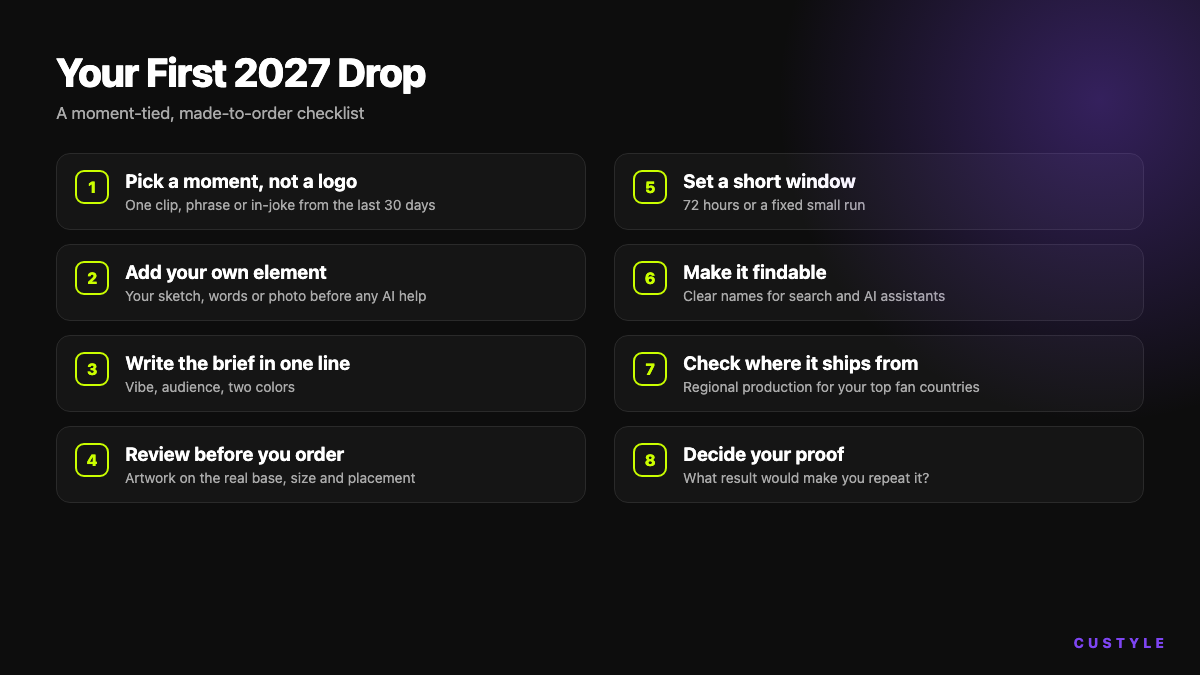 An eight-step checklist for a moment-tied, made-to-order drop in 2027.
FAQ
What are the biggest creator merch trends for 2027?
The strongest signals are moment-tied limited drops and plain-language design. Add AI shopping assistants, searchable storefronts and made-to-order production. Regional printing and human-plus-AI designs round out the list. Each is backed by 2025–2026 data, such as TikTok Shop's shift to Shop-tab sales and McKinsey's AI shopping surveys.
Will AI shopping agents buy creator merch in 2027?
Some will, but mostly at the discovery stage. McKinsey found 7–18% of US AI users completed purchases through AI in 2026, depending on category. Apparel showed the biggest yearly gain. Expect AI assistants to help fans find and compare merch more often than they check out on their own.
Is print-on-demand still worth it for creators in 2027?
For most creators, yes. Made-to-order removes inventory risk, and fashion estimates suggest 30–40% of produced garments go unsold. The trade-offs are higher per-unit cost and production time. Tariff changes also make printing close to buyers more valuable.
Can I copyright AI-generated merch designs?
Not from prompts alone. The US Copyright Office's January 2025 report says AI output is protectable only where a human adds enough expressive elements. Your own artwork, edits or arrangement can qualify. Each case is judged individually, so treat this as context, not legal advice.
How often should creators drop merch in 2027?
Many practitioners suggest six to eight themed drops a year. Each one ties to a specific moment and runs for a short window, like 72 hours. Keep a few evergreen pieces listed so fans who find a clip later can still buy.
Ready to make something?
Turn your ideas into real merch with AI. No design skills needed.
Start with a vibeArron Young
Founder, Custyle · Nov 25, 2026·11 min read
Further Reading
Explore all →
Zero-Inventory Brands: Why the Next Wave of Creator Merch Won't Hold Stock
A zero inventory brand makes merch only after someone buys it. Why creator merch is leaving the stockroom in 2026, the real trade-offs, and how to build one.
Read more →
Family Reunion Shirt Ideas with AI: Designs for the Whole Tree
Family reunion shirt ideas that tell your family's story: one base design, a color for each branch, names only where they count. Seven ideas, a prompt and an order timeline.
Read more →
Bachelorette & Wedding Party Shirts with AI: One Theme, Every Guest
Custom bachelorette party shirts the squad will wear again: one theme, a bride piece that leads, squad pieces that answer. Six sets, a prompt and an order timeline.
Read more →
Author & Book Club Merch Designed with AI: Quotes, Covers and Fandom Tees
Book merch ideas readers actually wear: quote tees, story-world crests, cover remixes and book club totes. Six AI prompts, plus the rights rules to check first.
Read more →