What Shopify Sidekick Means for the Merch Creator

Arron Young
Founder, Custyle · Nov 4, 2026·11 min read

What Shopify Sidekick Means for the Merch Creator
TL;DR: With the Fall '26 Edition, Shopify Sidekick can generate a design, show it on a product, and list it as print on demand. It's in early access and runs through Printful only. Sidekick commerce makes producing merch cheap and fast for every Shopify merchant. That's good news, and it moves your edge somewhere else. When anyone can make the product, you win on taste, audience, and intent: knowing what to make, for whom, and why now.
Last week a friend who runs a small band-merch shop sent me a screenshot. Sidekick had made a tee mockup from one sentence. Her message: "So… is this the end of what you're building?"
Fair question. My short answer: no. But it does end something.
This piece is for creators, small brands, and operators who sell merch on Shopify, or plan to. I'll cover what Shopify Sidekick actually does now, the new print-on-demand flow, where it stops, and what I'd do this month if I ran a merch store.
For the bigger picture first, read → Related: how agentic commerce is rebuilding online retail. This article zooms in on one platform and one kind of seller.
Table of Contents
- What Shopify Sidekick Is Now
- The Merch Headline: Prompt to POD
- What Sidekick Commerce Changes
- Where Sidekick Stops
- The Shopper Side Is Moving Too
- Where Your Edge Moves
- Your Sidekick Checklist
- FAQ
- The Takeaway
What Shopify Sidekick Is Now
Shopify Sidekick is the AI assistant built into the Shopify admin. Shopify calls it "your AI cofounder." It works for you, the merchant. It doesn't talk to your shoppers.
It started as a chat box that answered store questions. By late 2026 it's an agent that does work.
Here's what changed across 2026's Shopify Editions:
- Spring '26 (June 17, 2026): Sidekick App Extensions opened to every developer. Apps can now feed data into Sidekick's answers and stage actions for your confirmation. Launch partners include Klaviyo, Loop, Smile, Judge.me, and Yotpo, per Shopify's Spring '26 developer post.
- Fall '26 ("Exponential"): According to Shopify's Fall '26 Edition page, Sidekick "tackles complex workflows, stages multiple changes at once, computes, codes, and searches the internet." It also remembers: "Ask it once; it remembers."
You approve a plan once, and Sidekick applies the changes. One plan can rewrite descriptions across a whole collection. It can test proposed improvements in SimGym before you choose what ships. It also powers Canvas, a new editor where you design your whole store in one view.
Adoption is real. Shopify says daily Sidekick sessions grew 4.2x year over year on its Fall '26 page. Weekly active shops using Sidekick were up 4x year over year in Q1 2026, per the Spring '26 post. Coverage of Shopify's Q2 2026 results by Retail TouchPoints reported merchants built 36,000+ custom apps with Sidekick, up from about 12,000 in Q1.
Shopify Sidekick is no longer a help desk. It's a junior operator living inside your admin.
The Merch Headline: Prompt to POD
This is the part that matters for anyone who sells merch.
Shopify's Fall '26 Edition says you can "upload or generate a design with Sidekick, preview it on a product, then publish the final product on your store as print-on-demand."
The Shopify Help Center lays out the flow:
- Type "Help me create a custom product" in Sidekick.
- Pick a blank product.
- Generate a design from a description, or upload your own.
- Preview it on the product and ask for changes in chat.
- Click "Create product." The design saves to Content > Files.
- Connect Printful when prompted. The product lands there as a draft.
- Add a Printful billing method and set the product to Active.
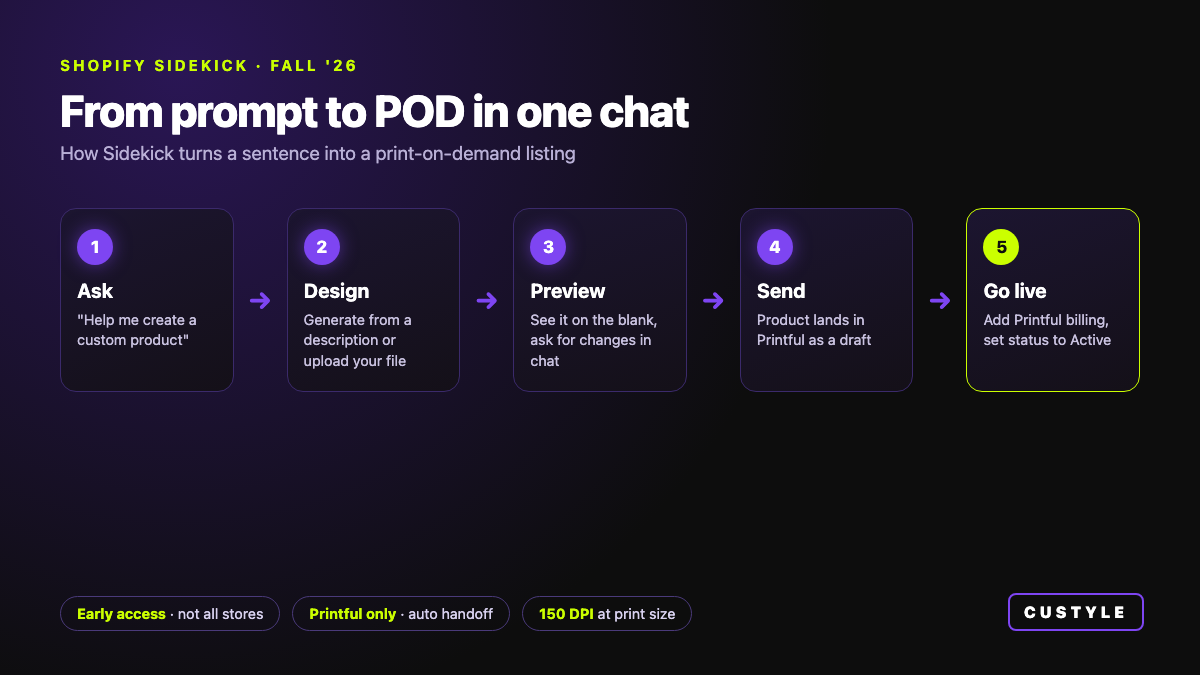
The Sidekick POD flow: one chat replaces four tools (an image generator, a mockup tool, a POD app, and the product editor).
The fine print matters, and Shopify states it plainly:
- Early access. "Creating custom products with Sidekick is in early access, so it isn't available to all stores."
- Printful only. "Only Printful receives your design automatically." Other POD apps need a manual upload.
- File specs. PNG or JPEG under 5 MB, at least 150 DPI at print size (for example 1,800 × 2,400 px). A transparent background works best.
- Image quality. Shopify warns generated images "can be unexpected or low quality." Generation limits depend on your plan and are shared across the store.
Still, the shape is clear. Shopify has collapsed idea, design, mockup, and listing into one conversation inside the admin. A year ago, that chain took four tabs and an afternoon.
What Sidekick Commerce Changes
Three things shift right away.
1. Making a product stops being a skill. If your edge was "I know how to get a print-ready file into Printful," that edge is gone. Shopify now does it in a chat.
2. Store ops get cheap. Bulk description rewrites, discounts, Flow automations, theme tweaks. A solo creator now gets the ops hours of a small team. Flatline Agency's Fall '26 recap cites a three-person fashion team using Sidekick to automate its operational work.
3. Catalogs will flood. When a new SKU costs one sentence, stores will list more of them. Most will be generic. Expect more shirts that look like every other shirt.
That third point is the one I keep coming back to.
When producing merch costs nothing, the scarce thing is knowing what's worth making.
The old print-on-demand model already ran on guessing. You guessed a design, listed it, and hoped it sold. Sidekick doesn't change that model. It makes the guessing faster and cheaper. That's useful. It's not the same as knowing.
Where Sidekick Stops
Sidekick is good. It's also clearly a merchant tool with a merchant's view. Here's where it stops today.
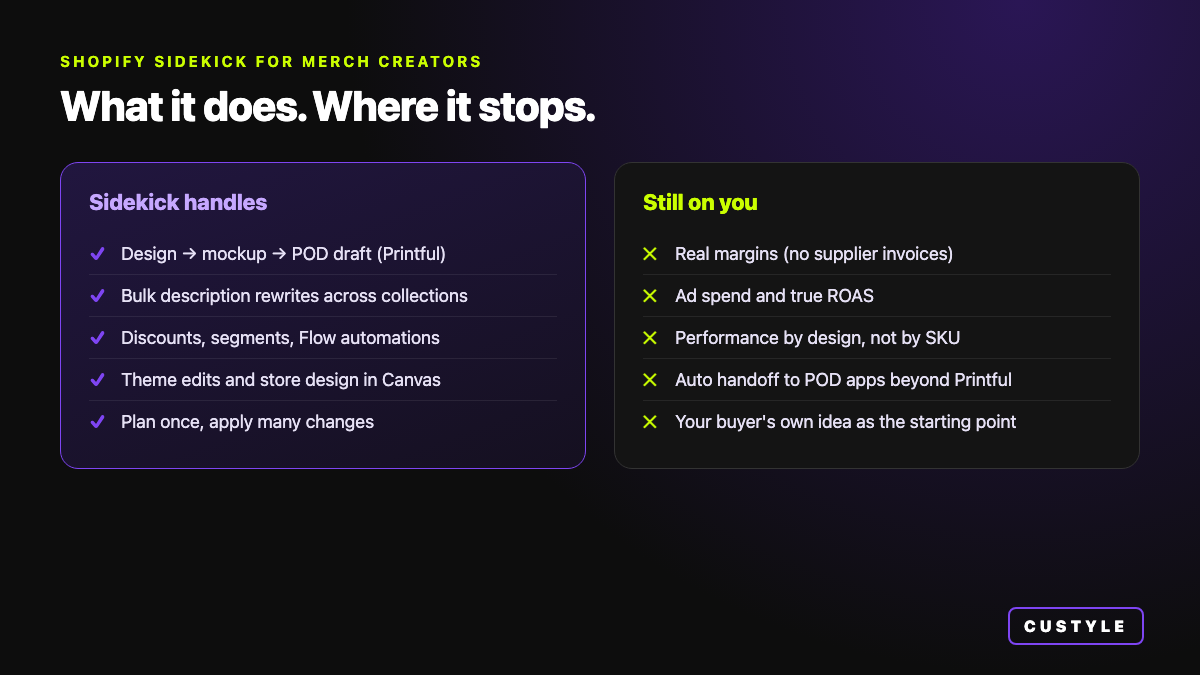
Sidekick covers the merchant's ops. The gaps sit around real costs and real buyer intent.
Your real margins. Sidekick can't see your Printful or Printify invoices. A July 2026 guide from PodVector notes that its profit figures rest on the costs you entered by hand, which often overstate profit. (PodVector sells a competing analytics tool, so weigh that. The mechanism is still sound.)
Your ad spend. The same guide notes that Sidekick has no native view of Meta or Google ad spend. True return on ad spend still means stitching data together.
Your design as a family. Shopify thinks in products, not designs. One design on a tee, a hoodie, and a mug is three separate things, so seeing how a design performs is a manual roll-up.
One supplier. Only Printful receives your design automatically. If you split production across suppliers, you're back to uploading files.
Your buyer's intent. This is the big one. Sidekick helps you make products. It doesn't help your fan make the thing they actually want. The design still starts from your guess, not their idea.
None of this is a knock on Shopify. It's a scope choice. Shopify serves millions of merchants, and Sidekick makes each one faster at running a store.
The Shopper Side Is Moving Too
On the shopper side, Shopify is pushing hard on checkout.
Per the Fall '26 Edition page, shoppers can now "discover products, approve purchases, and check out with Shop Pay" inside AI agents. Shopify's shop.md skill lets agents like ChatGPT and Claude find products and check out. Stores can also sell in Google Search, including AI Mode and the Gemini app.
The numbers behind it, from the same page:
| Metric | Figure |
|---|---|
| Products discoverable across AI channels | 1B+ |
| Shoppers with Shop Pay accounts | 400M+ |
| Shopify's Catalog API commission on agent-driven sales | 0.3% |
Underneath sits the Universal Commerce Protocol (UCP), co-developed with Google. It's an open standard for agents transacting with merchants, with backers including Amazon, Meta, Microsoft, Stripe, and Etsy.
Put both halves together. Sidekick makes products cheap for merchants to create. Agents make products easy for shoppers to buy. What neither half does yet is let the shopper's own idea become the product. The agent can buy what exists. It can't yet ask for what doesn't.
I wrote more on how agents reshape commerce in → Related: what Claude Code's architecture means for commerce agents.
Where Your Edge Moves
If production is solved, here's where I think the edge lives now.
Taste. Generic designs will be infinite. Specific ones, with a point of view and made for merch rather than for a screen, stay rare. Your taste is the filter.
Audience. Sidekick can make a shirt. It can't make three thousand people care about it. Community still compounds, and it's still yours.
Intent. This is the lane I'm betting on. The next step after "merchant guesses, AI produces" is "buyer describes, AI makes it real." At Custyle.ai, the AI Merch Agent, we built a crew of nine AI specialists for that second half. You bring a vibe. The crew turns it into the right product, made the right way.
You don't need Custyle to act on this. The principle stands alone: start from what a specific person wants, not from what's cheap to list. Sidekick just made the cheap part cheaper. So the intent part is worth more.
In the Sidekick era, every Shopify store can produce merch. Few can produce merch someone asked for.
Your Sidekick Checklist
Here's what I'd do this month if I ran a merch store on Shopify.
- Hand Sidekick the busywork. Bulk descriptions, discounts, Flow automations, theme tweaks.
- Decide who approves plans. One approval can now touch hundreds of products. Read the plan before you click.
- Test the POD flow on one design. If your store has early access, run one concept from prompt to draft.
- Check print specs yourself. Confirm 150 DPI at print size and a transparent PNG. Zoom to 100% before going Active.
- Enter real costs per variant. Sidekick's profit math is only as good as the costs you type in.
- Make your catalog agent-readable. Clear titles, real attributes, current policies and FAQs. Agents read these now.
- Group products by design. Tag each product with its design so you can see which designs actually sell.
- Spend the saved hours on taste and community. That's the part no assistant automates.
FAQ
What is Shopify Sidekick?
Shopify Sidekick is the AI assistant built into the Shopify admin. It answers store questions, builds reports and Shopify Flow automations, edits themes, and creates discounts. As of the Fall '26 Edition, it handles multi-step tasks, writes code, searches the web, and remembers context. You review and approve its changes. It works for merchants and doesn't talk to shoppers.
Can Shopify Sidekick create print-on-demand products?
Yes, in early access. Sidekick can generate or take your design, preview it on a blank product, and send it to Printful as a draft listing. You then add billing in Printful and set the product to Active. Only Printful receives designs automatically. Other POD apps need a manual upload, according to Shopify's Help Center.
Is Shopify Sidekick free?
Sidekick is included in Shopify plans with no separate subscription. Some features are limited by plan. Image generation has monthly and short-term limits that depend on your plan and are shared across your store. Shopify's Help Center lists custom app creation on the Basic, Grow, Advanced, and Shopify Plus plans. Check your admin for exact availability.
Will Shopify Sidekick replace print-on-demand apps?
Not today. Sidekick works on top of Printful rather than replacing it. Printful still handles product options, pricing, printing, and shipping. What Sidekick replaces is the manual chain of image generator, mockup tool, and product editor. For merch creators, production gets easier. Picking what to produce stays your job.
What should merch creators focus on now?
Focus on what Sidekick can't automate: taste, audience, and buyer intent. Let Sidekick run store ops, and enter real per-variant costs so its profit math holds. Make your catalog readable by AI shopping agents. Then put your saved time into designs with a point of view and products that start from what fans actually want.
The Takeaway
So, is Shopify Sidekick the end of what my friend's shop does? No. It's the end of production as a moat.
Shopify Sidekick commerce makes every merchant faster at making and listing merch. The early-access POD flow is genuinely useful, with honest limits: Printful only, variable image quality, and no view of your real costs.
The bigger shift is what's left once production is free. Taste. Audience. Intent. The creators who win next won't be the ones who list the most products. They'll be the ones whose products someone actually asked for.
Your vibe, made real, still beats a thousand generic SKUs.
Ready to make something?
Turn your ideas into real merch with AI. No design skills needed.
Start with a vibeArron Young
Founder, Custyle · Nov 4, 2026·11 min read
Further Reading
Explore all →
Matching Family Thanksgiving Shirts, Designed by AI in One Prompt
Skip the rack turkey. Turn one family story into matching Thanksgiving shirts with AI. See seven example sets, one prompt to copy, and a schedule for November.
Read more →
Ugly Christmas Sweater Designs with AI: From Inside Joke to Wearable
Turn your best inside joke into an ugly Christmas sweater with AI. See seven worked examples, three ways to build one, and when to order before the party.
Read more →
The Post-POD Era: What Comes After Print on Demand
Print on demand solved inventory. It never solved intent. Five shifts from 2024 to 2026 broke the old POD model. Here's what the post-POD era looks like, and who wins it.
Read more →
AI Christmas Gifts: 15 Custom Merch Ideas Made in Minutes
15 AI Christmas gift ideas for family, partners, friends and coworkers. Each one shows the detail you start with and the custom merch it becomes, in minutes.
Read more →