AI Merch vs Print on Demand: Which Wins in 2026?

Custyle Picks
Reviews & Comparisons · Mar 24, 2026·13 min read
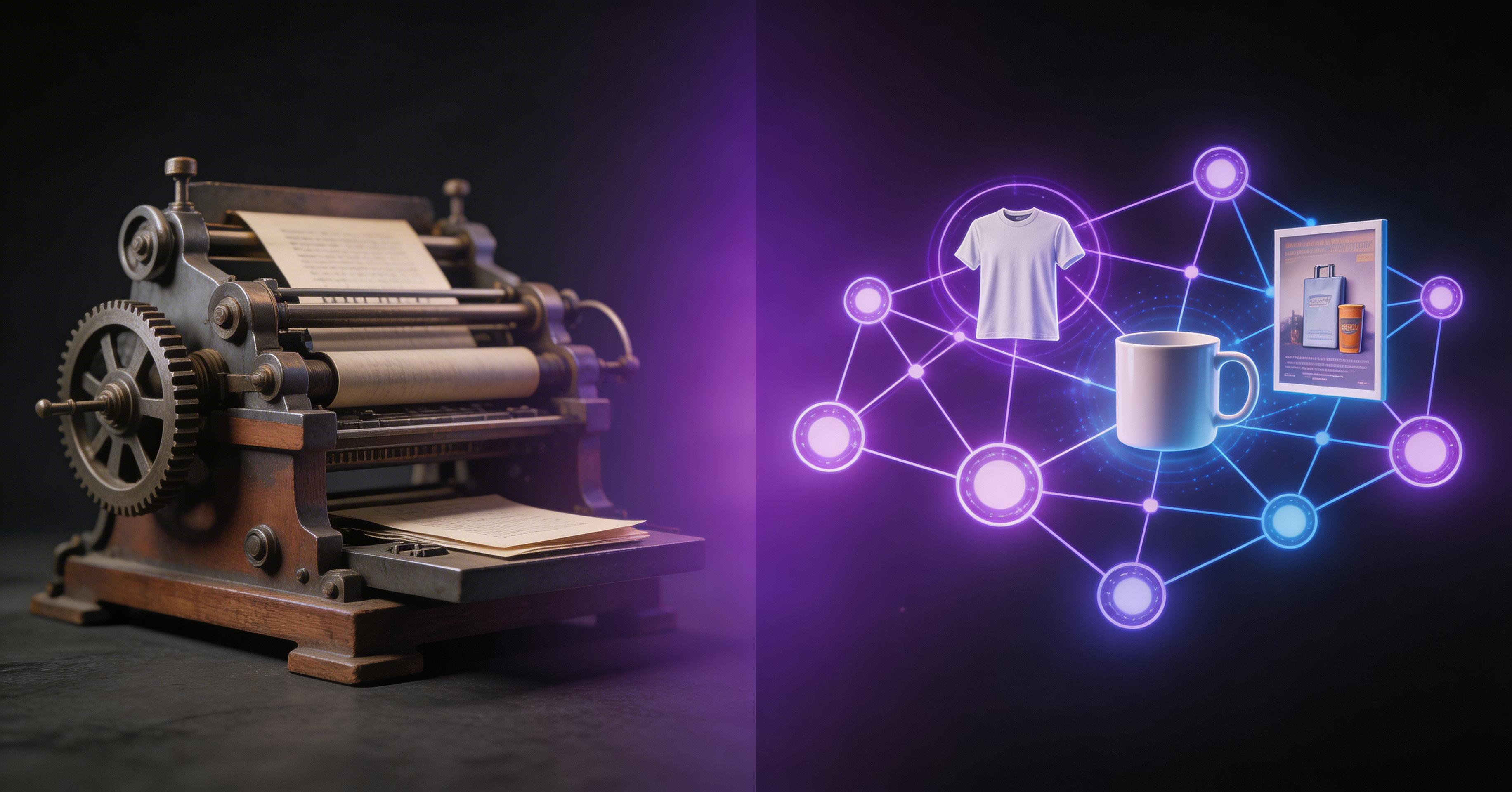
AI Merch vs POD
TL;DR: Traditional print on demand gives you full design control and a proven supply chain. AI merch platforms get you from idea to product in minutes, not hours. Neither is universally better — your skill level, speed needs, and creative vision decide. This guide breaks down 6 platforms, real timelines, and market data so you can pick the right path.
Table of Contents
- Quick Comparison
- What Is Print on Demand?
- What Is AI Merch?
- Speed: Hours vs Minutes
- Design Control: Pixels vs Prompts
- Platform Breakdown
- Cost and Margins
- Quality and Fulfillment
- Market Reality in 2026
- When to Choose POD
- When to Choose AI Merch
- FAQ
- Our Verdict
Quick Comparison
Choosing between AI merch vs print on demand? Here's the honest breakdown before we dive deep.
| Feature | Traditional POD | AI Merch |
|---|---|---|
| Time to first product | 2-16 hours | 2-10 minutes |
| Design skills needed | Yes (Photoshop, Canva) | No (text prompts) |
| Creative control | Full pixel-level control | Moderate (prompt-guided) |
| Product catalog | 400-900+ SKUs | 50-200+ SKUs |
| Fulfillment | Built-in (owned or partner) | Uses POD fulfillment |
| Best for | Skilled designers, brand builders | Quick launches, idea-first creators |
| Market size (2026) | $12.96-15.19B | ~$2.1B |
| Growth rate | 23-26% CAGR | 67% CAGR |
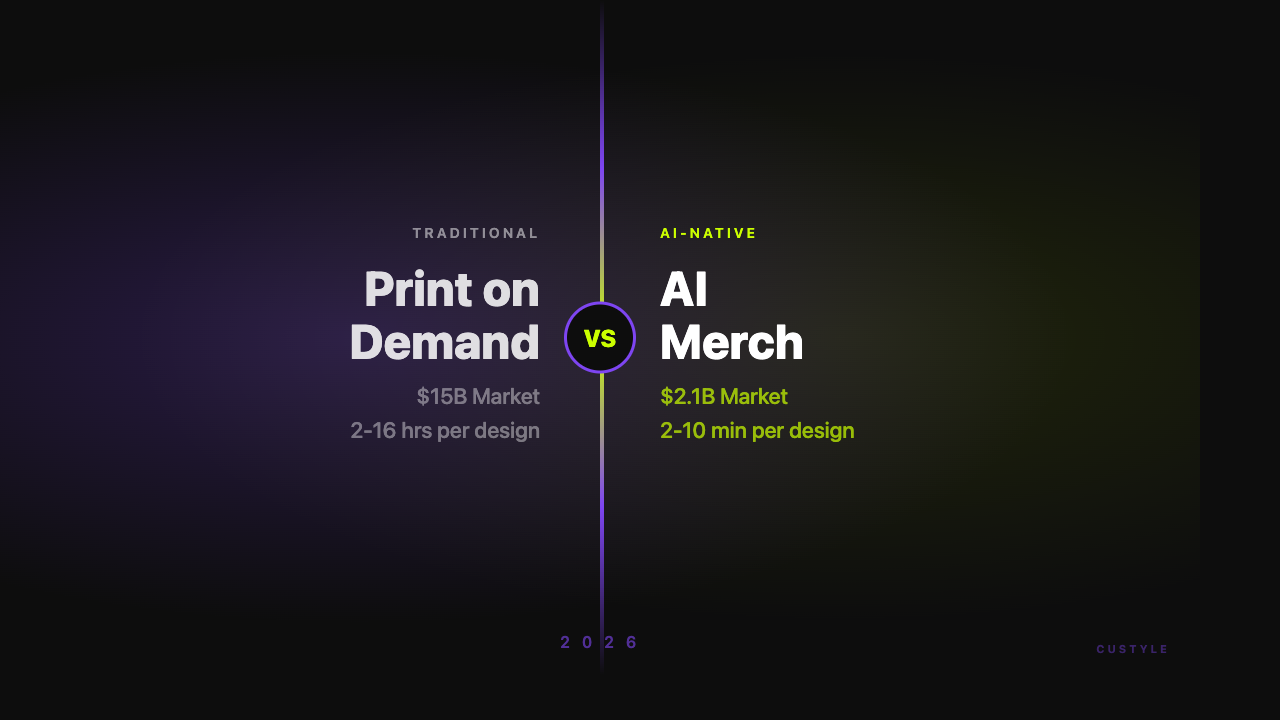 The merch landscape has split into two distinct paths for creators in 2026.
What Is Print on Demand?
Print on demand is the original creator merch model. You upload a design. A provider prints it on a product when someone orders. No inventory. No upfront cost.
The model has been around since the early 2010s. Platforms like Printful, Printify, and Gelato built global fulfillment networks. According to Grand View Research, the global POD market sits between $12.96B and $15.19B in 2026, growing at 23-26% CAGR.
"The print on demand market is projected to reach $46-103B by 2031-2034, making it one of the fastest-growing segments in e-commerce." — Grand View Research
POD solved a real problem: you no longer need 500 units to start selling merch. One order, one print. Return rates stay below 5%, compared to 20% in traditional retail.
But POD still has a bottleneck. You need a design file. That means hours in Photoshop — or paying a designer.
What Is AI Merch?
AI merch flips the starting point. Instead of uploading a finished design, you describe what you want. A text prompt, a reference image, a mood. AI handles the rest.
This is a newer category. The AI-native merch segment reached roughly $2.1B in 2026, growing at 67% CAGR according to industry reports. Investors put $890M into AI merch companies between 2024 and 2026.
The key difference: AI merch platforms still use traditional POD infrastructure for actual production. They add an AI design layer on top. Think of it as AI for the creative work, POD for the physical work.
"AI merch is not a replacement for print on demand — it's a new front door. The printing press stays the same. The design studio changes."
Platforms in this space range from traditional POD companies adding AI features (like Vistaprint's AI Logomaker, launched March 2026) to fully AI-native platforms like Custyle.ai, where the entire journey from intent to product happens through conversation.
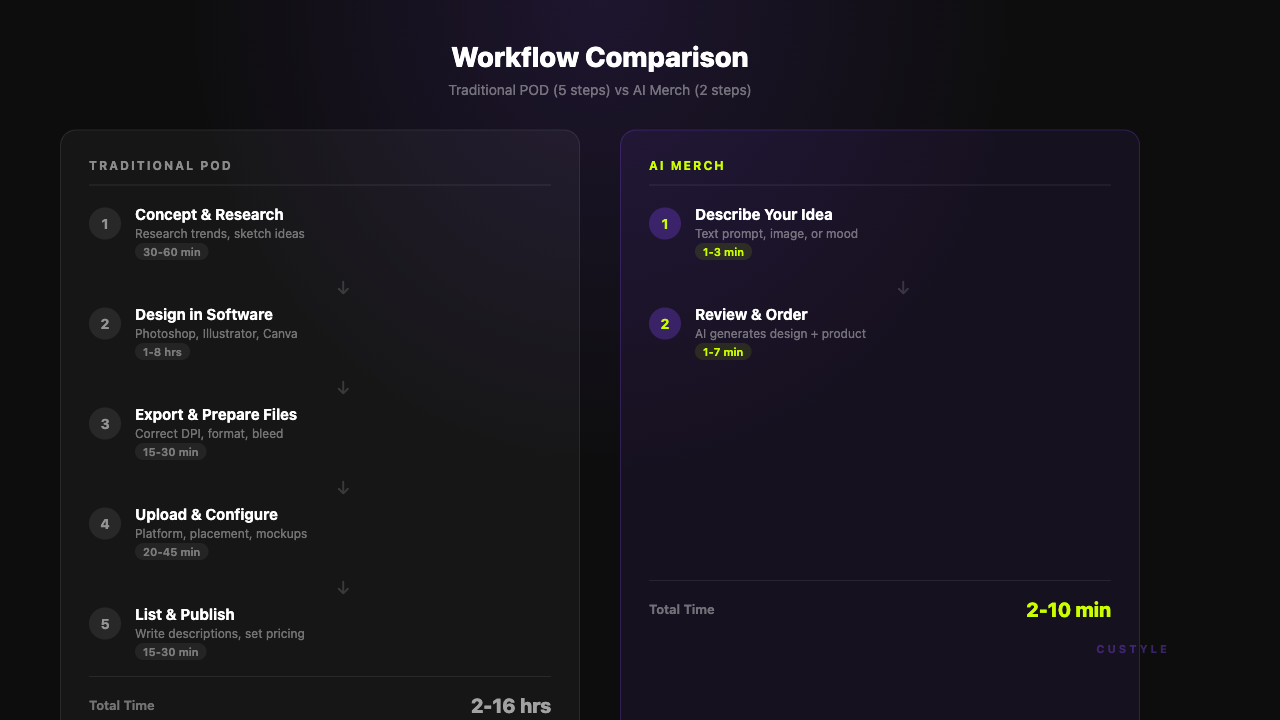 Traditional POD requires 5 steps and design software. AI merch compresses this to 2 steps with natural language.
Speed: Hours vs Minutes
This is where the gap is widest. Time-to-product tells the real story of AI merch vs print on demand.
Traditional POD timelines:
- Skilled designer: 2-4 hours (concept → design → mockup → upload)
- Novice using Canva: 8-16 hours (learning curve + iterations)
- Hiring a freelancer: 2-7 days (communication + revisions)
AI merch timelines:
- Describe your idea: 2-10 minutes to a finished, production-ready design
- That's a 60-120x speed improvement over traditional workflows
For a creator who drops merch based on trending moments — a viral meme, a pop culture event, a personal milestone — hours matter. By the time you finish a Photoshop design, the moment may have passed.
But speed isn't everything. If you're building a brand with a specific visual identity, rushing through AI prompts might not match what a skilled designer produces in four focused hours.
Winner: AI Merch — for raw speed, nothing comes close.
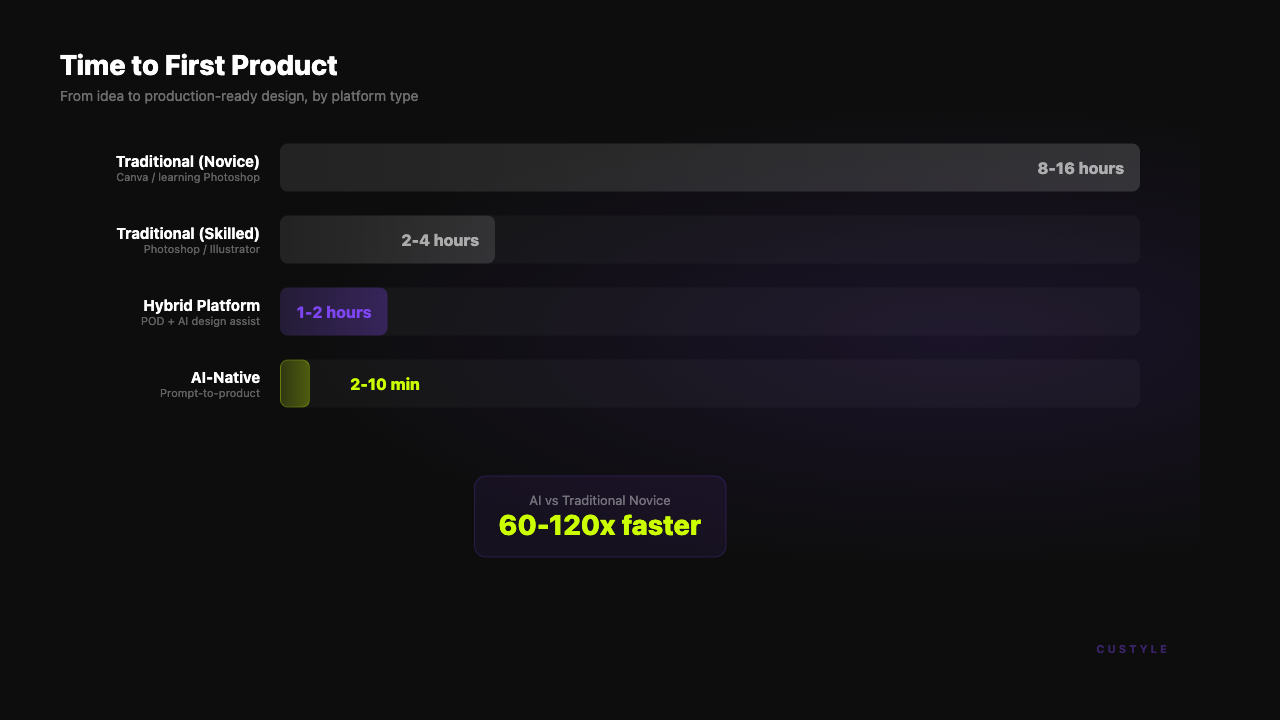 A novice creator spends 8-16 hours on traditional POD. AI-native platforms compress that to minutes.
Design Control: Pixels vs Prompts
Traditional POD gives you total control. Every pixel, every color value, every placement on the product. If you know Illustrator, you can execute any vision with precision.
AI merch trades some control for accessibility. You guide the output with prompts. The results can be impressive — but you're collaborating with the AI, not dictating to it.
Traditional POD control:
- Upload exact files (PNG, SVG, AI)
- Pixel-perfect placement
- Unlimited revisions before upload
- Full color management
- Complex multi-layer designs
AI merch control:
- Natural language descriptions
- Reference image uploads
- Style and mood guidance
- Iterative prompt refinement
- Growing but still limited precision
For brand owners with established visual systems, traditional POD is often the right call. Your brand guidelines exist as specific hex codes, typefaces, and spacing rules. AI can approximate these, but approximation isn't always enough.
For everyone else — the creator with a great idea but no design training — AI merch removes the biggest barrier to entry.
Winner: Traditional POD — if you have design skills. AI Merch — if you don't.
Platform Breakdown
Here's how the major players stack up in 2026. This is the landscape you're choosing from when weighing AI merch vs print on demand.
Traditional POD Leaders
Printful — The Vertical Giant
- 12 owned manufacturing facilities
- 483+ products in catalog
- 94-97% first-pass yield rate
- 8M+ registered users
- Strength: quality control through owned production
Printify — The Marketplace
- 80+ print providers worldwide
- 900+ SKUs (largest catalog)
- 5M+ users
- Strength: product variety and price competition between providers
Gelato — The Global Player
- 140+ production partners across 32 countries
- 72-hour global delivery promise
- 2M+ users
- 40-60% lower carbon emissions through local production
- Strength: speed and sustainability through local fulfillment
Redbubble — The Artist Marketplace
- 70+ product types
- 10M+ cumulative users
- Strength: built-in audience discovery for independent artists
Spring — The Creator Platform
- 50+ product types
- 5M+ users
- Strength: creator integrations (YouTube, Twitch, LinkTree)
AI-Native Players
Custyle.ai — The AI Merch Agent
- 400K+ users
- "1 minute from idea to product"
- 60-120x speed improvement
- Uses Printful/Gelato for fulfillment
- Strength: fully AI-native, prompt-to-product in one conversation
Vistaprint AI Logomaker — The Hybrid
- Traditional print giant adding AI design tools
- Launched March 2026
- Strength: trusted brand with massive existing infrastructure
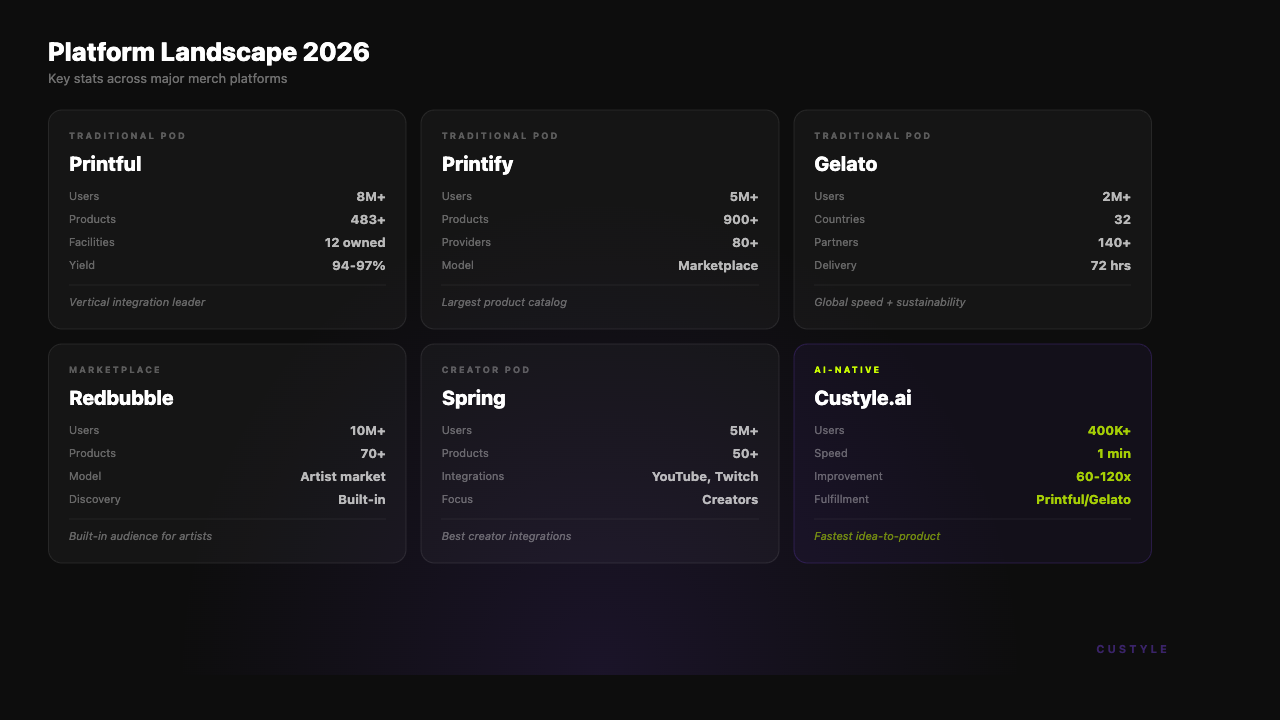 Each platform serves a different creator profile. No single platform wins across every dimension.
Cost and Margins
Pricing structures differ between traditional POD and AI merch, but the gap is narrower than you might expect.
Traditional POD costs:
- Base product cost: $8-25 depending on item and provider
- Design cost: $0 (DIY) to $50-500 (freelancer)
- Platform fees: most are free to use (they margin on production)
- Typical creator margin: 20-40% of retail price
AI merch costs:
- Base product cost: similar to POD (same fulfillment providers)
- Design cost: $0 (AI-generated, included in platform)
- Platform/AI fees: vary by platform ($0-20/month subscriptions)
- Typical creator margin: 15-35% of retail price
The real cost difference is in design. A creator who pays $200 for a freelance design needs to sell roughly 20 shirts to break even. With AI merch, that design cost drops to near zero.
But margins per unit can be slightly lower on AI platforms that add their own fee layer on top of POD base costs. Check the math for your specific product and volume.
Winner: Tie — depends on your design budget and volume.
Quality and Fulfillment
Here's the part most AI merch vs print on demand comparisons miss: the physical product quality is often identical.
Why? Because AI merch platforms don't own printing infrastructure. They route orders to the same fulfillment networks — Printful, Gelato, and others — that traditional POD sellers use.
A t-shirt ordered through an AI merch platform and a t-shirt ordered through Printful directly go through the same printer, the same quality checks, the same shipping network.
The quality variable is actually in the design, not the print. A well-composed design (whether AI-generated or human-made) printed on the same blank produces the same result.
"When AI merch platforms use Printful's 94-97% first-pass yield infrastructure, the physical output quality is indistinguishable from traditional POD orders."
Where traditional POD has an edge: experienced designers know how to optimize files for print. They understand bleed areas, DPI requirements, and color gamut limitations. AI-generated designs are improving here, but the gap exists.
Winner: Tie on fulfillment. Slight edge to Traditional POD on print-optimized design.
Market Reality in 2026
The numbers tell a story of convergence, not competition. Both sides of the AI merch vs print on demand landscape are growing.
Traditional POD:
- $12.96-15.19B global market in 2026
- 23-26% CAGR
- Projected $46-103B by 2031-2034
- US market: $2.53B in 2024, projected $27B by 2034
AI-native merch:
- ~$2.1B in 2026
- 67% CAGR (nearly 3x the growth rate of traditional POD)
- $890M invested 2024-2026
The AI segment is smaller but growing far faster. More importantly, traditional POD platforms are adding AI features. Vistaprint launched its AI Logomaker in March 2026. Printify and Printful have both introduced AI design assistants.
"The AI-native merch segment is growing at 67% CAGR — nearly three times faster than traditional print on demand's 23-26% — signaling a major shift in how creators approach merchandise."
The line between "traditional POD" and "AI merch" is blurring. In two years, every major POD platform will likely have AI design tools built in. The question isn't which category wins. It's which approach fits your workflow today.
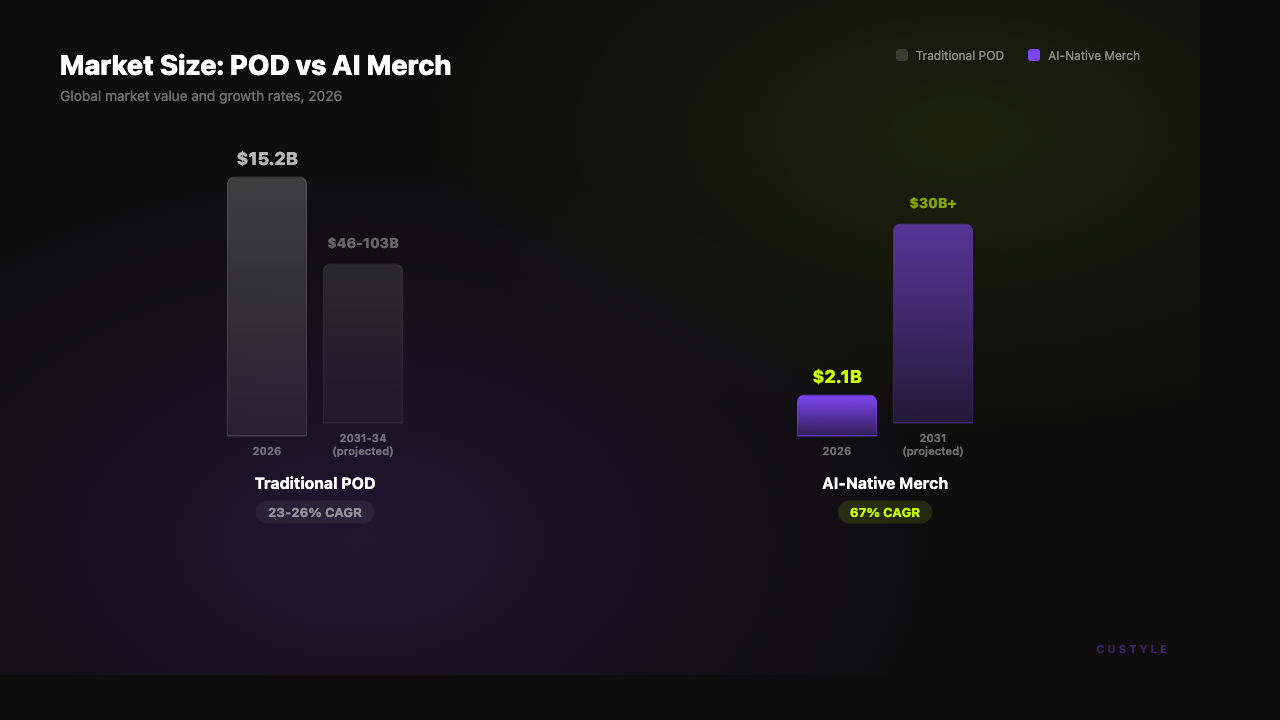 Traditional POD still dominates in absolute size, but AI-native merch is growing 3x faster.
Sustainability angle: the entire POD model — traditional and AI — is inherently more sustainable than bulk manufacturing. Zero inventory means zero overproduction. Traditional retail generates 13 million tons of textile waste annually. POD eliminates this. Gelato's local production model cuts carbon emissions by 40-60% compared to centralized shipping.
When to Choose Traditional POD
Pick traditional print on demand when:
- You have design skills. If you're comfortable in Photoshop or Illustrator, you'll get better results controlling every detail yourself.
- Brand consistency matters. Established visual identities with specific color palettes, typography, and layout rules need pixel-level control.
- You need a massive catalog. Printify offers 900+ SKUs. If you need phone cases, wall art, pet accessories, and custom shoes, traditional POD has the widest range.
- You want direct provider relationships. Printful's 12 owned facilities give you production quality you can audit.
- You sell high-volume. At scale, direct POD relationships offer better margins and more negotiating power.
- You're building a marketplace presence. Redbubble's 10M+ users can discover your work without you driving traffic.
Traditional POD is mature, reliable, and deeply integrated with Shopify, Etsy, WooCommerce, and Amazon. The infrastructure works.
When to Choose AI Merch
Pick AI merch platforms when:
- Speed is your edge. Trending moments, drop culture, and viral content reward whoever ships first. Minutes beat hours.
- You have ideas but no design skills. Describe your vibe. Get a finished product. No Photoshop. No freelancer invoices.
- You're testing ideas fast. Launch 10 designs in an afternoon. See what resonates. Kill what doesn't. Traditional POD makes this a week-long project.
- You want the lowest barrier to entry. One sentence can become a sellable product. That's a different starting point than opening a blank Illustrator canvas.
- You're a content creator first. Your value is your audience and your taste, not your technical design ability.
AI merch is where the energy is. The 67% CAGR signals that creators are voting with their wallets. Platforms like Custyle.ai represent the furthest end of this spectrum — a fully AI-native approach where the entire journey from intent to finished product happens in one conversation, with production routed to trusted partners like Printful and Gelato.
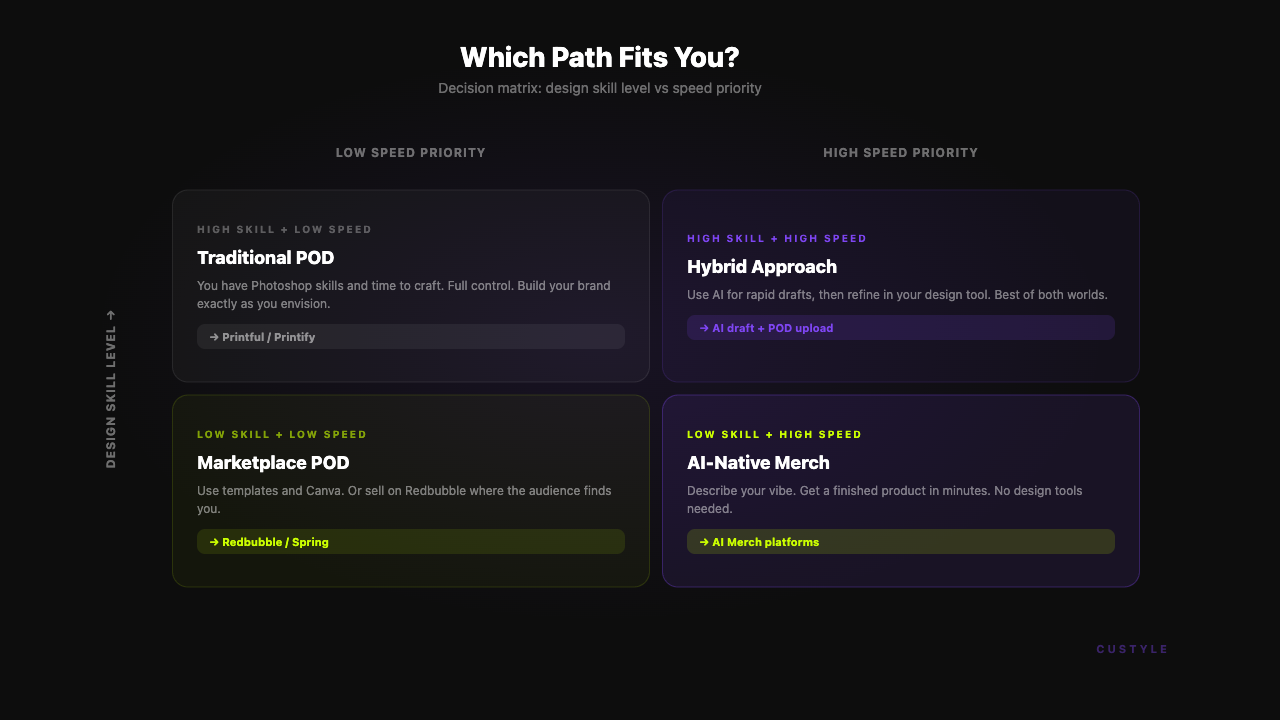 Your ideal platform depends on two axes: design skill and speed priority.
FAQ
Is AI merch better than print on demand?
Not universally. AI merch is faster and more accessible if you lack design skills. Traditional POD gives better creative control and wider product selection. AI merch platforms actually use POD infrastructure for production — they add an AI design layer on top. Choose based on your skills and speed needs, not hype.
Can you use AI designs on Printful or Printify?
Yes. Generate designs with any AI tool — Midjourney, DALL-E, or platform-specific generators — then upload to Printful, Printify, or Gelato as you would any design file. Check each platform's terms regarding AI-generated content, as policies are still evolving in 2026.
What is the best merch platform in 2026?
It depends on your profile. Printful leads in quality control with 94-97% first-pass yield. Printify has the largest catalog at 900+ SKUs. Gelato wins on global delivery speed and sustainability. Custyle.ai is the fastest for idea-to-product. Spring works best for YouTube and Twitch creators with built-in integrations.
How much does it cost to start selling merch with AI?
Most AI merch platforms are free to start. You pay per product ordered, not upfront. Base product costs mirror traditional POD ($8-25 per item). The savings come from eliminating design costs — no freelancer fees, no software subscriptions. Your real investment is time learning to write effective prompts.
Will AI replace print on demand?
No. AI merch needs POD for fulfillment. The relationship is additive, not competitive. AI handles the creative bottleneck (design). POD handles the physical bottleneck (production and shipping). The two are converging — expect every major POD platform to include AI design tools by 2028.
Our Verdict
The AI merch vs print on demand debate has a simple answer: they serve different creators at different stages.
Choose traditional POD if you're a designer, brand builder, or high-volume seller who needs full creative control and the widest product range. Printful, Printify, and Gelato are battle-tested.
Choose AI merch if you're an idea-first creator who values speed over pixel-level precision. The 2-10 minute time-to-product window changes what's possible — especially for trend-driven drops and content creators who see merch as an extension of their voice, not a design project.
The smartest play? Learn both. Use AI merch for rapid testing and trend responses. Use traditional POD for your core product line where brand consistency matters.
The $15B POD market and the $2.1B AI merch market are growing toward each other. By 2028, the distinction may not exist. The platforms that combine AI creativity with proven POD fulfillment — giving you speed without sacrificing quality — will define the next era of creator merch.
"Traditional POD offers $15B worth of proven infrastructure. AI merch adds a $2.1B design intelligence layer on top. The creator who uses both has the strongest toolkit in 2026."
Ready to make something?
Turn your ideas into real merch with AI. No design skills needed.
Start with a vibeCustyle Picks
Reviews & Comparisons · Mar 24, 2026·13 min read
Further Reading
Explore all →
AI Shopping Agent vs AI Merch Agent: Two Futures of Commerce
An AI shopping agent buys on your behalf — it searches, compares, and checks out. An AI merch agent creates on your behalf — it turns your idea into a real product. Here's how the two futures compare.
Read more →
Redbubble Alternative: AI Merch Agents for Creators Who Want Margin
Redbubble's Standard tier takes 50% of your monthly earnings. Compare real payouts across marketplaces, fulfillment platforms, and AI merch agents — and see which model keeps margin in your pocket.
Read more →
AI Merch Agent vs Midjourney for Merch: Why Image Gen Isn't Enough
Midjourney is the best paintbrush in the game — but nobody wears a paintbrush. Where image generation stops and AI merch agents take over: print prep, product matching, and fulfillment.
Read more →
Printful Alternative: Why AI Merch Agents Are the 2026 Upgrade
Most Printful alternatives save you $4 a shirt. None save you the 15-25 hours a week. The three tiers of alternative in 2026 — and how to pick the one that fits.
Read more →