AI Shopping Agent vs AI Merch Agent: Two Futures of Commerce

Custyle Picks
Reviews & Comparisons · Sep 1, 2026·11 min read

AI Shopping Agent vs AI Merch Agent: Two Futures of Commerce
TL;DR: An AI shopping agent buys on your behalf — it searches, compares, and checks out. An AI merch agent creates on your behalf — it turns your idea into a real product. Buying agents compress the transaction. Merch agents expand the catalog. Amazon now runs both in one app, and that convergence is the real story.
In this guide:
- The Short Answer
- What Is an AI Shopping Agent?
- What Is an AI Merch Agent?
- AI Shopping Agent vs AI Merch Agent: Nine Dimensions
- The Trust Gap Nobody Prices In
- Where the Two Futures Converge
- What This Means for Creators
- FAQ
The Short Answer
The comparison of ai shopping agent vs ai merch agent comes down to one question: which way does the money flow? An AI shopping agent serves the buyer. It hunts, compares, negotiates, and spends your money — ideally on the right product at the best price. An AI merch agent serves the maker. It takes your vibe, designs a product around it, and routes it to manufacturing. One sharpens a purchase. The other creates something that didn't exist an hour ago.
Both are "agentic commerce." But they sit at opposite ends of the value chain, run on different economics, and face different risks. Here's the full picture, with data.
What Is an AI Shopping Agent?
An AI shopping agent is software that discovers, compares, and increasingly completes purchases for a consumer. In 2025, nearly every major retailer and AI company entered the race (Modern Retail, 2026).
The landscape settled into three maturity tiers (Davies Meyer, 2026):
- Recommender agents — route you to merchants. Perplexity Shopping, Google AI Mode.
- Browser agents — click through checkout for you. OpenAI Operator, Claude computer use.
- Protocol-native agents — transact directly with merchant backends over standards like ACP and AP2.
The infrastructure race moved fast. OpenAI and Stripe launched the Agentic Commerce Protocol in September 2025. Google answered with the Agent Payments Protocol (AP2). Visa shipped Trusted Agent Protocol that October; Mastercard's Agent Pay came earlier, in April 2025 (Applied Technology Index, 2026). Shopify connected roughly 5.6 million US stores to agent traffic by March 2026 (commercetools, 2026).
The demand signal is loud. Adobe Analytics measured AI-referred traffic to US retail sites up 693% year over year during holiday 2025 — converting 31% better than other channels (Digital Commerce 360, 2026). McKinsey projects agentic commerce could redirect $3–5 trillion in global retail spend by 2030 (Stellagent, 2026).
But checkout is lagging discovery, badly. OpenAI effectively shelved Instant Checkout by March 2026 after only about 30 merchants went live. A Walmart executive reported ChatGPT purchase conversion at one-third of Walmart.com's rate (Modern Retail, 2026). Amazon, meanwhile, relaunched Rufus as Alexa for Shopping — 250M+ users, monthly actives up 149% year over year — while blocking OpenAI's crawlers and suing Perplexity over unauthorized agent purchases (Stellagent, 2026; Modern Retail, 2026).
Quotable: AI shopping agents are winning discovery and losing checkout — Adobe's referral traffic grew 693% while OpenAI's Instant Checkout signed only ~30 merchants in six months.
What Is an AI Merch Agent?
An AI merch agent is software that creates products for you. Describe an idea — a mood, a meme, your pet — and the agent designs it, shapes it for real production, and routes it to manufacturing. You get a physical thing: a hoodie, a tumbler, a print. Creation, not procurement.
→ Related: What is an AI merch agent? The full definition
The category is young, but the market underneath it is not:
- Print-on-demand sits at $13–15 billion in 2026, growing 22–26% a year (Grand View Research; Mordor Intelligence). Mordor projects $46.4 billion by 2031.
- 40–65% of print-on-demand sellers already use AI tools in 2026. AI-assisted sellers report shipping 100+ refined listings per day (Merch Titans, 2026).
- The creator economy grew from $255.7 billion in 2025 to a projected $323.5 billion in 2026 (Research and Markets, 2026). Creators with three or more revenue streams earned $75,000 more on average than single-stream creators in 2025 (ShortsIntel, 2026) — and merch is a core stream.
Then came the category's biggest validation. On June 8, 2026, Amazon launched AI merch design inside Alexa for Shopping. Prompt a design, edit it, order it through Merch on Demand — apparel, tumblers, water bottles (TechCrunch, 2026). PYMNTS framed it as Amazon deploying Alexa to disrupt print-on-demand.
Custyle.ai, the AI Merch Agent platform, defined the category's shape before the giants arrived: a crew of nine AI specialists that takes you from vibe to wearable — direction, design, try-on, production, delivery — in one chat. Not one AI doing everything badly. A whole crew, each handling one part of making it real.
Quotable: No analyst firm has sized the "AI merch agent" category yet — but its foundations are a $13–15B print-on-demand market growing ~24% annually and a creator economy heading past $323B in 2026.
AI Shopping Agent vs AI Merch Agent: Nine Dimensions
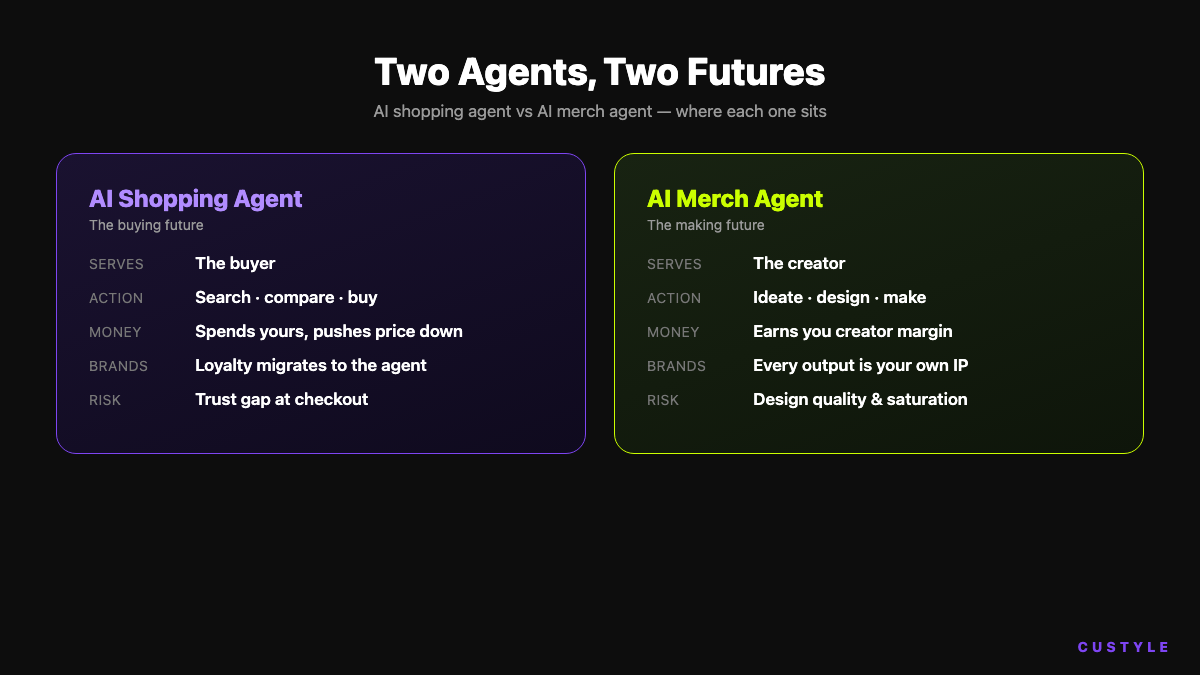 Two agents, two futures: the buying agent serves the buyer; the merch agent serves the creator.
| Dimension | AI Shopping Agent | AI Merch Agent |
|---|---|---|
| Who it serves | The buyer | The creator — or a buyer acting as a one-off creator |
| Core action | Search, compare, buy | Ideate, design, make |
| Value chain position | Checkout layer, between shopper and merchant | Creation layer, between idea and manufacturer |
| Direction of money | Spends your money; pushes price down | Earns you money, or turns intent into a new product |
| Revenue model | Take-rates, payment rails, affiliate fees | Product margin, print-on-demand markup, credits |
| Key players | ChatGPT shopping, Alexa for Shopping, Google "Buy for me", Perplexity | Custyle, Amazon Merch on Demand + Alexa, Printful/Printify AI tools |
| Brand relationship | Commoditizes brands — loyalty migrates to the agent | Extends your brand — every output is differentiated IP |
| Maturity | Heavy infrastructure, weak delegation trust | Younger as a category, but AI use is already mainstream among sellers |
| Core risk | Trust collapse, platform fights, conversion gap | Design quality, IP disputes, listing saturation |
The sharpest contrast is the brand row. Kearney describes shopping agents as a shift "from brand loyalty to bot logic" — agents rank on price, ratings, and delivery speed, not affinity (Kearney, 2026). BCG estimates unprepared retailers face up to 500 basis points of EBIT erosion from margin compression and traffic dispersion (BCG, 2025). A merch agent runs the opposite direction: everything it makes is yours. Your taste, your IP, your margin.
→ Related: Agentic creation vs agentic buying — the strategic deep dive
The Trust Gap Nobody Prices In
Here's where the shopping-agent story gets complicated. The trust data splits depending on what you ask.
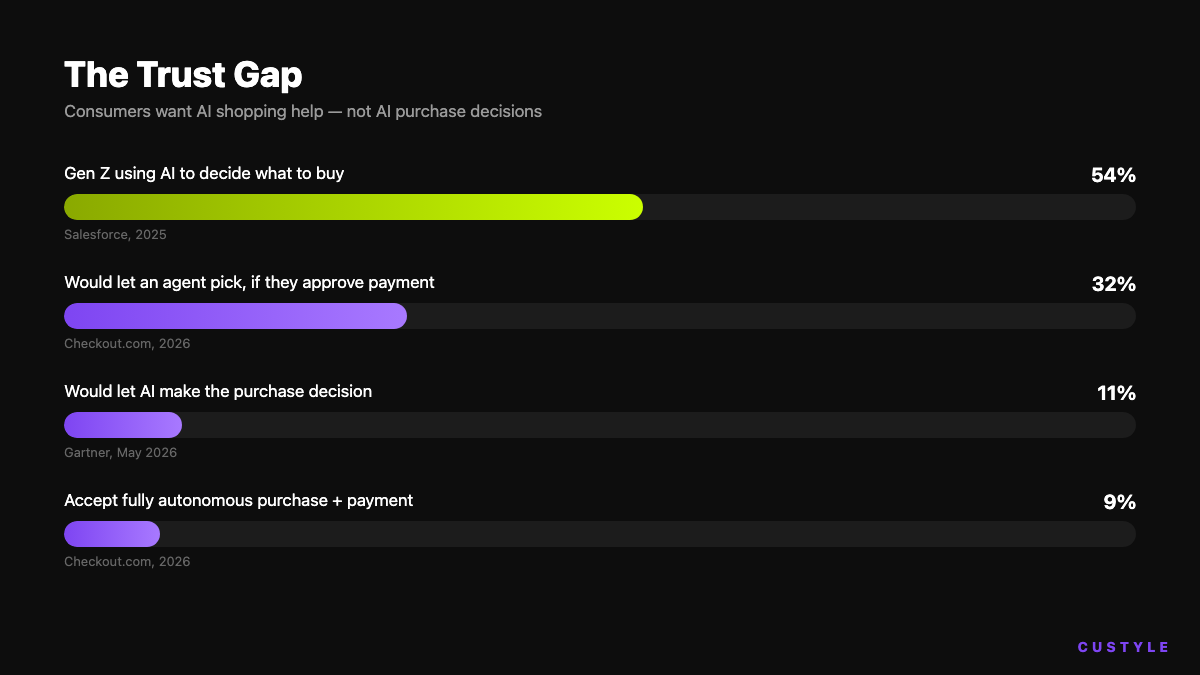 Help is welcome. Delegation is not — willingness collapses as autonomy rises.
- Accenture (25,590 consumers, 16 countries): 74% would trust a personal AI agent more than their best friend for a purchase (AI News, 2026).
- Gartner (322 US consumers, May 2026): willingness to let AI make the actual purchase decision topped out at 11% — even for low-stakes categories like personal care.
- Checkout.com (2026): 32% would let an agent pick a product if they authorize payment. Only 9% accept fully autonomous purchase plus payment. 24% say they'll never delegate at all.
- Bain (2026): shoppers trust retailers' own on-site agents three times more than third-party agents like ChatGPT or Perplexity (Modern Retail, 2026).
These numbers don't contradict each other so much as measure different things. Attitude toward a hypothetical trusted agent is one question. Handing over your card is another. Assistance is mainstream — Salesforce found 54% of Gen Z already uses AI to decide what to buy (Yotpo, 2026). Delegation is not.
Merch agents largely sidestep this problem. Nobody needs to trust an agent with an autonomous purchase to co-create a design. You see it before it's real. You approve it. Then it gets made. The trust threshold for creation is a preview; the trust threshold for delegated buying is your wallet.
Quotable: Consumer willingness to let an AI agent make the purchase decision tops out at 11% (Gartner, 2026) — but 54% of Gen Z already uses AI to help decide what to buy (Salesforce, 2025).
Where the Two Futures Converge
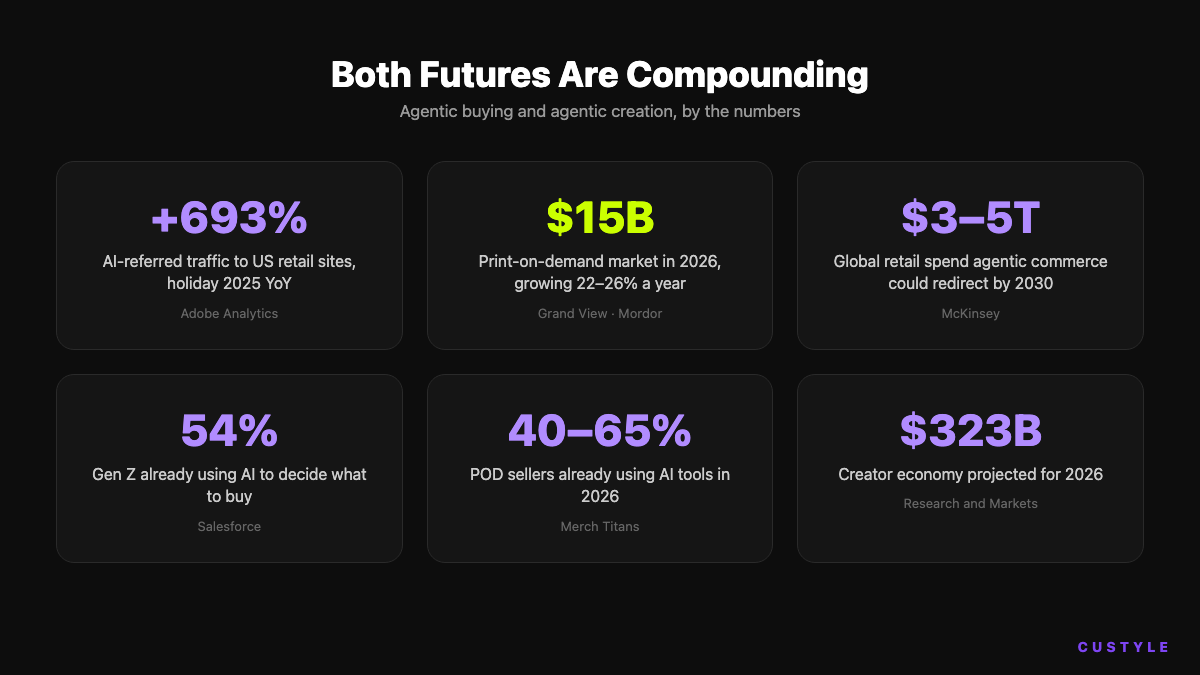 Both futures are compounding at once — buying on the traffic side, making on the seller side.
Watch what Amazon did in 2026. In May it relaunched its shopping agent as Alexa for Shopping. In June it added merch creation to the same app. The largest AI shopping agent on earth now also designs the product, then sells it to you — buying agent and making agent in one conversational surface.
That's the endgame in miniature. Shopping agents compress the transaction until buying is nearly invisible. Merch agents make creation so easy that the catalog itself becomes infinite. When both live in one chat, the line between "find me the right product" and "make me the right product" disappears. Sometimes the right product doesn't exist yet — so the agent builds it.
Retailers are already adapting to the buying side. The playbook is shifting from SEO to answer-engine readiness: structured product data, accurate attributes, live pricing that agents can read over protocols like MCP and ACP without loading a page (Bloomreach, 2026; agentShelf, 2026). The creation side needs no such retrofit. It was born agent-native.
What This Means for Creators
If you make things — content, community, culture — the two futures land very differently.
Shopping agents are neutral-to-hostile territory for brands. They rank on bot logic, and your margin funds the discount. Merch agents are home turf. They turn taste into product without design skills, minimums, or generic output. The creator economy's own numbers explain the pull: multiple revenue streams pay, and merch is the stream an AI agent can now build for you in minutes.
The naming vacuum is real, too. "AI shopping agent" has analyst coverage, protocols, and lawsuits. "AI merch agent" has none of that yet — no Gartner category, no market-size report. The closest proxies are print-on-demand's ~24% growth and mainstream AI adoption among sellers. Categories usually get named right before they get big.
FAQ
What is the difference between an AI shopping agent and an AI merch agent?
An AI shopping agent buys for a consumer: it searches, compares prices, and can complete checkout. An AI merch agent creates for a maker: it designs a product from your idea and routes it to manufacturing. Shopping agents spend money on existing products; merch agents make new products exist.
Are AI shopping agents safe to let buy things?
Adoption data says use them for research, not delegation. Gartner found only 11% of consumers would let AI make the purchase decision, and just 9% accept fully autonomous payment (Checkout.com, 2026). Protocols like ACP and AP2 add scoped payment tokens, but trust in full autonomy remains low.
How big is the market behind AI merch agents?
No analyst firm sizes "AI merch agents" directly yet. The underlying print-on-demand market is $13–15 billion in 2026, growing 22–26% annually (Grand View Research; Mordor Intelligence), and the creator economy is projected at $323.5 billion in 2026 (Research and Markets).
Can one agent do both shopping and merch creation?
Yes — Amazon proved it in June 2026 by adding AI merch design to Alexa for Shopping, its shopping agent with 250M+ users. Expect more platforms to merge buying and making into one conversational surface, where an agent either finds the right product or creates it.
The Bottom Line
The ai shopping agent vs ai merch agent question isn't really either/or. Buying agents will keep compressing transactions, dragged by a real trust gap. Making agents will keep expanding what exists, pulled by creator economics. The winners will speak both languages.
Want to feel the creation side yourself? Custyle turns any vibe into something real — described in a chat, made for merch, shipped to your door. One chat away from your next favorite thing.
Ready to make something?
Turn your ideas into real merch with AI. No design skills needed.
Start with a vibeCustyle Picks
Reviews & Comparisons · Sep 1, 2026·11 min read
Further Reading
Explore all →
Redbubble Alternative: AI Merch Agents for Creators Who Want Margin
Redbubble's Standard tier takes 50% of your monthly earnings. Compare real payouts across marketplaces, fulfillment platforms, and AI merch agents — and see which model keeps margin in your pocket.
Read more →
AI Merch Agent vs Midjourney for Merch: Why Image Gen Isn't Enough
Midjourney is the best paintbrush in the game — but nobody wears a paintbrush. Where image generation stops and AI merch agents take over: print prep, product matching, and fulfillment.
Read more →
Printful Alternative: Why AI Merch Agents Are the 2026 Upgrade
Most Printful alternatives save you $4 a shirt. None save you the 15-25 hours a week. The three tiers of alternative in 2026 — and how to pick the one that fits.
Read more →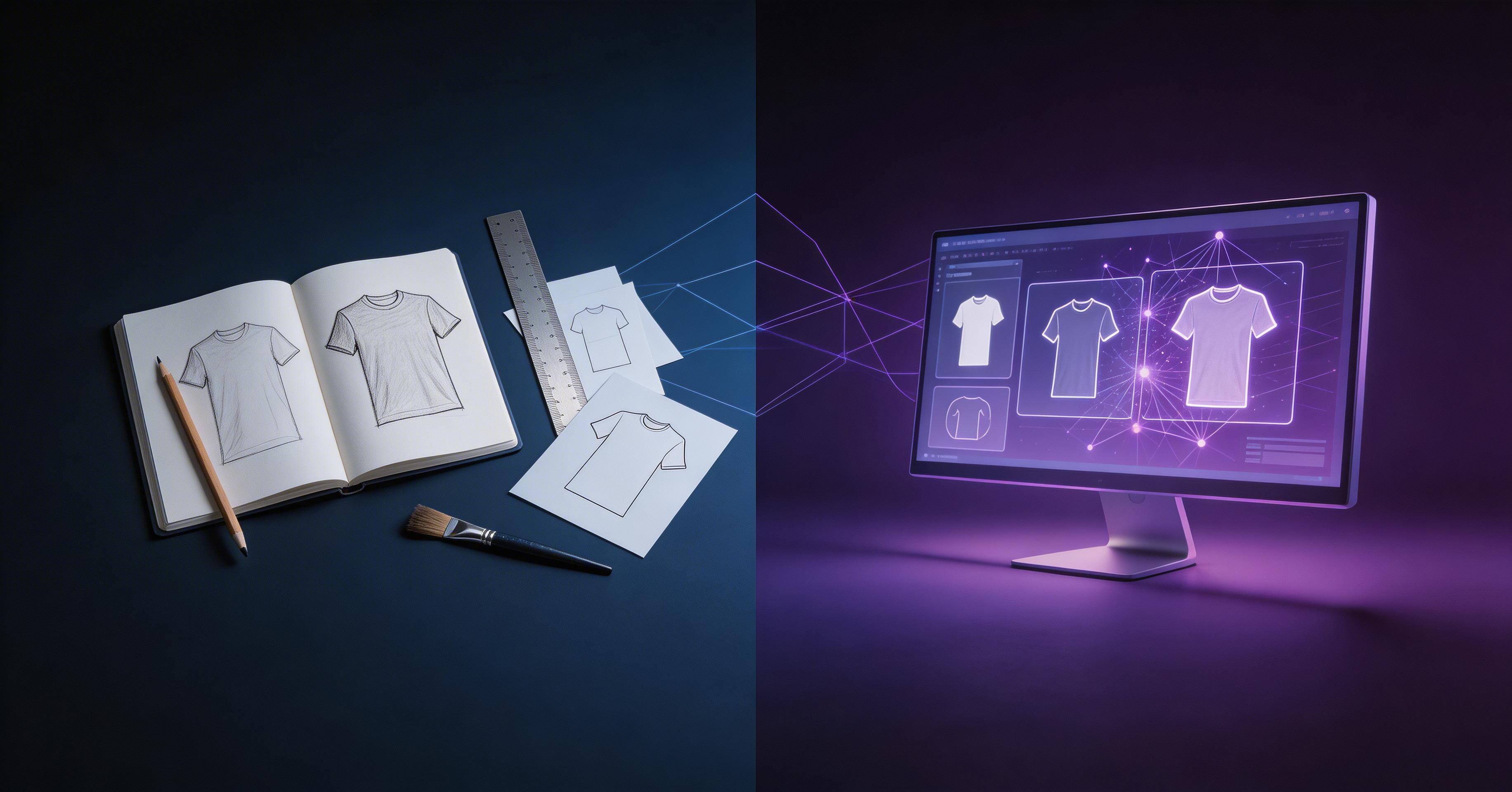
Print on Demand vs AI Custom Merch: What's the Difference in 2026?
POD gives you design control. AI merch gives you speed. Compare Printful, Printify, and AI Merch Agents across cost, quality, and workflow in 2026.
Read more →