Redbubble Alternative: AI Merch Agents for Creators Who Want Margin

Custyle Picks
Reviews & Comparisons · Aug 27, 2026·9 min read
Redbubble Alternative: AI Merch Agents for Creators Who Want Margin
TL;DR: Since September 1, 2025, Redbubble's Standard tier takes 50% of your monthly earnings as a platform fee. A $25 tee can net you around $3. Marketplace alternatives like TeePublic or Society6 pay a bit better but cap out near 10–30%. Fulfillment platforms like Printify pay 50–60% margins — if you do all the work. AI merch agents are the third option: fulfillment-level margin, with an agent running the pipeline for you.
Table of Contents
- Why creators want out
- What Redbubble actually pays now
- Path 1: Marketplace alternatives
- Path 2: Fulfillment platforms
- Path 3: AI merch agents
- The margin math, side by side
- Which path fits you
- FAQ
Why creators want out
Searching for a Redbubble alternative with AI in mind? You're asking the right question. The old answer — "just move to another marketplace" — stopped working. The new marketplaces pay almost as little as the old one.
Here's what changed. On September 1, 2025, Redbubble split artists into three account tiers. According to Redbubble's own help center, Standard tier artists now lose 50% of their monthly earnings to a platform fee. Premium tier artists lose 20%. Only Pro tier artists — a gated group — keep 100%.
Stack that fee on top of Redbubble's default artist margin of roughly 10–20% per product, and the math gets grim. Independent seller breakdowns put the net on a $25 t-shirt at as little as $3 for Standard tier artists. Sellers across community reviews report earning 50–70% less than they did in 2020–2022.
One more sting: artists watched the marketplace fill with AI-generated designs while their own payouts shrank. The platform embraced AI content. It didn't share the upside with creators.
So the real question isn't "which site replaces Redbubble?" It's "which model replaces it?" You have three: another marketplace, a fulfillment platform behind your own store, or an AI merch agent. Each pays differently. Let's run the numbers.
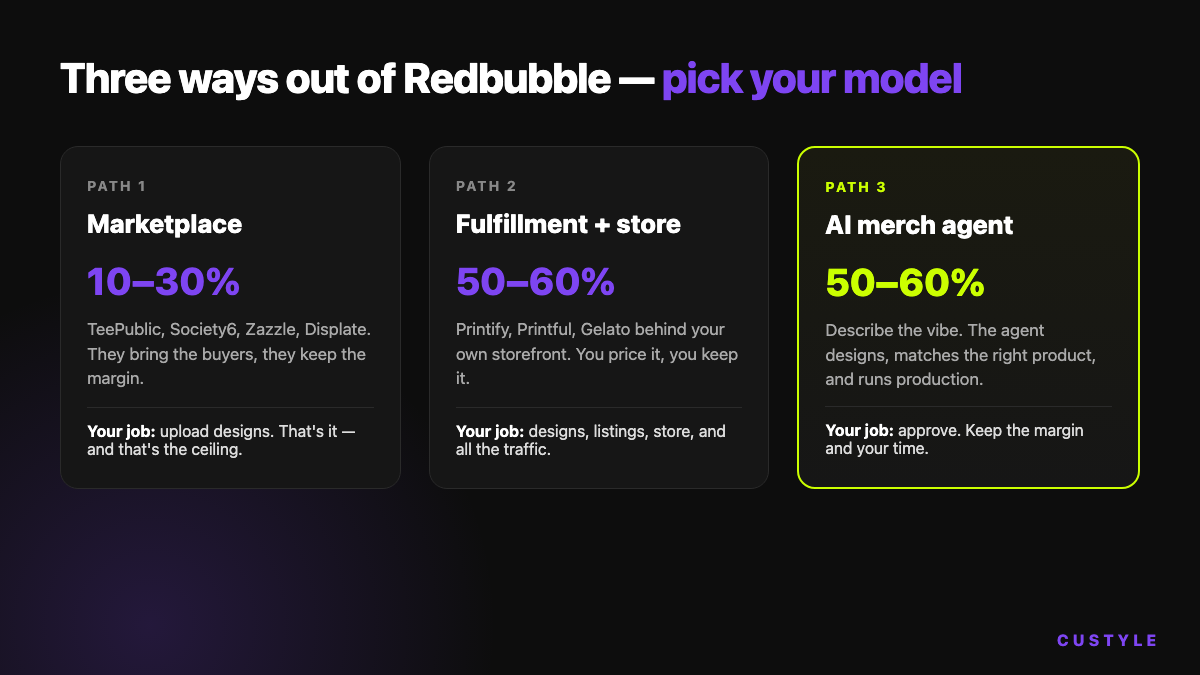 The three models compared: what each pays and what each asks of you.
What Redbubble actually pays now
Quick baseline before comparing alternatives. On a typical $25–$30 tee:
| Redbubble tier | Platform fee | Net on a ~$25 tee |
|---|---|---|
| Standard | 50% of monthly earnings | ~$1.50–$3 |
| Premium | 20% of monthly earnings | ~$2.40–$4.80 |
| Pro | 0% | ~$3–$6 |
Fees for Standard and Premium accounts are capped at $150 per payment period. And from July 1, 2026, Redbubble lowers its payout threshold from $20 to $10 — a small concession that doesn't change the core math.
The takeaway is one sentence: on Redbubble's Standard tier in 2026, the platform's cut of your royalty is larger than your royalty.
Path 1: Marketplace alternatives
Marketplaces bring the traffic. You bring the designs. In exchange, they keep most of the money. Here's how the big ones pay in 2026:
| Marketplace | Typical artist payout | Worth knowing |
|---|---|---|
| TeePublic | Flat $2–$4 per tee (~11–20%) | Owned by Redbubble's parent, Articore. Same roof, different room. |
| Society6 | 10% standard | Custom markup only on wall art |
| Zazzle | 15–25%, you set the rate | Higher rates hurt conversion |
| Displate | 25–30% on $40–$100 orders | Metal posters only — great niche, narrow niche |
| Fine Art America | You set the markup | Wall art focused |
Displate pays best — if metal posters fit your work. For apparel, TeePublic's flat $2–$4 is the honest ceiling. That's real money at volume, but it's Redbubble Premium-tier money, from the same parent company.
→ Related: AI Merch vs Print on Demand: Which Wins in 2026?
The structural problem: no marketplace fixes your margin, because the marketplace is the margin. You're paying 70–90% of every sale for their traffic. When their algorithm shifts or their fees change — and both did — your income moves with it. You're renting an audience, and rent went up.
Path 2: Fulfillment platforms
Flip the model. Printify, Printful, and Gelato don't bring you customers. They print and ship what you sell through your own store. You set retail prices, so you keep everything above base cost.
The 2026 base costs on a standard tee:
- Printify: $10.36 — lowest of the three
- Gelato: $9.80–$11.50 depending on region, with local production in 30+ countries
- Printful: $11.69 — best-in-class quality and branding, at a price
According to Ink & Pxl's 2026 profit guide, that $1.33 gap between Printify and Printful equals $133 less profit per month at 100 orders — nearly $1,600 a year.
Sell a $27.99 tee through your own store with Printify and you gross roughly $14–$16 per shirt. That's a 50–60% margin. Five times what any marketplace pays.
The catch is the workload. You now run design, product selection, mockups, listings, pricing, storefront, and — the hard part — traffic. The standard playbook for making this work is brutal: top AI-assisted sellers maintain 2,000+ active listings and produce 50–100 designs a day to feed the catalog. Fulfillment platforms hand you margin and hand you a second job in the same motion.
Path 3: AI merch agents
Here's the newest option, and the reason you searched "AI" alongside "Redbubble alternative."
First, a distinction that matters. AI design tools — Midjourney, Leonardo.ai, Kittl, Pixelcut — speed up one step: making the artwork. Everything after that is still on you. A faster first step on the same treadmill.
An AI merch agent runs the pipeline. You describe the vibe. The agent generates designs made for merch — not just for screens — matches them to the right product, builds the mockups and the listing, and routes production and delivery. You approve instead of operate. That 50-designs-a-day grind that fulfillment sellers use to win? An agent does it as a background process while you keep taste and final say.
→ Related: What Is an AI Merch Agent?
This isn't a fringe idea. The AI-native merch segment is growing at roughly 67% annually — close to three times the 23–26% pace of traditional print on demand. The wider shift is bigger: agentic commerce is projected to reach $1 trillion in US consumer retail revenue by 2030, and analysts at Fact.MR size the agentic AI market in retail at $11.2 billion in 2026, headed to $67.5 billion by 2036. Traditional platforms see it too — Printify and Printful both added AI design assistants, and Vistaprint shipped an AI logo maker in March 2026. Adding AI features to an old model, though, isn't the same as a new model.
Custyle is built as this third path: an AI Merch Agent, not another marketplace. A crew of AI specialists handles design, product matching, and production the right way, and you keep fulfillment-level margin without the fulfillment-level job. Your idea stays yours. The margin does too.
The margin math, side by side
One $25–$30 tee, every model, 2026 numbers:
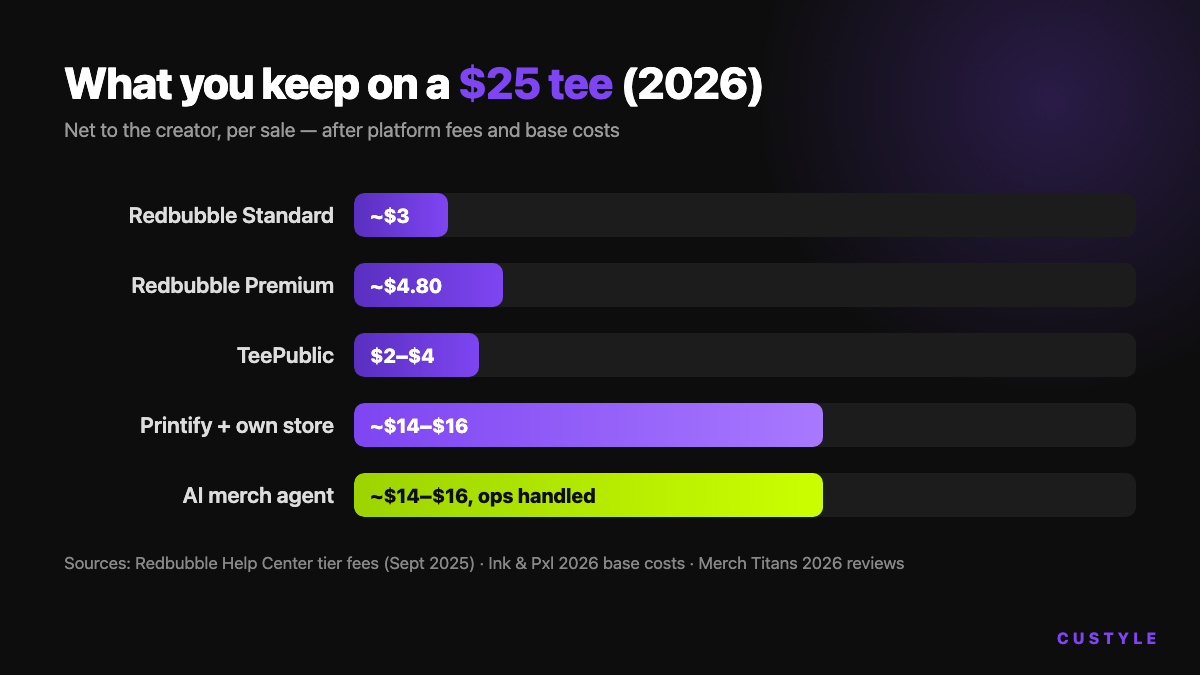 Net per sale on a $25 tee. Sources: Redbubble Help Center, Ink & Pxl, Merch Titans.
| Model | Example | You keep per tee | You also do |
|---|---|---|---|
| Marketplace (old) | Redbubble Standard | ~$1.50–$3 | Nothing — and it shows |
| Marketplace (better) | TeePublic | $2–$4 flat | Nothing |
| Marketplace (niche) | Displate | ~$10–$30 (posters) | Nothing |
| Fulfillment + own store | Printify | ~$14–$16 (50–60%) | Everything: listings, store, traffic |
| AI merch agent | Custyle | Fulfillment-level margin | Approve, share, sell |
Quotable version: marketplaces pay 10–30% and bring the audience; fulfillment platforms pay 50–60% and bring nothing; AI merch agents aim at fulfillment margins with the operations handled.
Which path fits you
Skip the "20 best alternatives" listicle format. Three honest recommendations:
Stay on marketplaces if you have zero interest in owning a store and treat merch as passive pocket money. Move to TeePublic or Displate, take the flat payout, accept the ceiling.
Go fulfillment if you already have an audience and time to run a shop. Printify for margin, Printful for polished branding, Gelato if your buyers are global. Your traffic is the whole business — make sure you actually have some.
Go AI merch agent if you want the margin without the second job. You bring taste and intent; the agent makes it real. This is the path built for creators who left Redbubble over money and don't want to inherit a fulfillment company's workload as the price of fixing it.
→ Related: Best AI Merch Tools 2026
FAQ
What is the best Redbubble alternative in 2026?
It depends on the model, not the site. For hands-off marketplace selling, TeePublic and Displate pay best. For maximum margin with your own store, Printify leads on base costs. For margin without running operations yourself, an AI merch agent like Custyle is the newest path — the agent handles design-to-delivery while you approve.
How much does Redbubble take from artists in 2026?
Standard tier artists pay a 50% platform fee on monthly earnings; Premium tier pays 20%; Pro tier pays nothing. That fee comes on top of low default margins of 10–20% per product, so a $25 t-shirt can net a Standard artist roughly $3. Fees are capped at $150 per payment period.
What is an AI merch agent?
An AI merch agent is an AI system that runs the full merch pipeline — design generation, product matching, mockups, listing, production, and delivery — from your prompt or idea. You approve rather than operate. It differs from AI design tools, which only create artwork and leave the selling work to you.
Do AI merch agents pay better than Redbubble?
The models differ structurally. Redbubble pays a royalty and then charges up to 50% of it back in fees. An AI merch agent works on the fulfillment model: you keep what's above base cost — typically 50–60% on apparel — while the agent does the operational work a store owner would normally do.
Is print on demand still worth it in 2026?
Yes, but the margin lives in specific places. Marketplace print on demand pays 10–30% and is shrinking for most artists. Store-plus-fulfillment pays 50–60% for sellers who can drive traffic. The fastest-growing segment is AI-native merch, expanding at roughly 67% annually versus 23–26% for traditional print on demand.
The bottom line
Redbubble answered the margin question for you: on Standard tier, half your earnings are theirs. The alternatives listicles keep pointing at sites that share the same structure with slightly better rates. The real choice in 2026 is between models. Rent an audience for 10–30%. Run a store for 50–60%. Or hand the operations to an agent and keep the margin and your time.
Start with the vibe. Custyle's crew makes it real — the right product, built for you, margin included.
Ready to make something?
Turn your ideas into real merch with AI. No design skills needed.
Start with a vibeCustyle Picks
Reviews & Comparisons · Aug 27, 2026·9 min read
Further Reading
Explore all →
AI Shopping Agent vs AI Merch Agent: Two Futures of Commerce
An AI shopping agent buys on your behalf — it searches, compares, and checks out. An AI merch agent creates on your behalf — it turns your idea into a real product. Here's how the two futures compare.
Read more →
AI Merch Agent vs Midjourney for Merch: Why Image Gen Isn't Enough
Midjourney is the best paintbrush in the game — but nobody wears a paintbrush. Where image generation stops and AI merch agents take over: print prep, product matching, and fulfillment.
Read more →
Printful Alternative: Why AI Merch Agents Are the 2026 Upgrade
Most Printful alternatives save you $4 a shirt. None save you the 15-25 hours a week. The three tiers of alternative in 2026 — and how to pick the one that fits.
Read more →
Print on Demand vs AI Custom Merch: What's the Difference in 2026?
POD gives you design control. AI merch gives you speed. Compare Printful, Printify, and AI Merch Agents across cost, quality, and workflow in 2026.
Read more →