Podcast Merch with AI: Turning Your Show's Inside Jokes into a Drop

Custyle Lab
Research & Guides · Nov 7, 2026·10 min read
Podcast Merch Ideas
TL;DR: The best podcast merch ideas aren't your logo. They're the running gag your listeners already repeat. Turn one inside joke into three AI design directions. Put each on the right product for its audience. Then sell it in a 15-day drop. Cotton Bureau's math says 1,000 downloads an episode can mean 20–30 shirt sales. That's a real campaign, with no inventory needed.
Who this is for: independent podcasters and small shows with a loyal audience, no design budget, and a bit that won't die.
Table of Contents
- Why Jokes Outsell Logos
- Run the Numbers First
- Pick the Right Bit
- Show, Don't Tell: One Joke, Three Directions
- Match Product to Fan Tier
- Run It as a 15-Day Drop
- Clear the Rights
- Drop-Ready Checklist
- FAQ
Why Jokes Outsell Logos
Your logo tells strangers what you're called. Your inside joke tells other fans who you are. That's what people pay to wear.
Nate Peretic, co-founder of Cotton Bureau, has watched a lot of podcast shirt campaigns. His advice in a Simplecast Q&A: base designs on what your audience shares, not on the show name. Logo tees, he says, have a lower ceiling.
The shows with cult merch follow the same pattern. My Brother, My Brother and Me builds designs around its bits and characters. How Did This Get Made leaned into jokes about the movies it roasts. Smosh runs fan-voted designs. None of them leads with a logo.
Printify's knowledge hub frames the split clearly:
| Design type | Who it's for | What it does | Best format |
|---|---|---|---|
| Inside joke | Superfans | A "secret handshake" that signals membership | Limited drop, heavyweight hoodie, higher price |
| Standalone quote | New listeners | Works out of context, sparks "where's that from?" | Basic tee, impulse price, always on |
Inside-joke merch works because it's exclusive on purpose. Someone who doesn't get it isn't the buyer. They're the person who asks your buyer about it.
Run the Numbers First
Before you design anything, run a quick check. Peretic's formula is simple: the size of your audience multiplied by its enthusiasm.
Here's his rough math for a weekly show, from the same Simplecast interview:
- ~25% of listeners click through at the high end, with a strong host read.
- 3–15% of those visitors buy a good tee, depending on design, price and how long it's on sale.
- 1,000 downloads per episode ≈ 200 site visits ≈ 20–30 sales.
- Typical profit: $5–15 per shirt.
Small shows can win here. Cotton Bureau points to The Co-Main Event Podcast. It had 356 iTunes reviews and sold over 1,000 shirts in 2018. Peretic adds that one shirt campaign can match or beat a show's ad revenue for the same period.
Survey data backs up the appetite. The Canadian Podcast Listener survey, reported by RAIN News, found 10% of monthly listeners had bought a show's merch. Another 10% gave through crowdfunding, and 23% had given money to creators directly. It's a 2019 Canadian sample, so treat it as directional. Still, one in ten is a real buyer base.
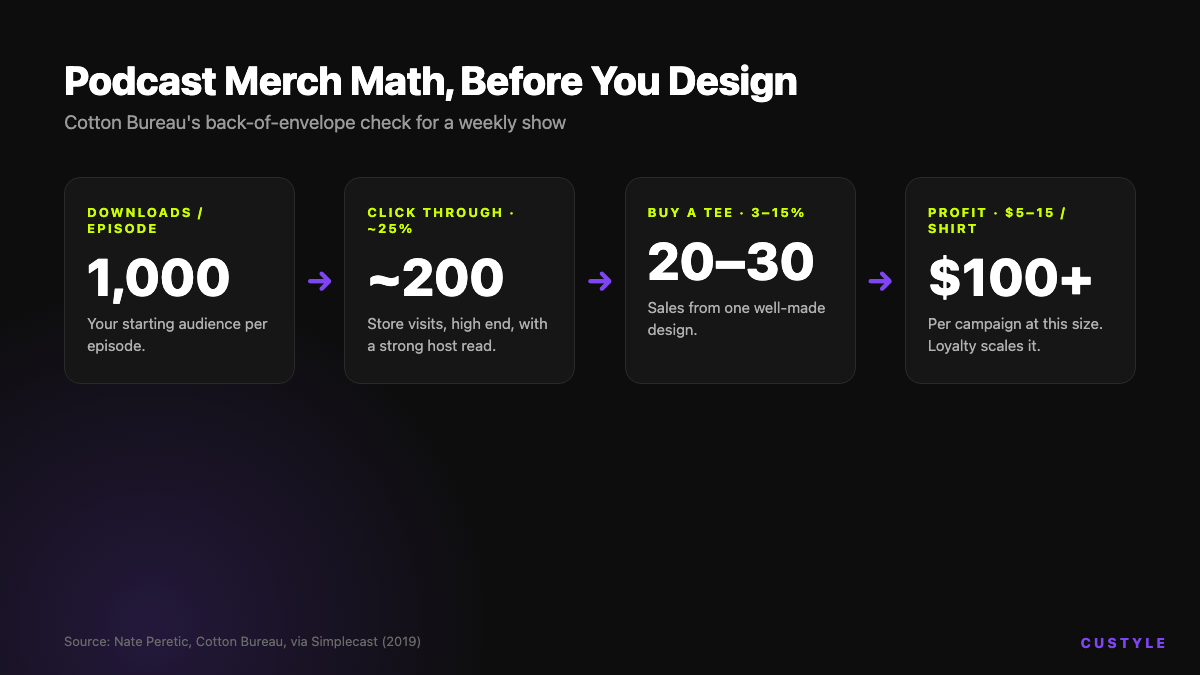 Cotton Bureau's rough math: 1,000 downloads ≈ 20–30 tee sales.
The timing signal: listeners asking "how can I support the show?" Peretic calls that a strong sign you're ready.
Pick the Right Bit
Not every joke wears well. Before you open any design tool, run each candidate through four tests:
- It's yours. It came from your show, not from a movie, brand or celebrity.
- It's repeated. Listeners already quote it back in comments, reviews or DMs.
- It reads in six words or fewer. Long bits make cramped shirts.
- It has a visual. A mascot, an object or a place beats a pure phrase.
Shopify's podcast merch guide suggests the same raw material: a signature saying or your show's unofficial mascot.
Can't decide? Ask. Printify recommends pulling ideas from comments, DMs and polls. A poll does double duty. It picks the bit and starts the hype.
Show, Don't Tell: One Joke, Three Directions
Here's the method on a made-up show. Tape Delay is a fictional true-crime comedy podcast. Its running gag: whenever a case stalls, a host says "the raccoon did it." Listeners now draw raccoons in the comments.
That bit passes all four tests. Here's how it becomes three directions.
Direction 1 — Typographic. The phrase alone, set like an evidence label. "THE RACCOON DID IT" in a stamped, case-file style. This one is quiet. Only fans catch it.
Direction 2 — Mascot. A raccoon in a detective coat, holding a microphone. This is the one strangers ask about. It has the widest reach.
Direction 3 — Faux-vintage. A fake 1970s "Raccoon Detective Agency" badge with an invented founding year. It feels like merch from inside the show's world.
This is where an AI crew changes the timeline. In Custyle, you describe the bit and the vibe you want. Nova shapes the loose prompt into sharper directions. Ink builds the artwork. Grid places it so it sits right on the product. You get to "pick one" in a single conversation, with no designer brief.
Three directions, one joke, one afternoon. That's the whole point. You stop guessing which design works and start testing.
Prompt template you can steal:
"Merch design for my podcast's running joke: [the phrase]. Context: [one line on where it came from]. Vibe: [e.g., stamped evidence label / cartoon mascot / fake vintage badge]. Audience: [superfans or new listeners]. Keep the text to [N] words."
Match Product to Fan Tier
Different fans want different things. Match each direction to a tier.
| Fan tier | Direction | Product | Pricing idea |
|---|---|---|---|
| Casual listener | Mascot | T-shirt or mug | Impulse price, always on sale |
| Regular | Typographic | Hat or tote bag | Mid price |
| Superfan | Faux-vintage | Heavyweight hoodie, limited | Higher price, drop only |
A few notes from the research:
- Tees are the canonical starter, Peretic says. Stickers and buttons work as add-ons.
- Hats have a price band. PrintKK suggests $28–32 for embroidered hats. Under $25 reads as a cheap giveaway.
- Tie it to the episode. PrintKK also recommends linking the source episode in the product listing. New buyers get the reference. Old fans relive it.
- Skip stock-heavy items at first. Enamel pins usually need about 100-unit minimums at $3–4 each, per Cotton Bureau. Print-on-demand lets you test with zero inventory.
Want the same logic for musicians? See AI band merch design.
Run It as a 15-Day Drop
Peretic notes that campaigns typically run about 15 days. That fits a weekly show: three episodes, three host reads.
Day 0 — Tease. Mention the bit on air. Post the three directions and let listeners vote.
Day 1 — Launch. Open the drop with the winning designs. Read it on the episode. Put the link in show notes and bios.
Day 7 — Mid-drop push. Show a fan wearing it, or a "see it before it's real" try-on. Read it again.
Day 14 — Last call. Say it's closing tomorrow. Peretic recommends a strong closing push, not a quiet fade.
Day 15 — Close and keep. Retire the superfan hoodie. Move the best-selling tee to your always-on store. Printify calls this growing an evergreen collection without "merch overload."
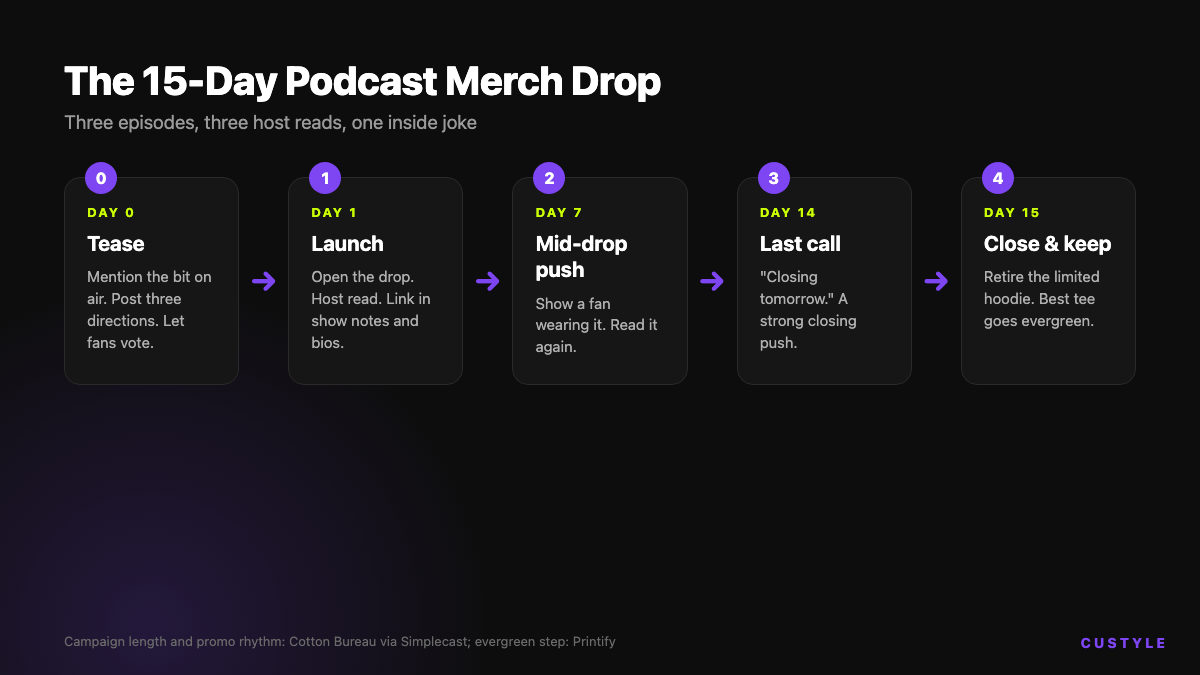 Three episodes, three host reads, one inside joke.
Two launch styles both work, per Peretic. Build hype in public with teasers and votes, or surprise-drop once everything's ready. Either way, his rule holds: "you need to tell people early and often."
Repeat the cycle. Printify suggests anniversaries, holidays and milestone episodes as natural drop moments. Your 100th episode is a drop waiting to happen.
Clear the Rights
Inside jokes feel like they belong to everyone. Legally, they don't. Check these before you sell. This is general guidance, not legal advice.
- Guest lines need guest permission. Rights to a guest's words come from your guest release, not your show's copyright. Podcast-law commentators recommend releases that cover specific uses. Add merch to yours.
- Stay off other people's IP. A joke about a movie title, brand or celebrity can raise trademark issues. Keep the design about your show's own language.
- Add human choices to AI art. Output made solely by AI typically isn't protected by copyright on its own, per BakerHostetler. Your selection, edits and arrangement strengthen your claim.
- Protect the show name. Commentators recommend registering a distinctive show name as a trademark.
Drop-Ready Checklist
- One bit that's yours, repeated, short and visual
- Quick math: downloads × ~25% × 3–15% ≈ expected sales
- Three design directions: typographic, mascot, faux-vintage
- One product per fan tier, priced on purpose
- Source episode linked in every listing
- Guest release covers merch (if a guest said it)
- Host reads on Day 1, Day 7 and Day 14
- Plan for which design goes evergreen after Day 15
Want a template to share the results afterward? Use the creator case study template.
FAQ
What are the best podcast merch ideas?
The best podcast merch ideas come from your show's own running jokes, catchphrases, recurring segments and fan nicknames. Merch platforms and Cotton Bureau's co-founder agree that logo tees have a lower ceiling. Start with a tee or mug for casual listeners and a limited hoodie for superfans.
How many listeners do I need to sell podcast merch?
There's no hard threshold. Cotton Bureau's rough math says 1,000 downloads per episode can mean about 20–30 shirt sales. Loyalty matters as much as size: The Co-Main Event Podcast had 356 iTunes reviews and sold over 1,000 shirts in 2018. If listeners ask how to support you, you're ready.
Should podcast merch use inside jokes or quotes?
Use both, for different people. Inside jokes act as a secret handshake for superfans and suit limited drops at higher prices. Standalone quotes work out of context and pull in new listeners at impulse prices. Printify suggests testing both on print-on-demand and keeping the winners.
Can I use AI to design podcast merch?
Yes. AI design tools can turn one inside joke into several directions in an afternoon, with no designer brief. Add your own selection and edits, though. Output generated solely by AI typically isn't protected by copyright on its own, so human choices strengthen your claim.
Can I put a guest's quote on merch?
Only with permission. Rights to a guest's words come from your guest release, not your show's copyright. The safest route is a release that explicitly covers merchandise. A guest's name or face may raise separate issues, so check with a lawyer before you sell.
Your Move
Podcast merch ideas don't need a brainstorm. Your listeners already wrote them in the comments. Pick the bit they repeat most. Turn it into three directions, match each to a fan tier, and give it 15 days. Then let the numbers tell you what goes evergreen.
Ready to make something?
Turn your ideas into real merch with AI. No design skills needed.
Start with a vibeCustyle Lab
Research & Guides · Nov 7, 2026·10 min read
Further Reading
Explore all →
Same Idea, Better Prompt: 10 Before-and-After AI Merch Prompts
10 AI merch prompt examples, each written twice: the vague version, the sharper one, and the single decision that changes what you get back.
Read more →
Branded Merch for Small Businesses: AI-Designed Tees, Mugs & Totes Without an Agency
Small business branded merch no longer needs an agency or a 48-piece minimum. See what tees, mugs and totes return, what they cost, and a 7-step plan to start with one piece.
Read more →
Streamer Merch with AI: From Twitch Emote to Hoodie in an Afternoon
Your emote is 112 pixels. A hoodie front needs about 3,000. Here's the afternoon streamer merch design workflow, from rights check to sample order.
Read more →
Agent-to-Agent Commerce: When the Buyer's AI Talks to the Maker's AI
Agent to agent commerce got real rails in 2026, but every protocol assumes the seller is a catalog. Here's what changes when the seller's AI has to make the thing.
Read more →