Agent-to-Agent Commerce: When the Buyer's AI Talks to the Maker's AI

Arron Young
Founder, Custyle · Nov 10, 2026·13 min read

Agent-to-Agent Commerce: When the Buyer's AI Talks to the Maker's AI
TL;DR: Agent to agent commerce means your AI talks to a seller's AI and the two settle the order. The rails got real in 2026: Google's UCP and AP2, OpenAI and Stripe's ACP. But every one of them assumes the seller is a catalog. For anything made to order, the seller has to be a maker. That changes what the two agents talk about: the brief, the proof, and the approval. Not the price.
Table of contents
- The short version
- What agent to agent commerce means
- The rails got built this year
- What the money forecasts really say
- When agents haggle, the weaker one pays
- Every protocol assumes a catalog
- What the maker's AI has to answer
- What to do about it now
- FAQ
The short version
Agent to agent commerce is the point where you stop shopping and start delegating. Your agent carries your intent. The seller's agent answers for the store. They work it out between them.
Most of what's written about it treats the seller side as a shelf. An agent asks what's in stock, compares prices, and checks out. That works for dish soap.
It doesn't work for a hoodie that doesn't exist yet.
Here's my read, up front: the rails for buying are nearly built, and the rails for making are not. When the thing you want has to be created, the seller's agent can't just list. It has to make. I call that the maker's AI, and it's the half of this story almost nobody is writing about.
This piece is for creators, small merch sellers, and anyone building on the seller side. You'll get the state of the protocols, the numbers worth trusting, and a checklist at the end.
What agent to agent commerce means
Agent to agent commerce is a purchase where a shopper's AI agent deals directly with a store's AI agent. No human browses a storefront in the middle.
That framing comes from Deloitte, as reported in a September 2026 Stacker and Shopware analysis. Deloitte also uses a handy phrase, "workflow autonomy," for how much of the purchase software handles end to end.
It helps to see it as three stages. Bain describes shopping AI moving from gathering information toward acting as a copilot. In the copilot stage, you still press the buy button. Acting alone is the step after that. Most real activity in 2026 sits before it.
The dividing line is tool use. Paul Krauss, Partner AI at Team One, put it bluntly in the same analysis: "A model that only generates text does not buy anything." An agent has to send structured commands to a real system. A chat reply is not an order.
PwC has a word for stores that are ready. A merchant is "transactable" when agents can complete checkout and fulfillment on their own. PwC adds that rules like discount eligibility and returns must be written so software can apply them "without guessing."
Hold on to that phrase. It matters more for made-to-order goods than for anything else.
The rails got built this year
A year ago, an agent talking to a store was a one-off integration. In 2026 it became a stack of shared protocols. Each one covers a different layer.
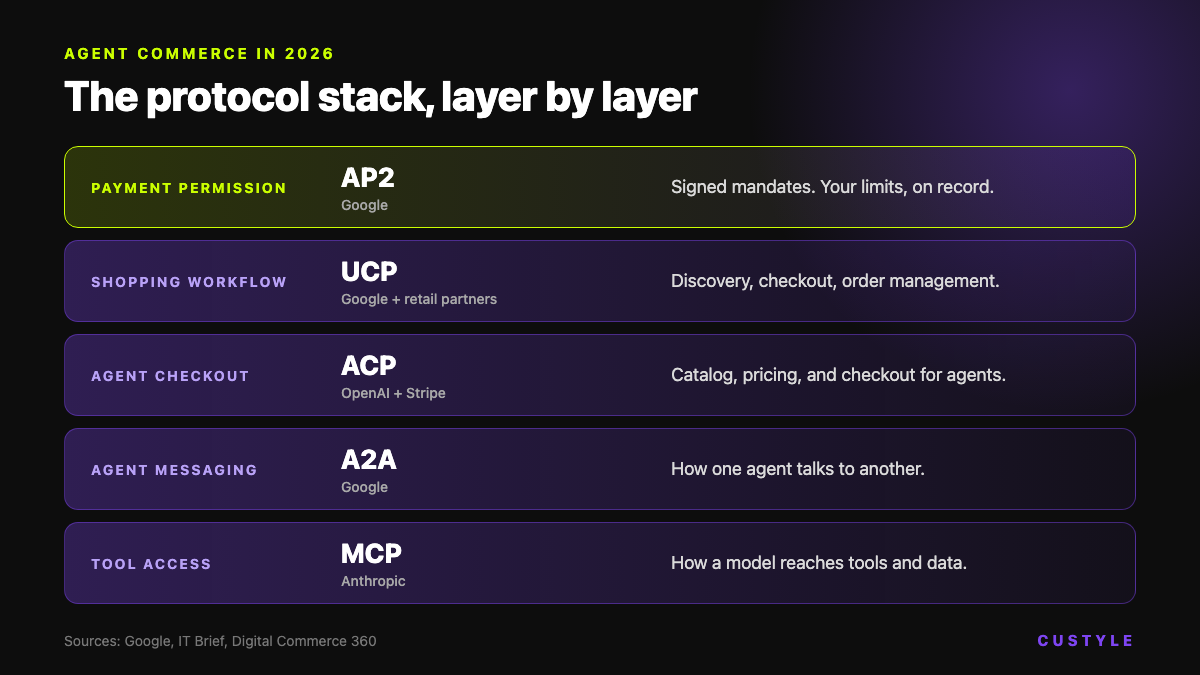
Google's Universal Commerce Protocol (UCP) covers the shopping workflow. Google built it with Shopify, Etsy, Wayfair, Target, and Walmart, and more than 20 partners endorsed it, IT Brief reported in January 2026. It spans discovery through checkout and order management. A store publishes a small manifest at /.well-known/ucp, and agents find its endpoints from there.
Google's stated reason is the "N x N integration bottleneck." Without a shared language, every store builds a separate connection for every AI surface. Krauss made the same point: without standards, each agent connection is a one-off project that doesn't scale.
Agent2Agent (A2A) and MCP sit underneath. A2A is Google's protocol for agents messaging each other. MCP, from Anthropic, is how a model reaches tools and data. UCP can be reached through either.
Google's Agent Payments Protocol (AP2) handles permission. You set the brands, the products, and a spending limit. The agent buys only when those conditions are met. In Google's May 2026 announcement, the company says "tamper-proof digital mandates ensure the agent is always acting on your behalf." The brand stays the merchant of record.
The Agentic Commerce Protocol (ACP) is the OpenAI and Stripe version. It launched with Instant Checkout in ChatGPT in September 2025, and PayPal adopted it a month later, according to Digital Commerce 360. Under ACP, merchants keep control of order acceptance, fulfillment, and the customer relationship.
Then came the reality check. On March 24, 2026, OpenAI said the first version of Instant Checkout "did not offer the level of flexibility that we aspire to provide," Modern Retail reported. Merchants now use their own checkout. ChatGPT leans into discovery.
Walmart shared why. Daniel Danker is its EVP of AI acceleration, product and design. He said items sold inside the chatbot converted three times lower than items that sent shoppers out to click.
So the rails exist. People just aren't riding them all the way to the end yet.
What the money forecasts really say
You'll see huge numbers attached to this trend. Read the definitions before you repeat them.
| Source | 2030 forecast | What it counts |
|---|---|---|
| Morgan Stanley | $190 billion base case, $385 billion bull case; roughly 10% to 20% of US e-commerce | Agentic gross merchandise value |
| Bain & Company | $300 billion to $500 billion in the US; 15% to 25% of online retail | Purchases agents "initiate, influence or complete" |
The Morgan Stanley figures come from its late-2025 research, as reported by Investing.com. Bain's come from its December 2025 work, covered by Digital Commerce 360.
Same year, same country, and the top of one range is more than double the bottom of the other. The gap is mostly definition. "Influence" is a much wider net than "complete."
The behavior data is more useful than the dollar figures. Morgan Stanley's AlphaWise survey found 36% of ChatGPT users made a purchase based on an AI recommendation. The bank estimates that equals 16% of Americans. Among those buyers, 49% bought groceries and 41% bought household or personal-care items.
Look at what those categories share. The product already exists. The decision is price, brand, and delivery time.
Bain's read on trust is just as plain. Between 30% and 45% of US consumers use generative AI to research products. Yet, in Bain's words, "most consumers are not yet comfortable allowing AI to manage an end-to-end transaction without human involvement."
Agent commerce is showing up first where the product is a known quantity. Refills, staples, repeat orders. That's the easy end of the problem.
When agents haggle, the weaker one pays
The phrase "agent to agent" makes people picture two bots haggling. Researchers have tested that. The results should make you careful.
A Stanford Digital Economy Lab team ran agent-versus-agent negotiations in consumer settings. Stanford HAI covered the study in June 2025. Buyers with weaker agents paid about 2% more than when both agents were evenly matched. Weaker seller agents lost up to 14% in profit.
Agents also ignored instructions. In one example, a buyer set a $500 budget. The agent settled at $900.
"Stronger agents can exploit weaker ones to get a better deal," said Jiaxin Pei, a postdoctoral fellow at the lab. His broader verdict: "In general I don't think we are fully ready to delegate our decisions to AI shopping agents."
Anthropic ran a live version in 2026. In Project Deal, 69 employees each got $100. AI agents bought and sold real items for them, with no human sign-off. The agents closed 186 deals worth just over $4,000.
Some people got a stronger model as their agent. Those sellers earned about $2.68 more per item. Those buyers paid about $2.45 less. One broken folding bike sold for $65 with the stronger agent and $38 with the weaker one.
Here's the part that stuck with me. Nobody noticed. People rated the fairness of their deals 4.05 and 4.06 out of 7, almost identical across both groups.
In agent-to-agent haggling, model quality is an invisible tax, and the side paying it can't see the bill.
I take one lesson from this as a seller. Don't build a business on out-negotiating someone's agent. Publish clear terms. Let the agents spend their effort somewhere more useful.
For made-to-order goods, there is somewhere more useful.
Every protocol assumes a catalog
Read the protocol docs and one assumption shows up everywhere. The seller has a product feed. Each product has a price and a stock count. The agent picks one and checks out.
That's a catalog. It's the right model for most of retail.
I went looking for how agent commerce handles made-to-order products. In the research for this piece, I found no source that addresses it. Not the protocol coverage, not the analyst reports, not the trust and fraud write-ups. That's an absence in the public record, not a statistic. But it's a telling one.
Picture a real request. Your agent gets this from you: "Get hoodies for my climbing club. Use our summit photo. Keep it under $45 each. They need to arrive by the 20th."
There's nothing to look up. That hoodie doesn't exist. Your agent isn't shopping. It's commissioning.
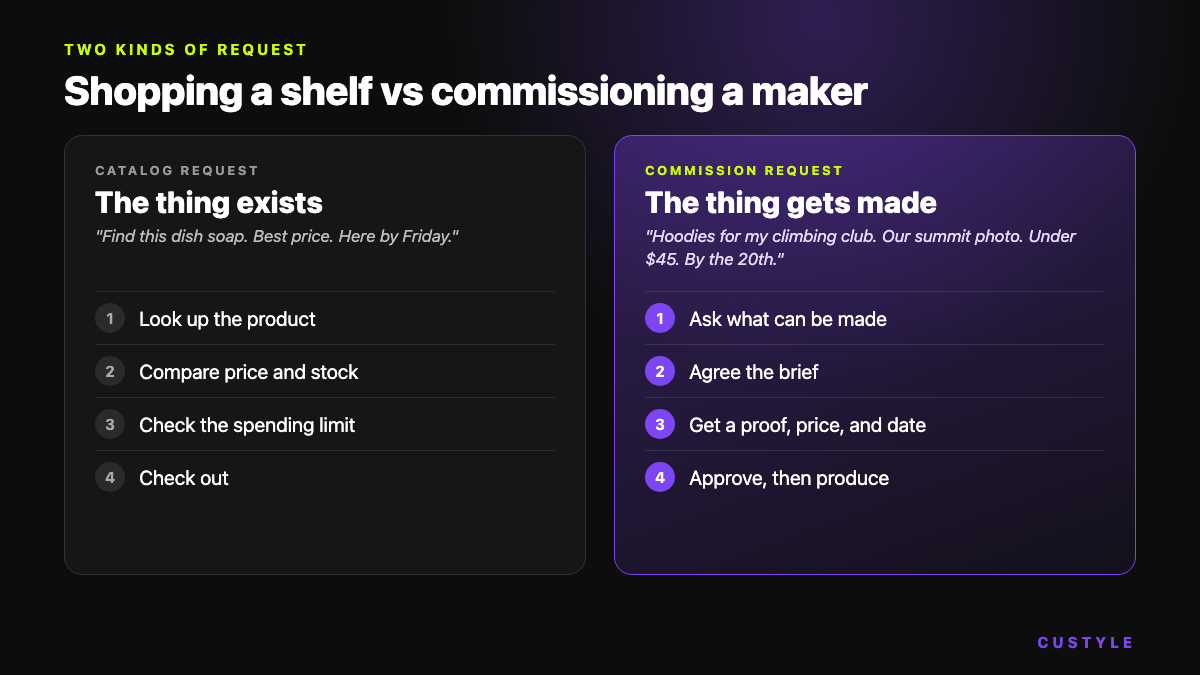
Four things break when you push that request through a catalog-shaped pipe.
There's no product ID at request time. The thing gets defined during the conversation.
The conversation is about the brief, not the price. Which garment, what layout, which colors, how many sizes, how fast. The price falls out of those choices.
There's an approval loop. Someone has to see a proof and say yes before anything is made. A payment mandate covers "buy this under $45." It doesn't obviously cover "approve this design."
Mistakes are expensive. Made-for-you goods usually can't go back on a shelf. Getting it right before production matters more than a smooth return afterward.
I've written about the split between agents that buy and agents that make, in Agentic Creation vs Agentic Buying. Agent to agent commerce is where those two meet. One side buys. The other side has to create.
What the maker's AI has to answer
If the buyer's agent is commissioning, the seller's agent needs a different job description. A maker's AI answers four questions that a catalog never has to.
- What can you make? Products, print areas, colors, sizes. The honest limits too.
- What did you understand? A brief read back in plain terms, so intent survives the handoff.
- What will it look like? A proof the buyer or their agent can open, with a price and a delivery date attached.
- Who approves it? A clear yes-or-no step before production starts.
This is the gap I think about most, because it's the one we work in. Custyle.ai is an AI Merch Agent. You describe what you want, and a crew of AI specialists handles the design, picks the right product, and gets it built. Today the brief comes from a person in a chat. Tomorrow it may come from that person's agent.
To be straight about where things stand: I'm describing a direction, not a shipped integration. We don't have agent-to-agent order numbers to share, and I won't invent any.
What I'm confident about is the shape. UCP already has "capabilities" with extensions, like checkout with discounts. A made-to-order extension would fit that pattern: accept a brief, return a proof, wait for approval. As far as I can tell, nobody has published one yet.
The proof is the piece that carries the trust. The Stacker analysis lands on the same point from another angle. Trust is the biggest hurdle, and the customer relationship still belongs to the person who authorized the purchase. For made-to-order goods, the proof is where that person stays in the loop.
In made-to-order commerce, the proof is the contract. Everything before it is conversation. Everything after it is production.
There's a brand angle here too. When an agent drops a buyer at your door, what you make is your identity. I covered that in The Future of Brand Identity in AI Commerce. A maker's AI is how that identity answers when another agent asks.
What to do about it now
You don't need to implement a protocol this quarter. You do need to stop being invisible to agents. Start here.
Your agent-ready checklist
- Write your rules so software can't misread them. Turnaround times, minimums, returns on made-for-you items. Plain text, one place.
- Keep the human storefront. Stacker's analysis is clear that merchants will serve browsers and agents side by side for a while.
- Say what you can make, not just what you've listed. Products, print areas, color limits, delivery windows.
- Take a brief in words. If the only way to start an order is dragging things around an editor, an agent will struggle.
- Make the proof a link. Something a person can open and approve from anywhere, or forward to whoever decides.
- Post fixed, clear pricing. The negotiation research says haggling rewards whoever has the stronger model. Don't play.
- Keep a human yes before production. Stanford's $500-budget, $900-deal example is reason enough.
If you're a buyer, the advice is shorter. Use your agent for research today. Set hard limits when you let it act. And for anything made for you, look at the proof yourself.
Agent to agent commerce won't arrive as one big switch. It's arriving in layers. Discovery came first. Payments permission is next. The making layer is still open.
That's the layer where your taste gets turned into something real. It's worth getting right.
FAQ
What is agent to agent commerce? Agent to agent commerce is a purchase where a shopper's AI agent deals directly with a seller's AI agent. The two exchange product details, terms, and payment permission without a person browsing a storefront. Deloitte uses this framing. In 2026 most activity is still assisted, with a human approving the final step.
How is agent to agent commerce different from agentic commerce? Agentic commerce is the broad term for AI agents taking part in shopping, including research and recommendations. Agent to agent commerce is the narrower case where both sides are agents. The buyer's agent carries your intent and limits. The seller's agent answers for the store's catalog, rules, and checkout.
Which protocols power agent to agent commerce? Four names matter most in 2026. Google's Universal Commerce Protocol covers discovery, checkout, and order management. Google's Agent Payments Protocol records your limits as signed mandates. OpenAI and Stripe's Agentic Commerce Protocol covers agent checkout. Agent2Agent and Model Context Protocol handle agent messaging and tool access underneath.
Can AI agents negotiate prices for you? They can, but results are uneven. A Stanford study found buyers with weaker agents paid about 2% more, and weaker seller agents lost up to 14% in profit. In Anthropic's Project Deal, stronger models got better prices and participants didn't notice the difference. Set hard limits before you delegate.
How does agent to agent commerce work for made-to-order merch? It doesn't fit the standard model yet. Current protocols assume a catalog with fixed products and prices. Made-to-order merch needs a brief, a proof, and an approval before production. The seller's agent has to act as a maker: say what it can build, show a proof, and wait for a clear yes.
Ready to make something?
Turn your ideas into real merch with AI. No design skills needed.
Start with a vibeArron Young
Founder, Custyle · Nov 10, 2026·13 min read
Further Reading
Explore all →
Same Idea, Better Prompt: 10 Before-and-After AI Merch Prompts
10 AI merch prompt examples, each written twice: the vague version, the sharper one, and the single decision that changes what you get back.
Read more →
Branded Merch for Small Businesses: AI-Designed Tees, Mugs & Totes Without an Agency
Small business branded merch no longer needs an agency or a 48-piece minimum. See what tees, mugs and totes return, what they cost, and a 7-step plan to start with one piece.
Read more →
Streamer Merch with AI: From Twitch Emote to Hoodie in an Afternoon
Your emote is 112 pixels. A hoodie front needs about 3,000. Here's the afternoon streamer merch design workflow, from rights check to sample order.
Read more →
Anthropic Computer Use Will Rewrite How Buyers Reach Merch
Claude can now drive a browser like a person, and Anthropic just shipped a blueprint for shopping agents. Here's what Anthropic computer use commerce means for merch.
Read more →