Branded Merch for Small Businesses: AI-Designed Tees, Mugs & Totes Without an Agency

Custyle Picks
Reviews & Comparisons · Nov 12, 2026·11 min read
Branded Merch for Small Businesses: AI-Designed Tees, Mugs & Totes Without an Agency
TL;DR: Small business branded merch used to need two things you didn't have: a design budget and a bulk order. Both barriers are gone. AI handles the design in minutes. Made-to-order production means no minimums and no boxes of leftovers. Start with one goal and one useful product. Order one sample. Keep what people actually use.
Who this is for: Owners of cafés, studios, shops, gyms and other small brands who want merch people keep, without hiring an agency or guessing at a bulk order.
Table of contents
- The short version
- Why branded merch earns its keep
- What the old path costs
- What changed: AI plus made-to-order
- Tee, mug or tote?
- Seven steps to your first piece
- Mistakes that waste a merch budget
- When a bulk order still wins
- Your first-order checklist
- FAQ
The short version
Small business branded merch is any useful item that carries your brand into someone's day. A tee on your barista. A tote on a regular's shoulder. A mug on a client's desk.
You don't need an agency to make it. You don't need to buy 48 of anything either. You need a clear goal, a product people will use, and a design that looks like something they'd pick themselves.
This guide covers the numbers, the costs, and a seven-step plan. Everything here works for a team of three.
Why branded merch earns its keep
Merch feels like a nice-to-have. The data says it's advertising, and cheap advertising.
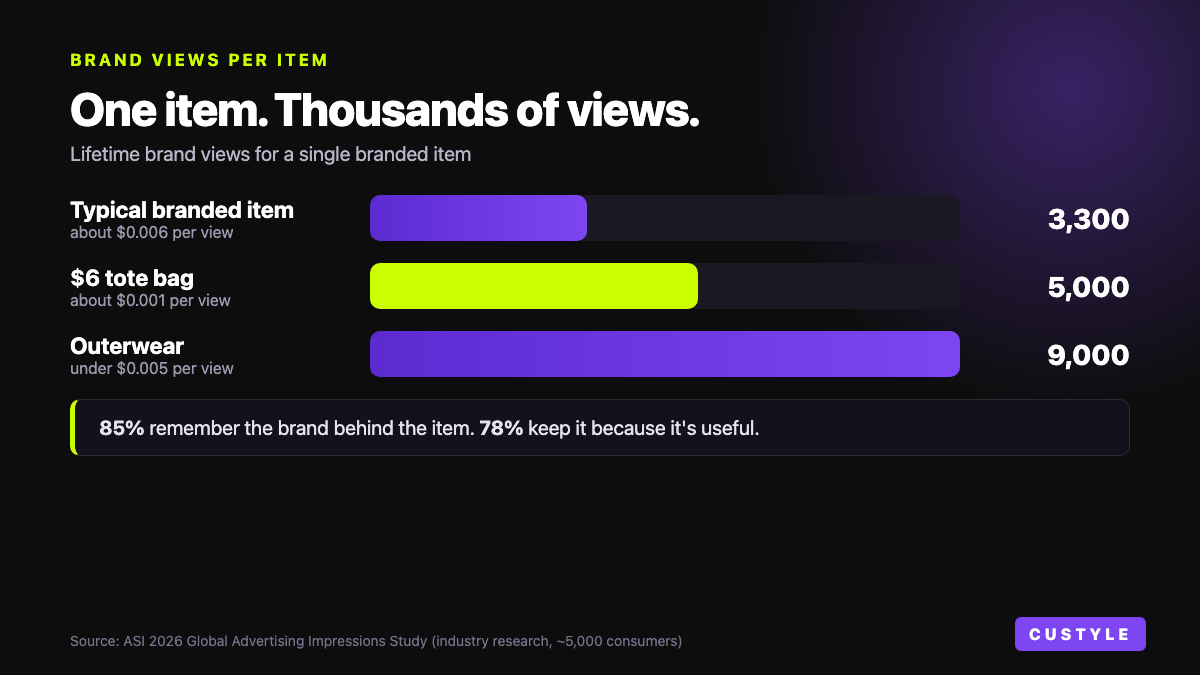
The Advertising Specialty Institute (ASI) is the trade body for the promotional products industry. Its 2026 Global Advertising Impressions Study surveyed nearly 5,000 consumers. It's industry research, so read it as the industry's own case. The numbers are still worth knowing:
- A typical branded item earns about 3,300 brand views over its life.
- The average cost per view is $0.006. That's six-tenths of a cent.
- 85% of people remember the brand that gave them an item.
- 76% say they're more likely to buy from that brand.
- 78% keep an item because it's useful.
That last number is the one to plan around. People keep merch because it's useful, not because it carries your logo.
Product choice changes the math. According to ASI, a $6 tote bag earns about 5,000 views across its life. That works out to roughly a tenth of a cent each. Outerwear earns about 9,000 views at under half a cent each, a rate ASI's follow-up coverage calls comparable to T-shirts and baseball caps.
ASI's CEO, Ashish Mittal, puts it bluntly. "Branded merchandise isn't a feel-good spend, it's one of the most cost-efficient, measurable types of advertising available."
So the return is real. The problem for a small business was never the return. It was the cost of getting started.
What the old path costs
The old path has two bills. One for the design. One for the print run.
The design bill
You can pay for design in a few ways. ManyPixels' October 2026 roundup of merch design services lists approximate prices:
| Route | Typical price | What you manage |
|---|---|---|
| Marketplace gig | About $10 to $200+ per design | Brief, revisions, file checks |
| Hourly freelancer | About $15 to $60+ per hour | Brief, feedback rounds, timeline |
| Design contest | $199 to $799 per contest | Brief, judging, picking a winner |
| Design subscription | About $699 per month | A steady queue of requests |
| Creative agency | About $15,000 per month, annual terms | Meetings |
The price isn't the whole cost. Every route starts with a brief. Most owners have never written one. Then come concepts, feedback and revisions. Days pass before anything gets made.
The print bill
Traditional bulk printing is priced for volume. A first-order guide from eCommerce Fastlane gives these planning figures:
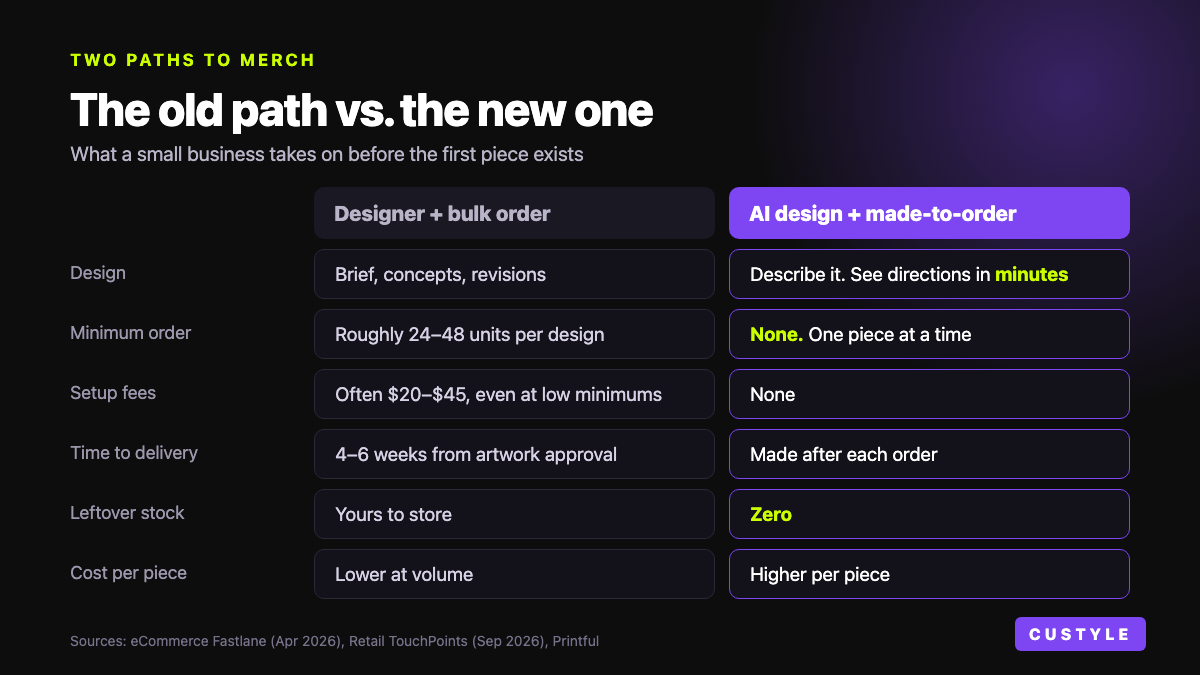
- Minimum runs of roughly 24 to 48 units per design.
- 10 to 14 business days of production.
- 4 to 6 weeks from artwork approval to delivery.
- Rush fees that add 20 to 50%.
- Per-unit costs that swing 40% or more with volume.
That last point is the trap. The price per shirt drops as the order grows. So you order more than you need. Then the boxes sit in the back room.
Small orders carry their own tax. Andrew Witkin, CEO of StickerYou, writes in Retail TouchPoints that even "low minimum" suppliers "often tack on $20 to $45 in setup or processing fees."
Add it up. A small business had to bet real money on one design, before a single customer saw it.
What changed: AI plus made-to-order
Two shifts removed both bills.
Made-to-order production. Each piece gets made after it's ordered. No minimums. No stock to store. Printful, one of the large made-to-order printers, describes the model as "no order minimums or inventory needed." Bulk orders, by contrast, leave you with "too much or too little stock."
This isn't a niche anymore. Grand View Research estimates the global print-on-demand market at about $10.8 billion in 2025. It projects $57.5 billion by 2033. Apparel made up 39.5% of that market in 2025.
AI design. You describe what you want in plain words. You see directions in minutes, not weeks. No brief, no back-and-forth.
Witkin's point about what this means is the sharpest one in the research. Owners don't suddenly have more ideas. In his words, "they just have the ability to try them affordably and easily." The gap between big and small business marketing, he argues, "was the cost of discovering which ideas worked."
That's the real change. Testing used to be a luxury. Now a coffee roaster can try five label designs and keep the best two. That's Witkin's own example.
One caution. An image generator is not a merch tool. Vistaprint's guide to AI T-shirt design flags the common snag: turning a low-resolution AI image into a file that prints well. A pretty picture on a screen can still fail on cloth.
This is the gap an AI merch agent closes. Custyle.ai, the AI Merch Agent platform, works from your description or your logo. It shapes the design for the actual product, shows you the result before it's made, and builds one piece at a time. For a look at the full chain, see how one Custyle product goes from prompt to box.
Tee, mug or tote?
Start with one product. Pick it by job, not by habit.
| Product | Best job | Why it works |
|---|---|---|
| Tee | Staff wear, merch for sale | T-shirts lead the category in sales and demand, per ASI |
| Tote | Customer giveaways, loyalty gifts | About 5,000 views for a $6 bag, per ASI |
| Mug | Client gifts, in-shop sales | Lives on a desk or counter every day |
A few scenes to make it concrete.
The café. Your team wears the tee. Regulars ask where to get one. Now it's a product on the shelf by the register.
The studio. A yoga or pottery studio gives a tote at sign-up. It goes to the market every Saturday. So does your name.
The service business. An accountant or agency sends a mug to new clients. It sits on a desk long after the welcome email is forgotten.
The local brand. Witkin describes an RV campground owner who made a "local" sticker line for guests. Merch became a small revenue line, not a cost.
Useful wins every time. Remember the 78%.
Seven steps to your first piece
- Pick one goal. Staff wear, giveaway, resale or gift. One goal decides the product, the look and the count.
- Pick one useful product. Tee, mug or tote. Add a second only after the first works.
- Describe your brand in plain words. Say the colors, the mood and who walks through your door. "Warm neighborhood bakery, cream and brick red, hand-drawn feel" is enough. Drop your logo if you have one.
- Look at several directions. Ask for a few takes. Pick the one you'd wear on a day off.
- See it on the product. A design can look right on a screen and wrong on a chest. Check size and placement before anything gets made.
- Order one sample. Hold it. Wash it. Hand it to your pickiest employee.
- Test small, then repeat. Make a handful. Watch which ones people ask about. Reorder the winners.
Steps three to five are where the agency used to sit. They now take one sitting. If you're curious how words become a physical thing, Prompt to Product explains the idea.
Mistakes that waste a merch budget
Chasing the lowest unit price. A cheap price per shirt on 200 shirts is still 200 shirts. Unsold stock is the most expensive merch you'll ever buy.
Slapping the logo on. A giant logo on a white tee is a uniform. People wear merch that looks like a product. Lead with a line, an illustration or a mood. Let the logo sit small.
Picking things nobody uses. ASI's study says 78% keep items for usefulness. Ask one question of every item: would they use it weekly?
Guessing the size mix. An even split from Small to XXL rarely matches real people. Ask your team first. With made-to-order, each person simply picks a size.
Skipping the sample. Colors shift between screen and cloth. One sample costs far less than one bad batch.
Rushing the date. Rush fees on a bulk order run 20 to 50%, per eCommerce Fastlane. Plan events early, or use made-to-order.
Sending a screen-size file. A logo pulled from your website is too small for a tee. Use the original file, or rebuild the art at print size.
When a bulk order still wins
Made-to-order is not always the cheapest per piece. Be honest about the trade.
A single made-to-order tee costs more than one tee from a 200-piece run. You pay a little more per item. In return you carry no minimum, no setup fee and no leftovers.
Bulk wins when three things are true. You know the design works. You know the count. You have somewhere to store it. A 5K race with 300 confirmed runners is a bulk job.
Printful frames the two as complementary, and that's the right read. Test with made-to-order. Move only proven designs to bulk.
Your first-order checklist
- One goal chosen: staff, giveaway, resale or gift
- One useful product chosen
- Brand described in two plain sentences
- Original logo file on hand, not a web copy
- At least three design directions compared
- Design checked on the product at real size
- One sample ordered, worn and washed
- Sizes collected from real people
- A plan to reorder winners, not everything
Small business branded merch no longer starts with a big bet. It starts with one idea and one piece. The agency fee and the 48-piece minimum were never the point. A product people keep was. Start with a vibe and make it real.
FAQ
How much does small business branded merch cost to start? It can start with one piece. Made-to-order production has no minimums, so your first cost is a single sample. The old path costs more. Design gigs run about $10 to $200+ per design, per ManyPixels. Traditional bulk runs need roughly 24 to 48 units per design, per eCommerce Fastlane.
Is branded merch worth it for a small business? Industry data says yes, if the item is useful. The ASI 2026 Global Advertising Impressions Study puts the average cost per brand view at $0.006. It found 85% of people remember the brand behind an item. It also found 78% keep items because they're useful.
What are the best branded merch items for a small business? Start with tees, totes and mugs. T-shirts lead the category in sales and demand, according to ASI. A $6 tote earns about 5,000 brand views over its life. Mugs suit client gifts. Pick the one your customers would use every week.
Can AI design merch for my business without a designer? Yes. Describe your brand in plain words or share your logo, and AI returns design directions in minutes. Watch file quality, though. A plain image generator can produce art too small to print well. Use a tool that shapes the design for the actual product.
Do I need a minimum order for custom merch? Not anymore. Traditional bulk printing typically needs 24 to 48 units per design. Made-to-order production makes each piece after it's ordered. Printful describes it as "no order minimums or inventory needed." You pay more per piece and carry no leftover stock.
Ready to make something?
Turn your ideas into real merch with AI. No design skills needed.
Start with a vibeCustyle Picks
Reviews & Comparisons · Nov 12, 2026·11 min read
Further Reading
Explore all →
Same Idea, Better Prompt: 10 Before-and-After AI Merch Prompts
10 AI merch prompt examples, each written twice: the vague version, the sharper one, and the single decision that changes what you get back.
Read more →
Streamer Merch with AI: From Twitch Emote to Hoodie in an Afternoon
Your emote is 112 pixels. A hoodie front needs about 3,000. Here's the afternoon streamer merch design workflow, from rights check to sample order.
Read more →
Agent-to-Agent Commerce: When the Buyer's AI Talks to the Maker's AI
Agent to agent commerce got real rails in 2026, but every protocol assumes the seller is a catalog. Here's what changes when the seller's AI has to make the thing.
Read more →
Anthropic Computer Use Will Rewrite How Buyers Reach Merch
Claude can now drive a browser like a person, and Anthropic just shipped a blueprint for shopping agents. Here's what Anthropic computer use commerce means for merch.
Read more →