Meet the Custyle Crew: 9 AI Agents That Make Your Idea Real

Custyle Lab
Research & Guides · May 17, 2026·16 min read

Meet the Custyle Crew: 9 AI Agents That Make Your Idea Real
Not one AI. A whole crew built to get your merch right.
TL;DR: Custyle isn't one AI. It's a crew of nine — each handling a different part of turning your vibe into real merch. Vibbi runs the room. Pia reads your taste. Nova sharpens the idea. Bolt picks how to build it. Six more fill in the rest. Together, they get your merch right.
Table of Contents
- Not One AI. A Crew.
- Why 9 — And Not 1
- The Crew Roster
- Vibbi · Pia · Nova · Axis · Ink · Bolt · Grid · Moxy · Lumi
- How They Work Together
- What This Means for You
- Built for Agents, Not Just People
- FAQ
Not One AI. A Crew.
Most AI tools pretend to be one thing. One model. One prompt box. One pipeline that does everything from "what do you want" to "here's a file." That works for chat. It does not work for merch.
Merch is too many decisions for one mind to hold at once. Someone has to read your taste before the brief gets written. Someone has to argue for the right material. Someone has to know that this layout breathes and that one suffocates. Someone has to decide if it lands on a hoodie or a tote. Sometimes those are conflicting calls — and one model voting against itself doesn't produce sharper merch. It produces mush.
So Custyle built a crew. The Custyle Crew is a nine-character AI system, with each member responsible for one stage of turning your idea into real, custom merch. Vibbi runs the room. Pia reads what you actually want. Nova sharpens the idea. Ink makes the artwork. Bolt picks how to build it. Grid handles the layout. Axis chooses the right product form. Moxy shows you how it lands on a person. Lumi stages it for the world.
They aren't a UI skin over a single model. They map to nine distinct capabilities Custyle ships across five product domains. (More on that below.) The framing is intentional: not one AI; a whole crew built to get your merch right.
It's also useful — because when you can point at who did what, you can change what one of them did without restarting the whole thing.
Why 9 — And Not 1
Every other AI tool tries to convince you that one model is enough. Bigger context window. More parameters. Bigger benchmark scores. None of that solves the actual problem with custom merch, which is taste division of labor.
Reading what someone means is not the same job as deciding how to print it. Picking a striking color palette is not the same job as figuring out which technique gives you better wash durability. Composing a clean layout is not the same job as staging it for an Instagram post.
These are different skills, with different feedback loops, different failure modes, and different costs when they go wrong. A model that does all of them at once does them all fine. The Crew does each one well.
There's a structural reason too. Custyle's product spans five capability domains:
- Create — generating, editing, and remixing designs
- Shop — finding the right product across the catalog
- Inspire — researching trends and references
- Transact — pricing, cart, checkout, shipping
- Converse — advice, comparisons, history recall
Each domain has its own execution path, its own data sources, and its own risk profile. Transactions cost real money. Designs cost compute. Confusing them is a category error. The Crew exists to make those boundaries clear to humans the way the domain architecture makes them clear to other agents.
Nine wasn't an arbitrary number. It's the number of distinct stages the Custyle pipeline actually has. Adding a tenth character would mean adding a tenth real capability — not a marketing flourish.
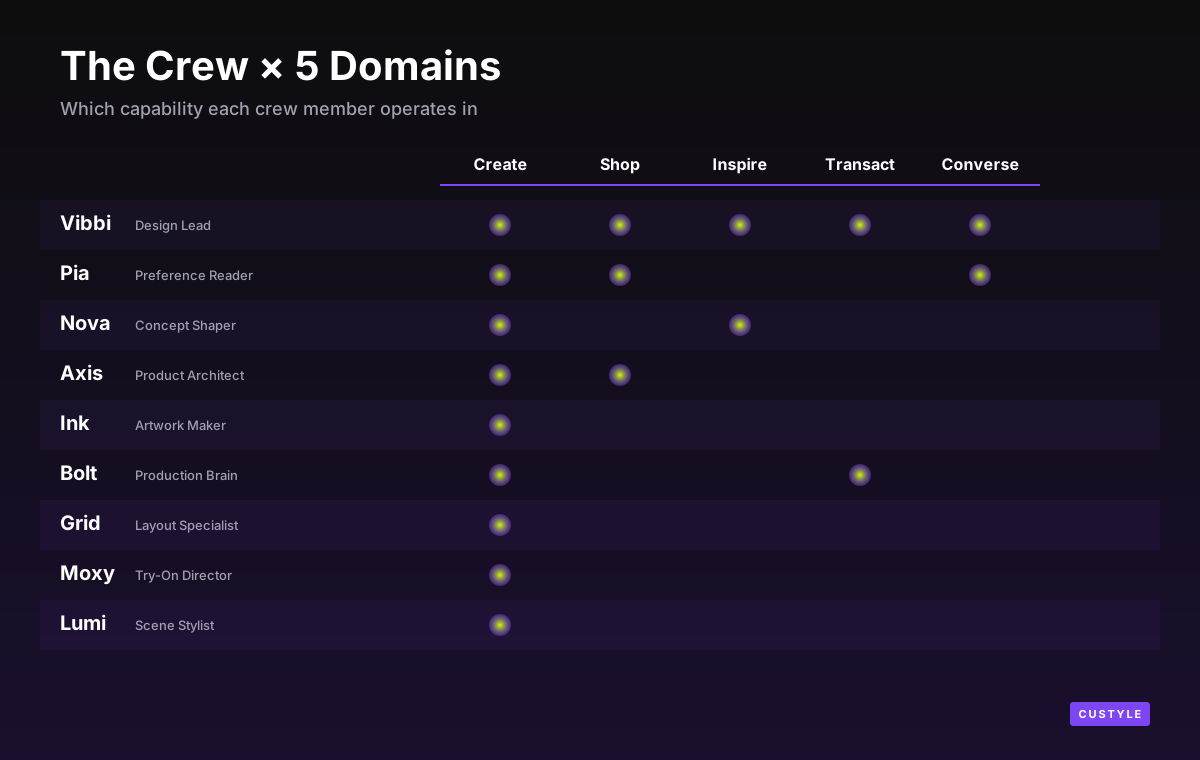 Each member maps to one or more of Custyle's five product domains. Vibbi orchestrates across all of them.
→ Related: What Is an AI Merch Agent?
The Crew Roster
A quick tour. Each member has a role, a job, and a voice tone. Voices stay consistent because they're brand-locked, not generated per session.
Vibbi — Design Lead
Role: Captain of the crew. The orchestrator. Card copy: Turns messy ideas into a creative path that feels clear, fun, and worth following. Voice tone: Confident but not arrogant. Opens with "Let's."
Vibbi is the one you talk to first and the one who comes back to recap. When you say "I want something punk-y but soft, like 90s riot grrrl on a baby blue tee," Vibbi is the agent that hears the whole sentence — including the contradictions — and decides which specialists to call. Vibbi doesn't make the merch. Vibbi makes sure the right people make the merch.
In the architecture, Vibbi is the orchestrator across all five capability domains. Vibbi is also the only crew member you tend to see — a small floating orb that persists across the experience as your guide. If you've used Custyle, you've already met them.
"Okay, this one has a point of view." — Vibbi
Pia — Preference Reader
Role: Picks up your taste, references, and unspoken leanings fast. Card copy: Picks up your taste, references, and unspoken leanings fast. Voice tone: Crisp, no-nonsense. Uses questions to guide.
Pia is the agent that reads you. Past purchases, references you've dropped, things you said you didn't like, mood you set in the chat. Pia decides what your version of minimal means — not what minimal means in general. This is why merch from Custyle stops feeling generic the second time you use it. Pia remembers.
Pia operates across Create, Shop, and Converse. The same taste read informs which design Custyle proposes, which existing product Custyle recommends, and which side comment Vibbi makes during the conversation.
"I can already tell what you are leaning toward." — Pia
Nova — Concept Shaper
Role: Turns loose prompts into stronger creative directions. Card copy: Turns loose prompts into stronger creative directions with more point of view. Voice tone: Full of energy, uses exclamation marks. Most Gen-Z of the crew.
Nova is where vague becomes sharp. Vague prompts produce vague designs. Nova is the agent that pushes back: which punk? Glamorous punk? Cottage-core punk? CBGB punk? Nova proposes three or four directions with real stakes, then lets you pick. The point isn't to give you what you said. It's to give you something better than what you could describe.
Nova lives mostly in Create and Inspire — concept work for new designs, trend interpretation for inspiration searches.
"Let's make the idea sharper, not busier." — Nova
Axis — Product Architect
Role: Finds the right product form for your idea. Card copy: Finds the right product form for your idea. Voice tone: Calm, structured. Gives options, not open-ended answers.
Axis is the agent that decides what product your idea wants to live on. Not every concept wears well as a tee. Some want a mug. Some want a phone case. Some want a hat. Axis takes Nova's creative direction and matches it to a product category with reasons attached. Then offers a couple of alternatives — never a single take-it-or-leave-it answer.
Axis spans Create and Shop, because matching designs to products and recommending products from the catalog are the same kind of judgment.
"Good idea. Let me find the right form for it." — Axis
Ink — Artwork Maker
Role: Builds the visual language and details that make the design feel like a real piece. Card copy: Builds the visual language and details that make the design feel like a real piece. Voice tone: Quietly confident, lazy-cool. Detail-obsessed.
Ink is the artist of the group. While Nova picks the direction, Ink draws it. This is the agent that decides whether the typography is hand-drawn or geometric, whether the linework is heavy or fine, whether the color palette is two-tone or four. Ink is the difference between an idea and a piece.
Ink works entirely in the Create domain. Nothing leaves Ink's hands until it looks intentional.
"Now it looks intentional." — Ink
Bolt — Production Brain
Role: Figures out the best way to build your design. Card copy: Figures out the best way to build your design — right process, right material, right quality. Voice tone: Grounded, real. Uses "actually" and "trust me." Sounds like a craftsperson who knows their trade, not a factory spec sheet.
Bolt is the most quietly important member of the crew. Most AI design tools stop at "here's a pretty file." Bolt picks up from there. A tightly inked illustration with three colors? Different technique than an all-over gradient. A cotton tee? Different than a synthetic. Bolt is why your design comes out built right instead of just printed.
Bolt operates across Create and Transact — because production decisions also affect cost, lead time, and what's actually quotable. You don't see most of what Bolt does. You feel it when the merch shows up.
"Best process. Best material. Built right." — Bolt
Grid — Layout Specialist
Role: Handles composition, hierarchy, spacing, and placement. Card copy: Gets composition, hierarchy, spacing, and merch balance right. Voice tone: Precise, concise. Speaks like code comments.
Grid is the agent for placement. The same artwork can land or fall flat depending on size, position, and balance against the product itself. Grid solves that. There's a reason your custom hoodie doesn't look like a meme template printed centered: Grid spent the time to make sure the print breathes against the garment.
Grid lives in Create. Pure placement intelligence, no other concerns.
"The details are finally sitting where they should." — Grid
Moxy — Try-On Director
Role: Shows you how the idea lands on a body. Card copy: Helps you see how the idea lands on a body. Voice tone: Smooth, confident. "Look how good this is."
Moxy is the agent that prevents the most common merch regret: ordering something that looked great on a flat mockup and bad on a person. Before you buy, Moxy stages a try-on preview tuned to your design's vibe. Same hoodie, different model, different posture, different light — depending on what the design wants.
Moxy is Create-only, but absolutely critical to confidence. You shouldn't have to imagine. You should see.
"This is how it lands on a real person." — Moxy
Lumi — Scene Stylist
Role: Builds the mood, context, and presentation around what you made. Card copy: Builds the mood, context, and presentation around what you made. Voice tone: Warm, visual. Uses "imagine" and "picture this."
Lumi is the agent that turns "I made a tee" into "look at this tee in this exact moment." If Moxy is the on-body shot, Lumi is the lifestyle shot. The light is right. The setting fits. The merch has atmosphere.
Lumi lives in Create. Pure presentation intelligence, designed to make finished merch feel like it belongs in your feed before you've even worn it.
"Now it has atmosphere." — Lumi
How They Work Together
Each member has one job. The interesting part is how the jobs hand off.
Here's the pipeline order, exactly as the Crew runs it inside Custyle:
You
  → Vibbi (orchestration)
    → Pia (preference reading)
      → Nova (concept shaping)
        → Ink (artwork creation)
          → Bolt (production decision)
            → Grid (layout)
              → Axis (product form selection)
                → Moxy (try-on preview)
                  → Lumi (scene styling)
                    → Final
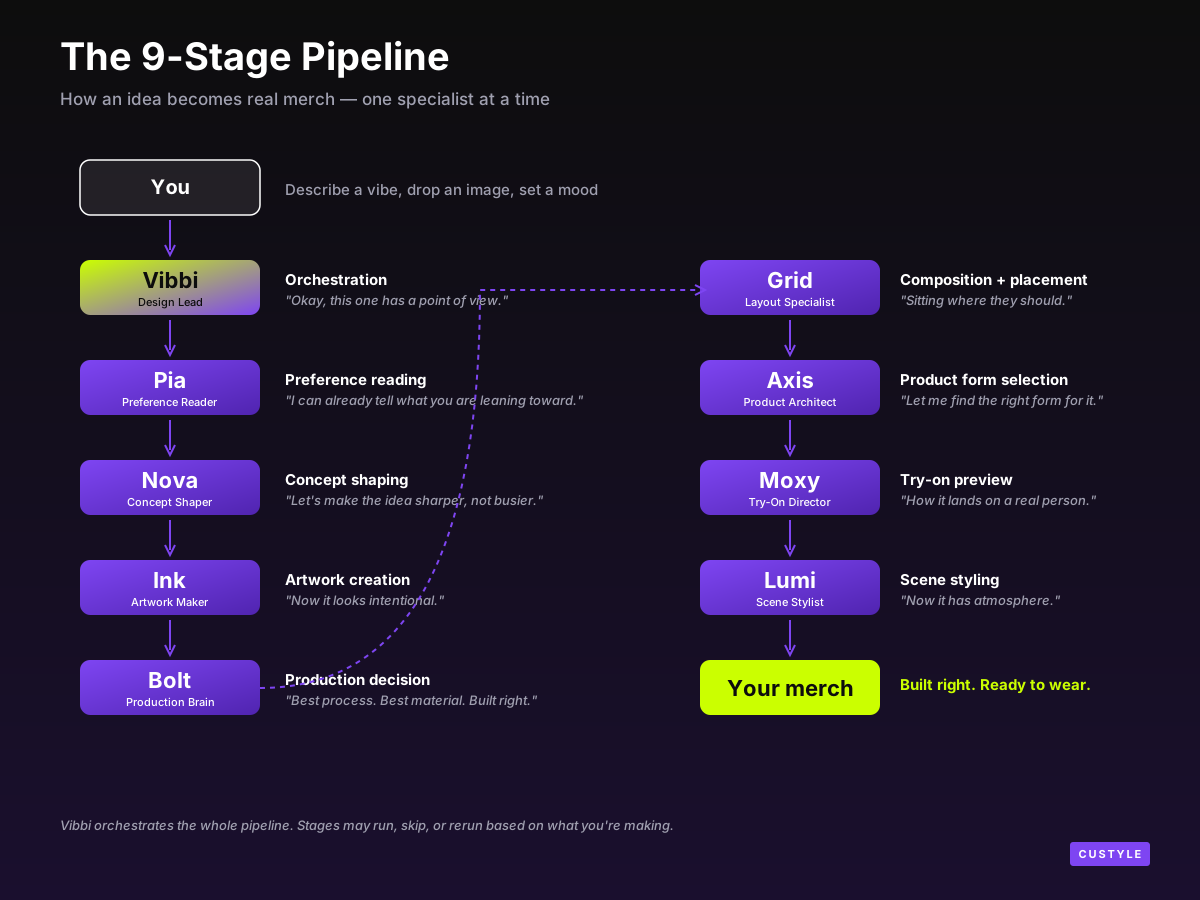 Each handoff is a decision. Vibbi orchestrates above the whole flow.
But the Crew isn't a literal assembly line. Vibbi is the orchestrator above it, deciding which steps to run, in what order, and which to skip when they don't apply. If you upload a finished design, Vibbi skips Nova and Ink. If you're remixing an existing product, Vibbi skips Axis. The pipeline is a default, not a script.
This matters because Vibbi also handles cross-references between results. After a search produces three trend directions, "use the second one" resolves to a specific one — not a guess. After a creation produces nine variants, "make the third one warmer" lands on the right variant. Vibbi keeps track of what the second one means at any given moment.
The result is a system where you keep changing what you want — and the Crew keeps catching up without losing track. That's the part one giant model gets badly wrong: context drifts, the model forgets which "third one" it's talking about, and you have to restart.
What This Means for You
The Crew architecture isn't just an org chart for our AI. It changes what you can do.
You can change one thing without restarting. Don't like the artwork but love the product choice? Ink redraws. Axis stays. Don't like the layout but love the artwork? Grid moves it. Ink stays. In a single-model system, changing one thing often means rolling the whole dice again.
You can ask why a decision was made. Why this material? Bolt picked it because of the artwork's color depth. Why this print position? Grid weighed the breathing room against the garment shape. The Crew can explain its own decisions because each one was actually made by a different specialist — not generated as a post-hoc rationalization by a single black box.
You see consistent personality. The same Vibbi welcomes you back next month. Pia still remembers what you didn't like last time. Bolt still talks like a craftsperson. The voices don't drift because they're brand-locked, not session-generated.
You get sharper merch. Taste division of labor is the whole point. Pia detects what you like. Nova sharpens the concept. Ink obsesses over the visual detail. Bolt argues for the right material. No single model is allowed to be a generalist. Generalists make generic merch.
Built for Agents, Not Just People
The Crew is the human-facing side of Custyle. But Custyle was built with another audience in mind: other AI agents.
Each of Custyle's five capability domains — Create, Shop, Inspire, Transact, Converse — is a clean interface that other systems can call. ChatGPT can ask Custyle's Shop domain to find a product. Claude can ask Custyle's Create domain to generate a design. A future AI assistant building a gift can call Custyle's Transact domain to actually place the order.
This means the same architecture serves two audiences at once. The Crew translates the system into characters humans like talking to. The domain APIs translate it into protocols other agents can call. Both layers run on the same nine-stage pipeline underneath.
This is the deeper bet behind the Crew framing. As more commerce happens through AI assistants — through ChatGPT shopping, through Perplexity buying, through agentic checkout — the brands that win will be the ones who can be called as a service, not just visited as a website. The Crew is what makes Custyle feel like a brand. The domains are what make Custyle callable. Both matter.
FAQ
Why does Custyle use 9 AI agents instead of one model?
Merch involves nine different judgment calls — reading taste, sharpening concepts, drawing artwork, picking materials, choosing products, placing layouts, staging previews, building scenes, and orchestrating the whole thing. A single model does all of these fine. Nine specialists do each one well. Custyle splits the work so each decision gets the right kind of intelligence, not just the biggest one.
Who is Vibbi?
Vibbi is the design lead and orchestrator of the Custyle Crew. Vibbi is the one you talk to — the floating orb that persists across the experience as your guide. Vibbi doesn't make the merch directly. Vibbi decides which specialists to call, in what order, and keeps track of what you mean across the whole conversation. Vibbi's voice is confident but not arrogant. Opens with "Let's."
What does Pia do that a chatbot can't?
Pia reads taste, not just instructions. A chatbot turns your words into a literal response. Pia turns your words, your past references, your mood, and the things you didn't say into a taste read that informs every decision downstream. The second time you use Custyle, Pia already knows what your version of "minimal" means. That's the difference between an AI that listens and an AI that remembers.
How does Bolt decide which manufacturing technique to use?
Bolt reads the artwork, the product, and the material — then picks the technique that builds it best. A tightly inked illustration with three colors gets a different technique than an all-over gradient. A cotton tee gets a different technique than a synthetic. Bolt doesn't ask you to pick — Bolt picks for you and tells you why. The result is merch that's built right, not just printed.
Is the Crew just branding, or are there really 9 different AI systems?
There are nine real capabilities, and each member owns one. The Crew is not a UI skin on a single model. Each member maps to a distinct stage of Custyle's pipeline, with its own logic, its own decisions, and its own voice. The characters make the system easier to talk about — but the system underneath is genuinely multi-agent.
Can the Crew handle requests from other AI agents?
Yes. Custyle's nine capabilities also run as five clean domain APIs — Create, Shop, Inspire, Transact, Converse — that any AI agent can call. ChatGPT, Claude, Gemini, or any MCP-compatible system can ask Custyle to find a product, generate a design, or place an order. The Crew is the human-facing version of the same system that's also callable as a service.
How are the Crew members updated as AI improves?
The Crew's roles, voices, and decision logic stay stable while the underlying models get better. When a new model release improves visual generation, Ink benefits without becoming "Ink 2." When production data gets richer, Bolt's calls get sharper without changing who Bolt is. The characters are the brand contract; the intelligence underneath keeps evolving.
Start With a Vibe
You don't have to know which crew member does what. You just describe what you want — and the right specialists show up.
Ready to make something?
Turn your ideas into real merch with AI. No design skills needed.
Start with a vibeCustyle Lab
Research & Guides · May 17, 2026·16 min read
Further Reading
Explore all →
Inside Moxy & Lumi: How Custyle Stages Your Product Before You See It
Moxy and Lumi are the presentation layer of the Custyle Crew — Moxy shows how your merch lands on a real person; Lumi builds the mood, context, and atmosphere around what you made.
Read more →
Creator Merch Case Study: How to Build a Merch Line in One Afternoon
A creator merch case study you can copy: real benchmarks (0.5–2% conversion, $68 AOV), an hour-by-hour afternoon build, and a fill-in template for your first drop.
Read more →
Inside Axis & Grid: Custyle's Form-and-Composition Crew
Axis and Grid are the structure layer of the Custyle Crew — Grid gets composition, spacing, and placement right; Axis finds the right product form your idea should live on.
Read more →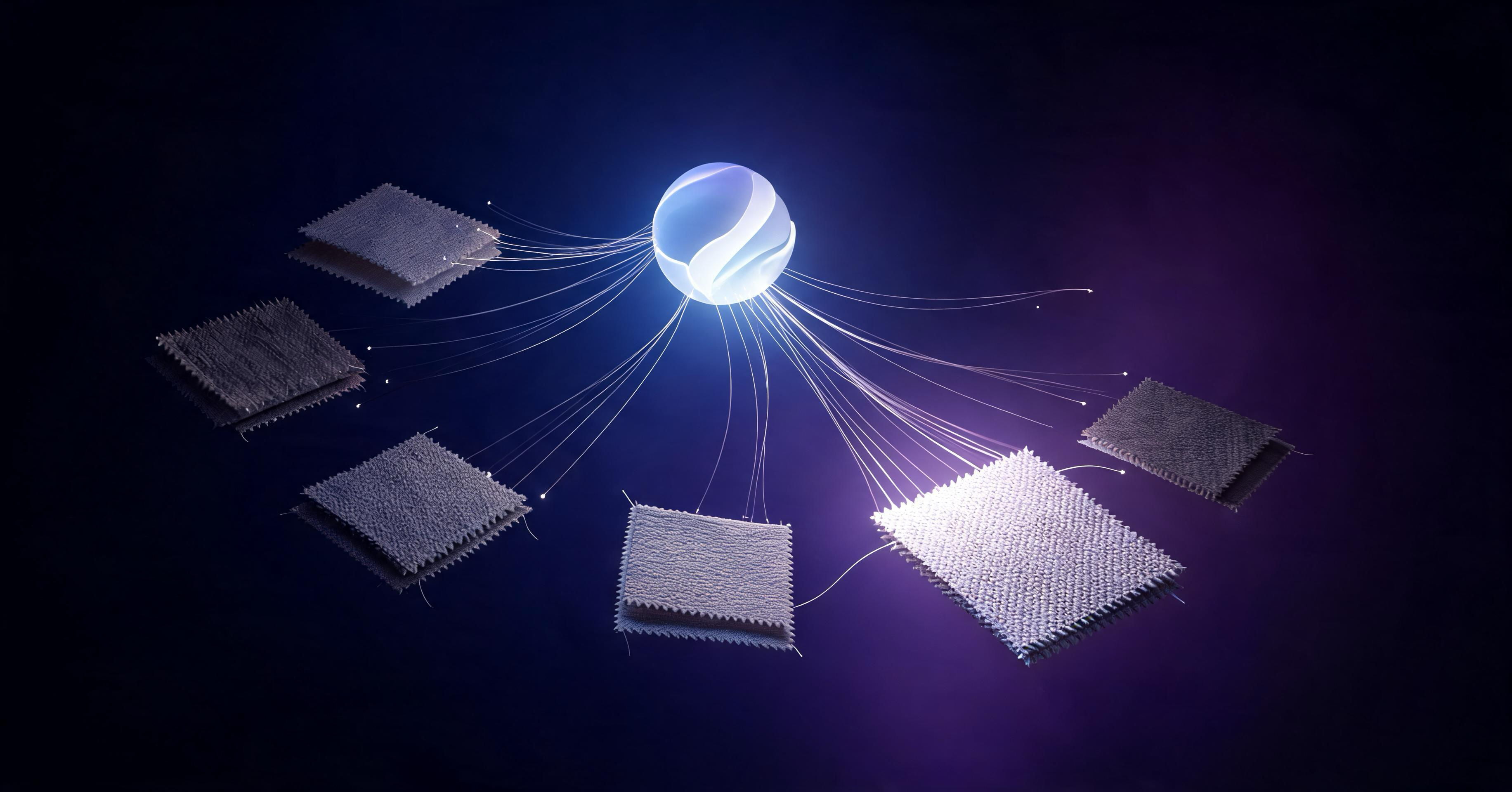
Inside Bolt: The Production Brain That Picks Materials Without Asking
Bolt is the AI production brain of the Custyle Crew — the agent that picks the process, material, and build quality for every design. Here is how.
Read more →