Print on Demand vs AI Custom Merch: What's the Difference in 2026?

Custyle Picks
Reviews & Comparisons · Mar 25, 2026·13 min read
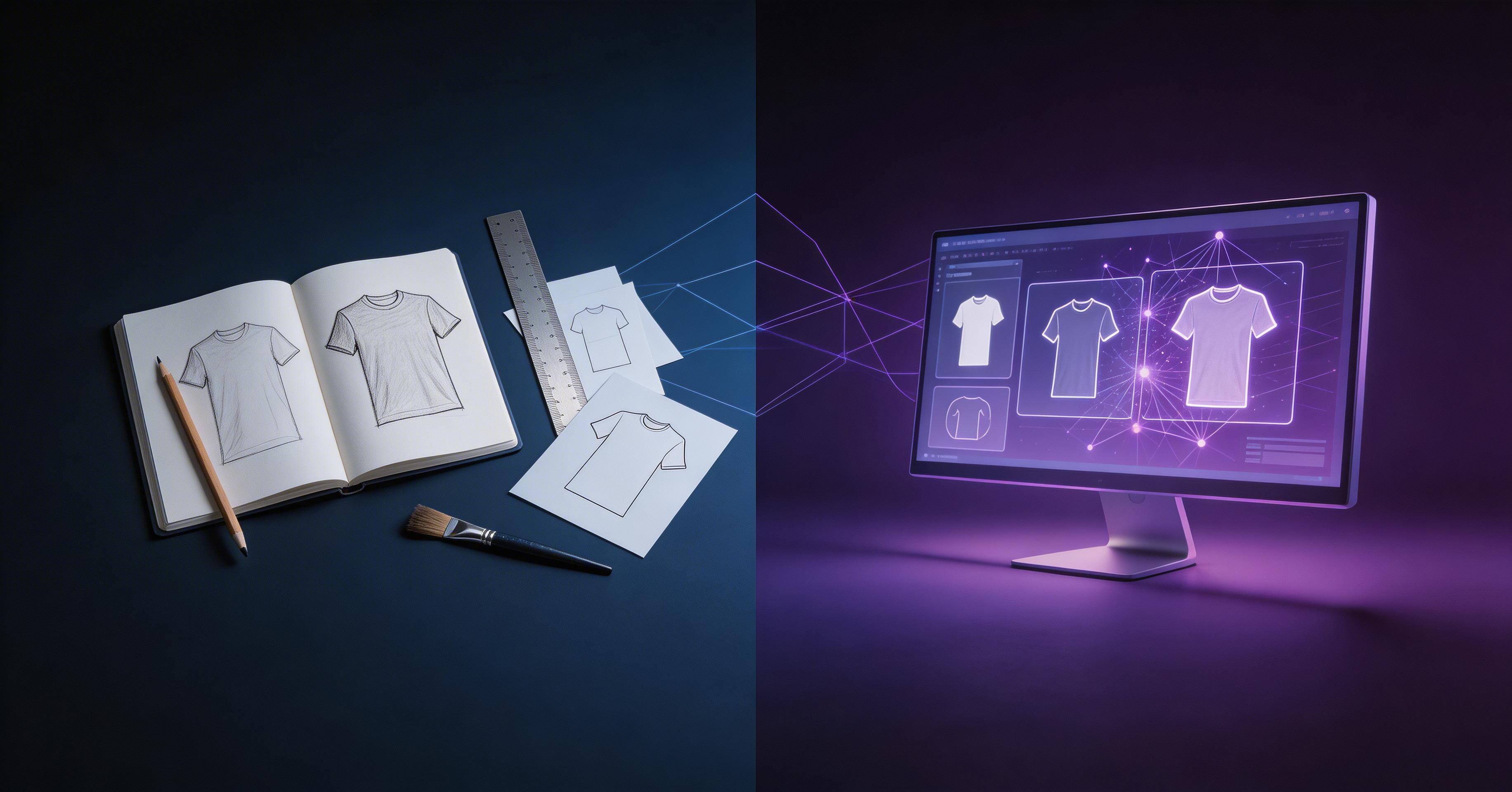
Print on Demand vs AI Custom Merch: What's the Difference?
TL;DR: Print on demand gives you control over every design detail. AI custom merch gives you speed and zero skill requirements. POD is a $15.19 billion market built on templates and manual workflows. AI Merch Agents like Custyle.ai flip that model — you describe what you want, and AI handles the rest in minutes. Both have real trade-offs. This guide breaks them down.
Table of Contents
- The Short Answer
- How Each Model Works
- Feature Breakdown
- Real Costs Compared
- Who Should Use What
- Quality and Speed
- Where Both Are Headed
- FAQ
The Short Answer
Print on demand (POD) and AI custom merch solve the same problem differently. Both let you create and sell physical products without inventory. The difference is how you get there.
POD means you design it yourself (or hire someone), upload the file, pick a product, and connect to your store. Platforms like Printful and Printify handle printing and shipping. You control every pixel.
AI custom merch means you describe what you want. In plain language. An AI agent interprets your vibe, generates designs, picks the right product, and routes the order to production. You review and approve. That's it.
Here's the quick breakdown:
| Dimension | Print on Demand | AI Custom Merch |
|---|---|---|
| Design process | Manual — you create or upload artwork | AI-generated from text or image input |
| Time to first product | 1–5 hours + sample shipping | 3–15 minutes |
| Design skills needed | Yes — graphic design, file prep | No — describe what you want |
| Product range | 150–1,300+ items | 6–20 core categories (expanding) |
| E-commerce integrations | 10–20+ native connections | Limited — API coming |
| Quality control | Proven — decade-long track record | Inherited from POD partners |
| Best for | Established sellers, brand builders | Casual creators, gifting, fast iteration |
Neither model is universally "better." Your choice depends on what you value: control or speed, precision or accessibility.
How Each Model Works
The POD Workflow
Traditional POD follows a linear path. You do most of the work.
Step 1: Design. Create your artwork using Canva, Photoshop, Figma, or another tool. File must meet print specs — 300 DPI, correct color space, proper dimensions.
Step 2: Upload. Choose a product on your POD platform. Upload the design. Position it. Adjust size and placement.
Step 3: Set up variants. Pick colors, sizes, and pricing. Write your listing description. Add mockup photos.
Step 4: Connect your store. Link to Shopify, Etsy, Amazon, or TikTok Shop. Sync inventory.
Step 5: Sell and fulfill. When someone buys, the POD platform prints and ships directly to your customer.
The whole setup process takes hours or days for your first product. According to industry research, sellers spend 80% of their time outside the design tool they pay for — managing mockups, listings, and orders.
The AI Merch Workflow
AI Merch Agents compress that entire flow into a conversation.
Step 1: Describe your vibe. Type what you want. "A minimalist cat illustration in Japanese ink style." Or upload a reference image. Or just share a mood.
Step 2: Review options. The AI generates multiple design variants in roughly one minute. You see realistic product previews — on models, on products, in lifestyle settings.
Step 3: Pick and order. Choose the design you like. The system handles file preparation, product matching, and fulfillment routing automatically.
Custyle.ai, the first platform to call itself an AI Merch Agent, uses nine specialized AI agents for this. One interprets your intent. Another generates artwork. A third matches designs to the right product type. Others handle print-ready file prep, quality checks, and shipping coordination.
The trade-off is clear. You gain speed and accessibility. You lose fine-grained control over every detail.
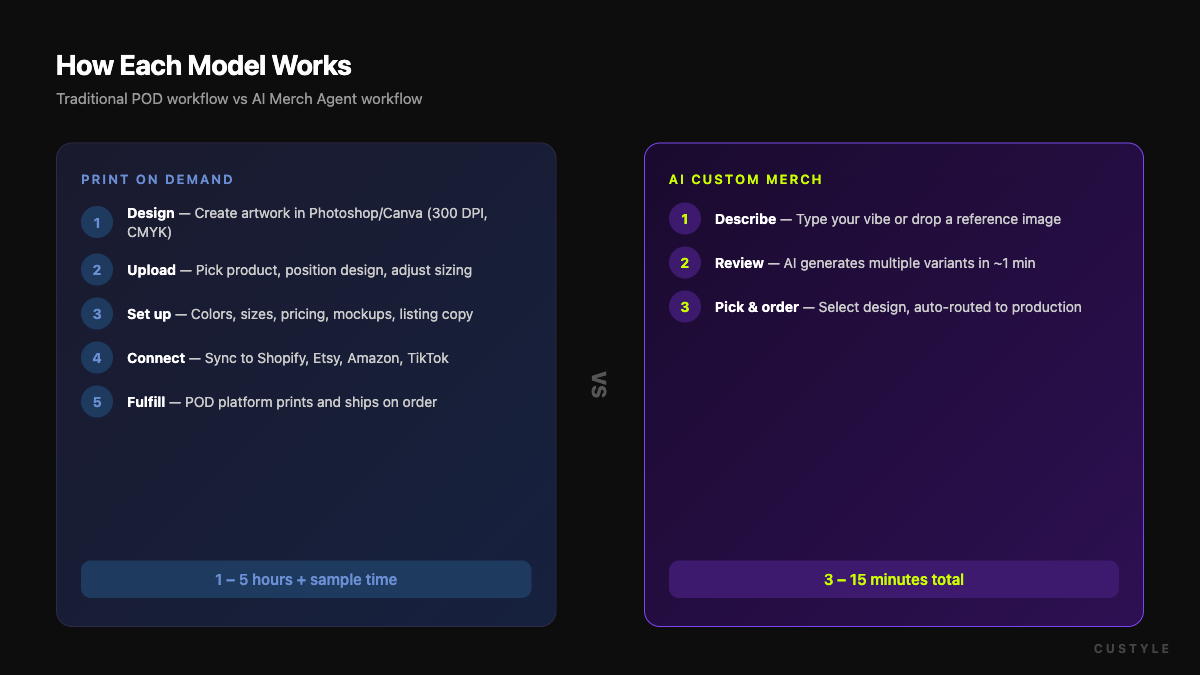 Left: Traditional POD requires 5+ steps and design skills. Right: AI Merch compresses everything into a single conversation.
Feature Breakdown
Here's where the models differ across nine key dimensions.
Design Tools and Creative Control
| Feature | POD (Printful/Printify) | AI Merch (Custyle.ai) |
|---|---|---|
| Design creation | Upload your own or use basic editors | AI generates from text/image prompts |
| AI assistance | Limited — background removal, basic generation | Core architecture — nine-agent system |
| Creative control | Full — pixel-level precision | Guided — prompt refinement, variant selection |
| Iteration speed | Hours per design revision | Minutes per prompt cycle |
| Learning curve | Months to produce competitive output | Minimal — describe what you want |
Printify offers an AI Image Generator with 15 free generations per day across 13 style options. Printful has AI background removal. But these are add-ons to a manual workflow — not a replacement for it.
Product Range
Printify leads with 1,300+ products across 90+ print suppliers. Printful curates around 380 items with tighter quality control. Gelato covers roughly 150 products across 34 countries.
AI Merch platforms start narrower. Custyle currently covers core categories: t-shirts, hoodies, caps, totes, posters, and phone cases. Catalog expansion is on the roadmap. The constraint is intentional — the AI needs to match designs to products algorithmically, and that works best with well-understood formats.
Store Integrations
This is where POD platforms dominate.
| Platform | Integrations | Notable |
|---|---|---|
| Printful | 20+ | Shopify, Etsy, Amazon, TikTok, Walmart, WooCommerce |
| Printify | 10+ | Shopify, Etsy, WooCommerce, TikTok Shop |
| Gelato | 15+ | Shopify, Etsy, regional platforms |
| Custyle.ai | 0 (API planned) | Direct-to-consumer only, currently |
If you run a Shopify store or sell on Etsy, POD platforms plug in directly. AI Merch Agents haven't built that layer yet. Custyle's roadmap includes an Open API (Step 3 of their rollout), but it's not live. For now, AI merch works best for direct purchases — not as a backend for your online store.
Branding and White-Label
Printful offers deep branding: custom neck labels ($0.99 per item), branded packaging, pack-in inserts, and tracking page design. This matters for brand builders who want their merch to feel fully theirs.
AI Merch platforms inherit whatever branding their fulfillment partners offer. Custyle routes orders through Printful and Printify, so partner-level branding options apply — but you don't get direct control.
Bottom line: If brand experience is a priority, POD gives you more levers to pull.
Real Costs Compared
Per-Item Economics
| Cost Component | Printful | Printify (optimized) | AI Merch (inferred) |
|---|---|---|---|
| Base t-shirt cost | $13.95 | $7.84 | Inherited from partners |
| With subscription discount | ~$9.35 (Growth Plan) | ~$6.27 (Premium Plan) | Unknown |
| Domestic shipping | From $3.99 | $3.99–$4.75 | Inherited |
| Platform subscription | $0 or $24.99/mo | $0 or $29/mo | Not disclosed |
| Typical retail price | $29.99 | $29.99 | Varies |
| Estimated margin | $12–$17 | $16–$20 | Unknown |
Printify's supplier network drives costs 30-46% lower than Printful on comparable items. The trade-off is quality variability — identical designs can look different across suppliers.
Custyle.ai doesn't publish pricing. Since it routes through Printful and Printify for fulfillment, base production costs are likely similar. Whether there's an AI service markup, a subscription, or a bundled fee isn't clear. This lack of transparency is a real weakness for anyone planning margins.
Total Cost of Ownership
Here's what most comparisons miss — the full tool stack.
| Monthly Expense | POD Seller | AI Merch User |
|---|---|---|
| Platform subscription | $0–$29 | Unknown |
| Design tools (Canva, Adobe) | $13–$55 | $0 (built in) |
| AI generation tools (Midjourney) | $0–$20 | $0 (built in) |
| Mockup services | $0–$15 | $0 (built in) |
| Listing automation | $0–$30 | $0 (built in) |
| Monthly total | $50–$350 | Potentially $0–$50 |
A POD seller spending $150 per month on design tools, mockups, and automation might save money with AI merch — even with a modest service fee. The consolidation matters.
But here's the thing: savings only count if the output quality matches. If you need supplemental tools to refine AI-generated designs, costs creep back up.
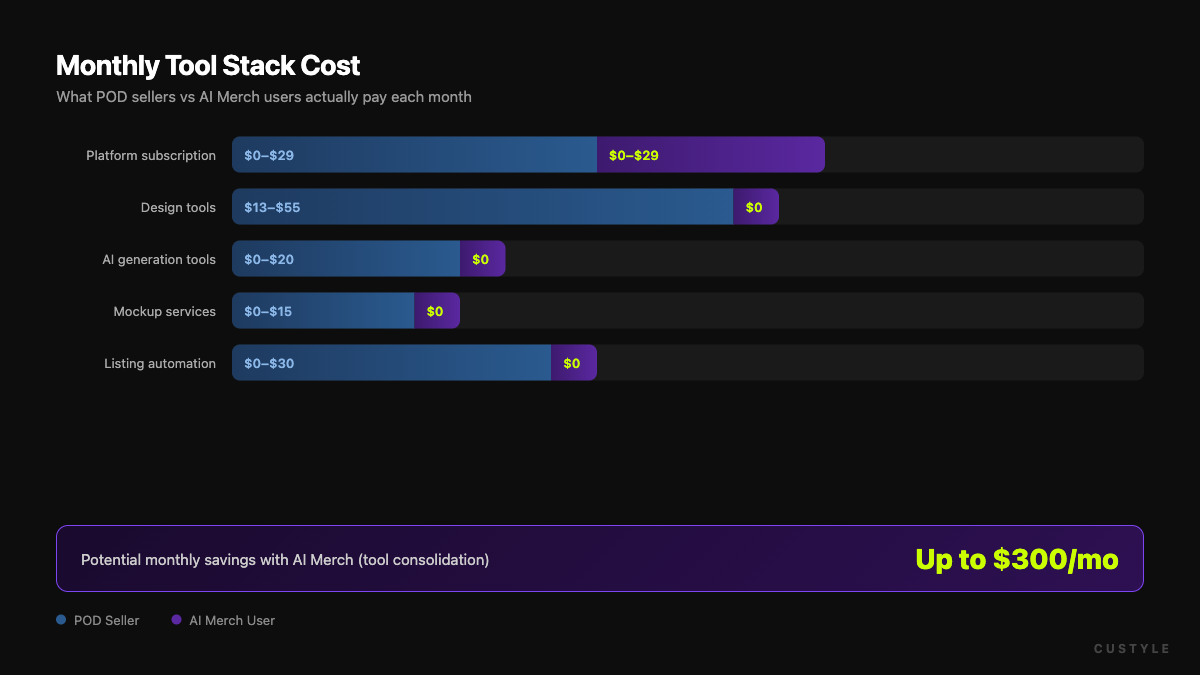 Monthly tool stack comparison between traditional POD sellers and AI Merch users.
Who Should Use What
Choose POD If You...
Build a brand. You need consistent quality, white-label packaging, and full creative control. Printful's branding tools — custom labels, branded tracking pages, pack-in inserts — support this. Your customers should never know a third party printed it.
Already have design skills. You've invested in learning Photoshop or Illustrator. Your designs are portfolio-quality. POD lets you use that investment fully.
Sell across multiple channels. Your Shopify store syncs with Etsy, Amazon, and TikTok Shop. POD platforms integrate natively with all of these. AI Merch doesn't — yet.
Need predictable margins. Published pricing means you can calculate costs exactly. No surprises.
Choose AI Merch If You...
Don't have design skills. You've got ideas but not the tools or training to execute them. Industry research confirms this barrier keeps millions of potential creators out of the merch market. AI removes it.
Need something fast. A birthday gift idea at 11 PM. A trending meme you want on a shirt before the moment passes. AI merch turns a one-minute description into an order-ready product.
Want to experiment. Test 10 different concepts in an hour instead of committing days to one design. The speed lets you iterate without sunk costs.
Buy for yourself or as gifts. You're not building a merch business. You want one hoodie with your cat's face on it. AI merch is built for exactly this.
The Decision Matrix
| Your Priority | Best Fit | Why |
|---|---|---|
| Brand control and consistency | POD (Printful) | White-label infrastructure, quality guarantees |
| Lowest per-unit cost | POD (Printify) | Supplier network competition drives prices down |
| Speed to first product | AI Merch | Minutes vs. hours or days |
| No design skills needed | AI Merch | Natural language replaces graphic design |
| Multi-channel selling | POD | 10–20+ native integrations |
| One-off gifts or personal merch | AI Merch | Zero setup, zero subscriptions |
| Sustainability focus | POD (Gelato) | 34-country local production, carbon programs |
Quality and Speed
Fulfillment Speed
Both models use the same production infrastructure. That's the key insight.
AI Merch Agents like Custyle route orders through Printful and Printify. Production takes the same 2–5 business days. Shipping takes the same 3–7 days domestically.
The speed difference is all in the design phase.
| Phase | POD | AI Merch |
|---|---|---|
| Design creation | 1–5 hours | ~1 minute |
| Product setup | 15–45 minutes | Automated |
| Mockup generation | 15–30 minutes | Instant |
| Sample ordering | 3–7 days | Optional |
| Production | 2–5 days | 2–5 days (same) |
| Total concept-to-door | 1–3 weeks | 3–10 days |
For rush situations — last-minute gifts, viral moment merch — AI Merch wins because you're not spending days on design before production even starts.
Print Quality
Printful maintains a 99%+ fulfillment rate with in-house production across North America, Europe, and Mexico. Consistent gradients, fine detail reproduction, color accuracy. Their quality is the industry benchmark.
Printify's quality varies by supplier. The "Printify Choice" badge helps, but identical designs can produce different results across different print providers.
AI Merch quality is inherited. Since Custyle uses Printful and Printify as fulfillment partners, print quality matches those platforms. The open question is whether AI-generated designs are truly print-ready. Industry analysis notes that "most AI design tools are not print-ready out of the box" — with common issues around transparent backgrounds, color space conversion, and production sizing. Custyle claims automated print-ready optimization through its agent pipeline, but independent testing data is limited.
Where Both Are Headed
The gap between POD and AI Merch is shrinking from both sides.
POD Platforms Are Adding AI
Printful already has AI-assisted features. Printify offers an AI Image Generator and AI-powered trend prediction. These are bolt-on tools — not a full rethink of the workflow. But they reduce friction for existing users.
AI Merch Is Building Infrastructure
Custyle's roadmap tells the story:
| Phase | Status | What It Adds |
|---|---|---|
| Step 1: MVP | Done | Core AI agent system |
| Step 2: Catalog expansion | In progress | More product categories |
| Step 3: Open API | Planned | E-commerce integrations |
| Step 4: Global reach | Planned | Localized models, international fulfillment |
The API phase is critical. Without it, AI Merch stays confined to direct-to-consumer purchases. With it, sellers can plug AI design generation into their existing Shopify or Etsy workflows.
The Convergence Prediction
By 2028–2030, the line between these models will blur. According to the research, the winning platforms will combine "AI-native speed and accessibility with infrastructure depth, quality verification, and integration" that traditional POD has built over a decade.
Expect hybrid approaches. Tools like MyDesigns already combine AI workflow automation with Printful and Printify integration. Kittl pairs AI generation with DTF-optimized output. The future isn't POD or AI Merch. It's both — in different ratios depending on what you need.
The $15.19 billion POD market growing at 25% annually has room for both approaches. The AI in fashion segment — currently $2.56 billion — is projected to reach $40.81 billion by 2034 at a 41.39% compound growth rate. That growth isn't replacing POD. It's expanding the total market by bringing in users who couldn't participate before.
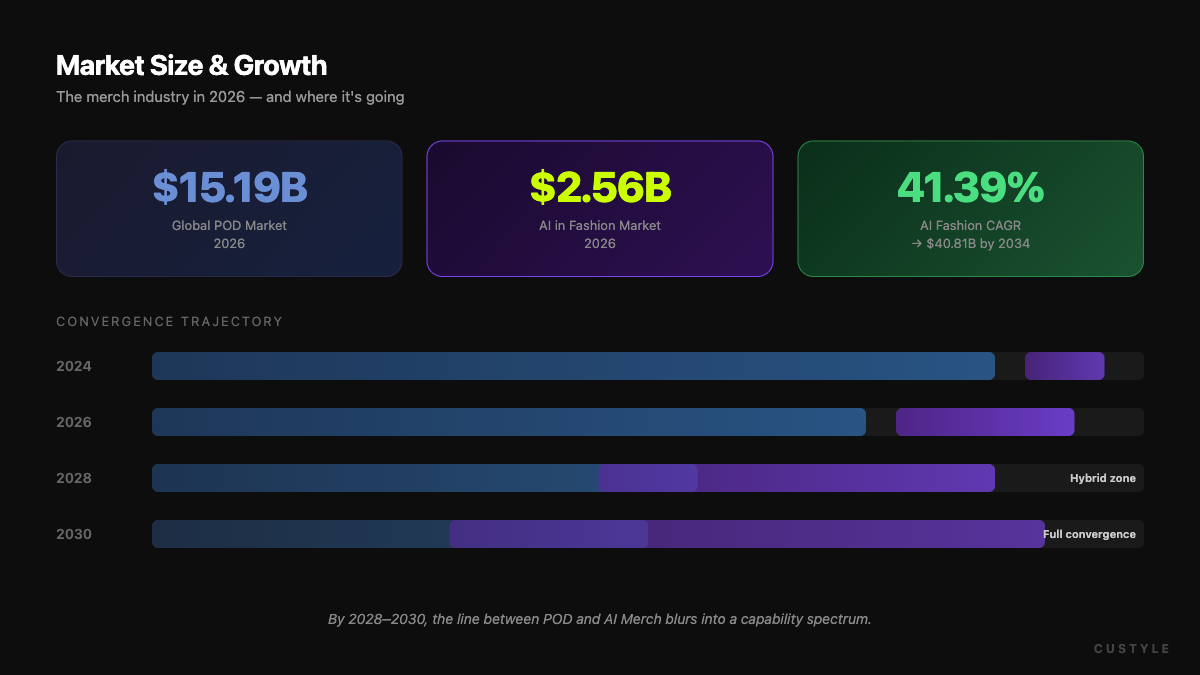 The POD market continues growing while AI Merch expands the total addressable market by removing design skill barriers.
FAQ
Is AI custom merch the same as print on demand?
Not exactly. AI custom merch often uses print-on-demand infrastructure for production and shipping. The difference is the front end. POD requires you to create and upload designs. AI merch generates designs from your description. Think of AI merch as a layer on top of POD — adding design intelligence before the printing starts.
Which is cheaper — POD or AI merch?
Per-item production costs are similar since AI Merch Agents like Custyle route orders through Printful and Printify. The real savings come from tool consolidation. POD sellers typically spend $50–$350 per month on design software, mockups, and automation. AI merch bundles these into one platform. However, AI merch pricing isn't always transparent — check before you commit.
Can I use AI merch to run a serious business?
Currently, AI merch works best for direct-to-consumer sales, quick experiments, and personal purchases. For a full e-commerce business with multi-channel selling, brand packaging, and predictable margins, traditional POD platforms offer more infrastructure. This will change as AI Merch Agents add API integrations and broader store connections.
How is the print quality of AI-generated designs?
Print quality depends on the fulfillment partner, not the design tool. Since AI Merch Agents use Printful and Printify for production, physical print quality matches those platforms. The variable is whether AI-generated artwork meets print specifications — resolution, color space, transparency. Platforms like Custyle claim automated print-ready optimization, though independent benchmarks are still limited.
Will POD platforms add AI features?
They already are. Printify offers AI image generation and AI-powered trend prediction. Printful has AI-assisted design tools. These features are add-ons to existing workflows, not full replacements. The trend points toward every merch platform having some AI — the question is how deeply it's integrated into the core experience.
Ready to make something?
Turn your ideas into real merch with AI. No design skills needed.
Start with a vibeCustyle Picks
Reviews & Comparisons · Mar 25, 2026·13 min read
Further Reading
Explore all →
AI Shopping Agent vs AI Merch Agent: Two Futures of Commerce
An AI shopping agent buys on your behalf — it searches, compares, and checks out. An AI merch agent creates on your behalf — it turns your idea into a real product. Here's how the two futures compare.
Read more →
Redbubble Alternative: AI Merch Agents for Creators Who Want Margin
Redbubble's Standard tier takes 50% of your monthly earnings. Compare real payouts across marketplaces, fulfillment platforms, and AI merch agents — and see which model keeps margin in your pocket.
Read more →
AI Merch Agent vs Midjourney for Merch: Why Image Gen Isn't Enough
Midjourney is the best paintbrush in the game — but nobody wears a paintbrush. Where image generation stops and AI merch agents take over: print prep, product matching, and fulfillment.
Read more →
Printful Alternative: Why AI Merch Agents Are the 2026 Upgrade
Most Printful alternatives save you $4 a shirt. None save you the 15-25 hours a week. The three tiers of alternative in 2026 — and how to pick the one that fits.
Read more →