Anthropic Computer Use Will Rewrite How Buyers Reach Merch

Arron Young
Founder, Custyle · Nov 8, 2026·12 min read

Anthropic Computer Use Will Rewrite How Buyers Reach Merch
TL;DR: Anthropic computer use lets Claude operate a screen the way you do: look, click, type. In 2026 it reached Chrome for every paid Claude plan, and Anthropic released an open blueprint for shopping agents. Agents now research and build carts. Payment still waits for a human. For merch, that means your next buyer may send an agent first. Stores that agents can read, and design steps they can follow, get picked.
Anthropic computer use commerce sounds like a niche developer topic. It isn't. It's a change in who shows up at your store.
For twenty years, a buyer meant a person with a mouse. Now it can mean a person, plus an agent doing the legwork. The agent reads every spec, compares every price, and gets stuck on anything it can't parse.
This piece is for merch sellers, creators, and small brands. I'll cover what Anthropic actually shipped in 2026, the two ways agents now reach a store, where they stop, and what I'd fix this month.
For the wider frame, read → Related: agentic creation vs. agentic buying first. This article zooms in on one company's tools and one kind of product.
Table of Contents
- What Computer Use Actually Is
- What Anthropic Shipped in 2026
- Two Roads Into Your Store
- Where Agents Stop Today
- Why Custom Merch Is the Hard Case
- What the Demand Data Says
- Your Agent-Ready Merch Checklist
- FAQ
- The Takeaway
What Computer Use Actually Is
Computer use is Claude operating a computer through screenshots and mouse and keyboard actions. Claude looks at a screenshot, decides what to do, and returns an action: click here, type this, scroll. An app on the developer's side carries out the action and sends back a new screenshot. Then the loop repeats.
Anthropic's computer use docs are plain about the mechanics. "Claude doesn't directly connect to this environment." It sees pixels. The current toolset has 17 actions, including screenshot, zoom, click, drag, scroll, and type.
That matters for commerce in one big way. A computer-use agent doesn't need your store to integrate with anything. If a person can use your site, an agent can try.
It also has a cost. Each screenshot runs roughly 1,000 to 1,800 tokens of context, per the same docs. Every page an agent has to "look at" is slower and pricier than a page it can read as data.
Computer use turns every website into something an agent can attempt. It doesn't make every website easy.
What Anthropic Shipped in 2026
Three moves in 2026 took this from demo to daily habit.
- March 23, 2026: Claude on your own computer. Anthropic said Claude could open apps, navigate a browser, and fill spreadsheets, prompted from your phone. It also said the feature was "still early compared to Claude's ability to code or interact with text," per CNBC's report. Claude asks permission before touching new apps.
- August 26, 2026: Claude in Chrome went generally available. It's on every paid Claude plan. It reads pages, clicks, types, fills forms, and "works with your existing logins," according to Anthropic's launch post. A safety classifier auto-approves actions it judges safe. You can switch that off and approve each step yourself.
- September 2, 2026: Claude for commerce. Anthropic released an open-source blueprint for two agents. One is a shopping agent for customers. The other is a merchant agent for the people running the store. Shopify, Priceline, Visa, Mastercard, Accenture, Square, and Wix all appear in the announcement.
Anthropic reports that retailers running Claude shopping agents saw "carts up to 35% larger." It also says shoppers were "60% more likely to complete a purchase." Those are company-reported numbers with no published baseline. Treat them as a signal, not a benchmark.
Anthropic has also tested agent-to-agent buying on itself. In Project Deal, 69 employees each got $100 and a Claude agent that bought and sold for them in Slack. The real run closed 186 deals across 500+ items, worth just over $4,000. The detail I keep coming back to: people whose agent ran on the weaker model got worse prices and didn't notice.
Two Roads Into Your Store
Here's the frame I'd use. In 2026, an agent reaches a store by one of two roads.
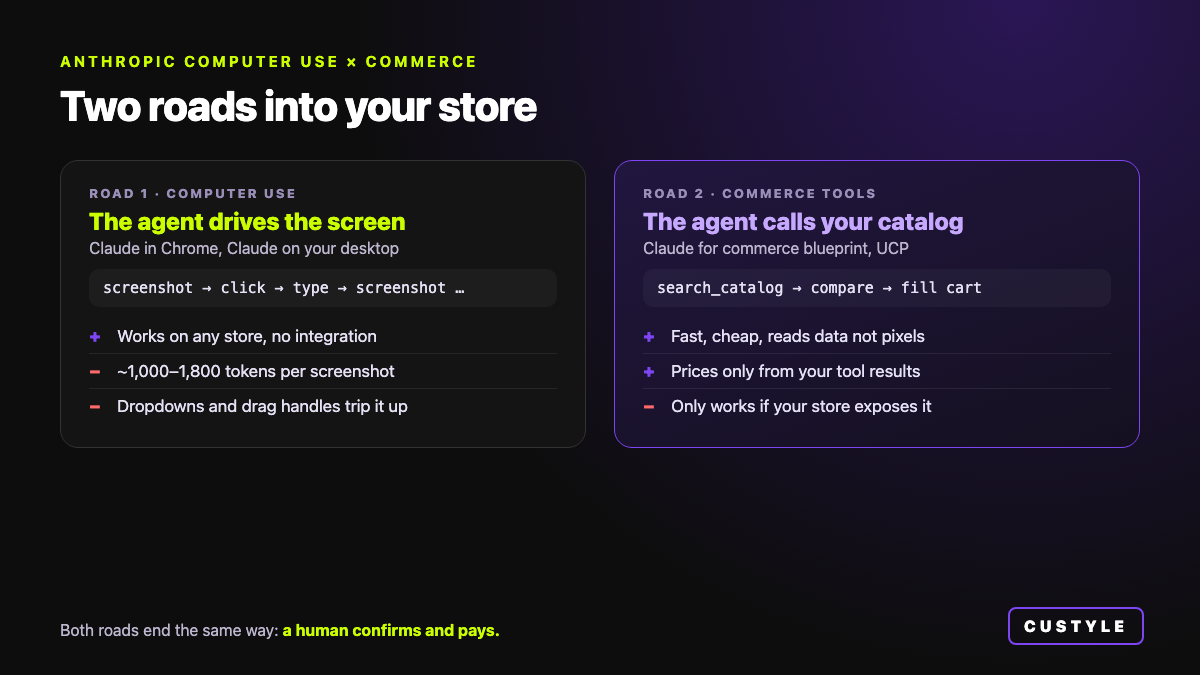
Road 1: The agent drives the screen. This is computer use. The buyer's agent opens your site in a browser and clicks around like a person. It works on any store, with no integration. It's also slow, costly, and brittle on complex pages.
Road 2: The agent calls your tools. This is the Claude for commerce blueprint. The store exposes its catalog, cart, and order systems as tools. The agent never "looks" at the page. It asks for data and gets data back.
The blueprint is strict about honesty. Per Anthropic's commerce agent guide, the shopping agent states products, prices, and availability "only from tool results." Cart writes accept only product IDs a catalog tool returned in that session. Your data is the agent's whole world.
The payment rails are filling in around both roads:
- Google's Universal Commerce Protocol (UCP) launched January 11, 2026, co-developed with Shopify, Etsy, Wayfair, Target, and Walmart.
- OpenAI and Stripe's Agentic Commerce Protocol handles checkout with single-use payment tokens.
- Visa Intelligent Commerce and Mastercard Agent Pay issue tokens scoped to an agent.
Anthropic sits in the reasoning layer and skipped the wallet. As PYMNTS put it, no transaction routes through Anthropic.
Road 1 means any store is reachable. Road 2 means some stores are easy. Agents, like people, prefer easy.
For the developer side of Road 2, see → Related: Claude Code commerce agents.
Where Agents Stop Today
Agents go far now. They still stop at the same place: the moment money or consent is on the line.
That's by design. Anthropic's own computer use docs advise "asking a human to confirm" any task "requiring affirmative consent, such as accepting cookies, completing financial transactions, or agreeing to terms of service."
The commerce blueprint goes further. "No method on that interface places an order or moves money." The agent fills the cart, then hands off to your checkout. The customer confirms there.
Safety is the other reason. In the August 2025 research preview of Claude for Chrome, prompt-injection attacks succeeded 11.2% of the time even with defenses, per The Register. By the August 2026 launch, Anthropic reported no successful attacks on its newest models with all safeguards on, and 0.3% on one. Anthropic's own line from late 2025 still holds: "no browser agent is immune to prompt injection."
So the practical shape of agentic shopping in late 2026 looks like this:
- The agent researches. It reads specs, reviews, and policies.
- The agent shortlists and compares. It's literal, so vague claims lose.
- The agent builds the cart.
- The human confirms and pays.
Steps 1 to 3 have moved to agents. Step 4 hasn't, and probably shouldn't yet.
Why Custom Merch Is the Hard Case
Custom merch is where this gets interesting, and hard.
Buying a blank tee is easy for an agent. Pick a size, pick a color, add to cart. Buying your tee is different. Someone has to place a logo on a left chest, pick ink colors, check a proof, and accept that custom items usually can't be returned.
Look at a typical design editor through an agent's eyes. Drag handles. Color pickers. Size grids in dropdowns. A canvas with no text in it. Anthropic's docs warn that "some UI elements (such as dropdowns and scrollbars) might be tricky for Claude to manipulate using mouse movements." Merch editors are mostly those elements.
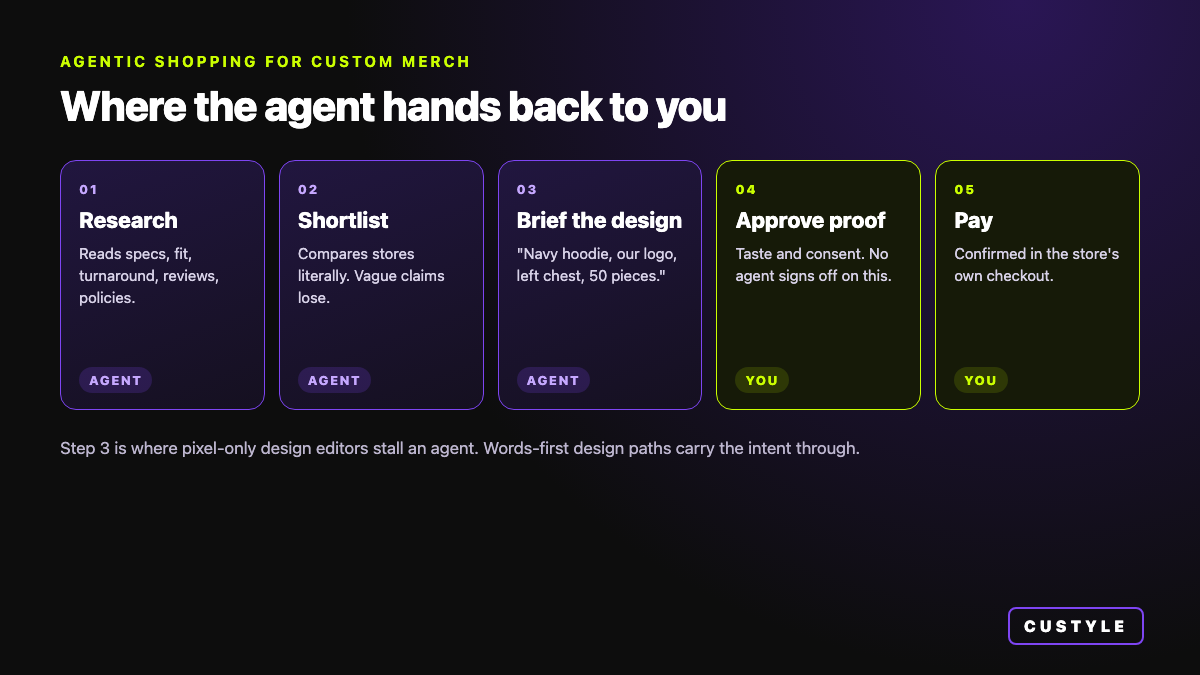
Then there's the proof. Approving a design is exactly the kind of "affirmative consent" Anthropic says a human should confirm. Even a perfect agent hands the proof back to you.
That splits the custom merch world in two:
- Pixel-first stores. The design step lives in a drag-and-drop canvas. Agents struggle, burn tokens, and often give up.
- Intent-first stores. You describe what you want in words: "navy hoodie, our logo, left chest, 50 pieces, by December 12." The store turns that into a design and a proof. An agent can pass that sentence along perfectly.
This is the bet behind Custyle.ai, the AI Merch Agent platform. You bring the intent. Our crew turns it into a design made for merch, and you approve the proof before anything gets made. That fits the shape agentic shopping is taking: agents carry intent, humans approve taste.
In agentic commerce, the design step is the new checkout. Whoever makes it readable wins the order.
What the Demand Data Says
The traffic is real and still small. Both things are true.
- AI-referred traffic is rising fast. Adobe Analytics reported AI-referred traffic to US retail sites up 393% year over year in Q1 2026. Growth has slowed since as the base grows, per Digital Commerce 360. Adobe sells analytics too, so read it as one vendor's lens.
- Those visitors buy. In August 2025, AI-referred visits converted 9% worse than other traffic. By March 2026, Adobe said they converted 42% more often.
- Shoppers are open but cautious. PYMNTS Intelligence and Worldpay found 45% of consumers would let an AI agent complete a purchase, rising to 54% for Gen Z. But 95% have at least one concern.
- Few actually hand over checkout. A First Page Sage panel of 4,936 US shoppers found only 6.8% had let an agent complete a checkout.
- Forecasts disagree wildly. McKinsey puts agentic commerce at $3 to $5 trillion globally by 2030. Bain says $300 to $500 billion in the US. One analysis counts a roughly 240x spread across forecasts.
Read together, the story is consistent. Agents already shape what people consider. They don't yet hold the wallet. That's the window to get ready.
Your Agent-Ready Merch Checklist
Here's what I'd fix this month if I sold merch online.
- Put specs in text, not images. Fabric weight, fit, print area, turnaround. Agents can't argue with a JPEG.
- Add product structured data. Variants, price, availability, and shipping time, all machine-readable.
- Keep prices consistent everywhere. Agents compare page, feed, and cart literally. Mismatches look like tricks.
- Offer a words-first design path. Let buyers describe placement and colors in plain text, not only by dragging.
- Make the proof shareable. A link the agent can hand back to the human for approval.
- Write your custom-order policy plainly. Returns, reprints, and minimums in one short block.
- Turn on agentic checkout if your platform has it. On Shopify, that's the UCP path through Agentic Storefronts.
- Track AI-referred traffic separately. It behaves differently, so measure it on its own.
None of this needs a big rebuild. Most of it is making the truth about your product easy to read.
FAQ
What is Anthropic computer use?
Anthropic computer use is a Claude capability for operating a computer through screenshots plus mouse and keyboard actions. Claude views the screen, returns actions like click, type, or scroll, and a developer's app carries them out. It first launched in October 2024. In 2026 it reached everyday users through Claude in Chrome on paid plans.
Can Claude buy things for me?
Claude can research products, compare options, and fill a cart. Anthropic's commerce blueprint deliberately has no method that places an order or moves money, and its docs advise human confirmation for financial transactions. In practice, you still confirm and pay. Payment flows through the store's checkout or an agentic payments provider, not through Anthropic.
What is Claude for commerce?
Claude for commerce is an open-source blueprint Anthropic released on September 2, 2026. It includes a shopping agent for customers and a merchant agent for store teams, with versions for retail, travel, telecom, and ticketing. It's a reference to fork and adapt, not a hosted product. Shopify, Priceline, Visa, and Mastercard are named partners.
How does agentic commerce affect custom merch?
Custom merch needs design placement, color choices, and proof approval, which are hard for agents to do on drag-and-drop editors. Proof approval also needs human consent. Stores that let buyers describe designs in words and share proofs as links are easier for agents to work with. Pixel-only editors are likely to lose agent-driven orders.
How do I make my merch store agent-ready?
Start with readable truth. Put specs in text, add product structured data, and keep prices consistent across pages and feeds. Offer a words-first way to describe designs. Make proofs shareable as links, and state your custom-order policy plainly. Then track AI-referred traffic separately so you can see what agents actually do.
The Takeaway
Anthropic computer use commerce isn't about robots buying hoodies. It's about who reads your store first.
In 2026, Claude learned to drive a browser for anyone on a paid plan. Anthropic also handed merchants a blueprint for agents that read catalogs directly. Both roads end in the same place: an agent does the research, and a human approves the final step.
For merch, the winners won't be the stores with the flashiest editor. They'll be the stores whose products, prices, and design steps an agent can understand, and whose proofs a human can approve in one tap.
Make your merch readable. The right buyer, and their agent, will find it.
Ready to make something?
Turn your ideas into real merch with AI. No design skills needed.
Start with a vibeArron Young
Founder, Custyle · Nov 8, 2026·12 min read
Further Reading
Explore all →
Same Idea, Better Prompt: 10 Before-and-After AI Merch Prompts
10 AI merch prompt examples, each written twice: the vague version, the sharper one, and the single decision that changes what you get back.
Read more →
Branded Merch for Small Businesses: AI-Designed Tees, Mugs & Totes Without an Agency
Small business branded merch no longer needs an agency or a 48-piece minimum. See what tees, mugs and totes return, what they cost, and a 7-step plan to start with one piece.
Read more →
Streamer Merch with AI: From Twitch Emote to Hoodie in an Afternoon
Your emote is 112 pixels. A hoodie front needs about 3,000. Here's the afternoon streamer merch design workflow, from rights check to sample order.
Read more →
Agent-to-Agent Commerce: When the Buyer's AI Talks to the Maker's AI
Agent to agent commerce got real rails in 2026, but every protocol assumes the seller is a catalog. Here's what changes when the seller's AI has to make the thing.
Read more →