When Shoppers Ask ChatGPT for Gift Ideas: How AI Search Is Changing Merch Discovery

Arron Young
Founder, Custyle · Nov 14, 2026·12 min read

Shoppers Ask AI First
TL;DR: AI search shopping discovery is growing fast, but from a small base. Adobe forecasts AI traffic to U.S. retail sites will rise 130% this holiday season. Surveys disagree on how many shoppers use it, from 28% to 65%. The pattern underneath is steady: shoppers use AI to research, then buy somewhere else. For merch sellers, that makes plain, specific product pages the job right now.
Table of Contents
- The Gift Prompt Has Arrived
- What the Traffic Data Shows
- Why the Surveys Disagree
- AI Is a Research Layer
- Gifting Is the Hard Case
- How Assistants Find Products
- Why Specific Merch Wins
- Your AI Discovery Checklist
- When Nothing in the Catalog Fits
- FAQ
The Gift Prompt Has Arrived
Picture the search. "Gift for my dad. He restores old Land Rovers. Under $40."
Nobody typed that into a search bar five years ago. It was too long and too personal. Today people type it into ChatGPT or Gemini without thinking twice.
That shift has a name: AI search shopping discovery. Shoppers describe a person, a budget and a feeling. An assistant answers with a short list.
This piece is for anyone who sells merch, especially small sellers and creators. You'll see what the 2026 holiday data says, where it contradicts itself, and what to do about it.
The short answer: AI is changing how products get found far faster than how they get bought. Your product page now has two readers. One is a person. The other is a model deciding whether to mention you.
What the Traffic Data Shows
Start with what gets measured, not what people say.
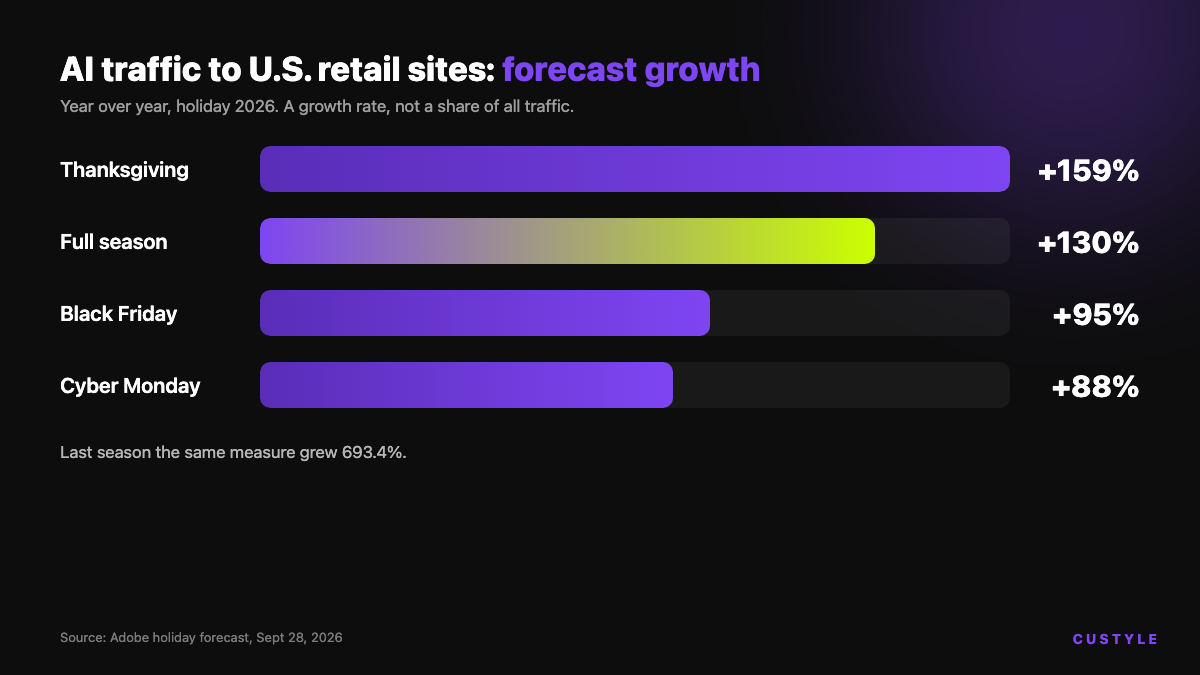
Adobe tracks visits to U.S. retail sites. In its September 28, 2026 holiday forecast, it expects AI traffic to rise 130% year over year this season. That counts shoppers who click a link from an AI tool between November 1 and December 31.
The peak days look like this:
| Day | Forecast AI traffic growth (YoY) |
|---|---|
| Thanksgiving | +159% |
| Black Friday | +95% |
| Cyber Monday | +88% |
| Full season | +130% |
Adobe also forecasts $275.1 billion in U.S. online holiday spend, up 6.7%.
Read the 130% carefully. It is a growth rate, not a share. Adobe's release does not say what slice of all retail visits comes from AI. Last season the same measure grew 693.4%, according to Adobe data cited by Tinuiti. So growth is cooling as the base gets bigger.
Quotable: Adobe forecasts AI traffic to U.S. retail sites will grow 130% year over year in the 2026 holiday season, down from 693.4% growth the season before.
Salesforce goes further. Its 2026 holiday predictions, published July 20, 2026, say "20% of all 2026 holiday ecommerce traffic will originate from AI chat agents." The same post says 50% of shoppers use an AI assistant at some point in the buying journey.
Treat that 20% as a forecast, and a broad one. Agent traffic is not only people arriving from a chat. Still, both companies point the same way. More shopping journeys now start with a question to a model.
Why the Surveys Disagree
Now ask shoppers directly, and the picture splits.
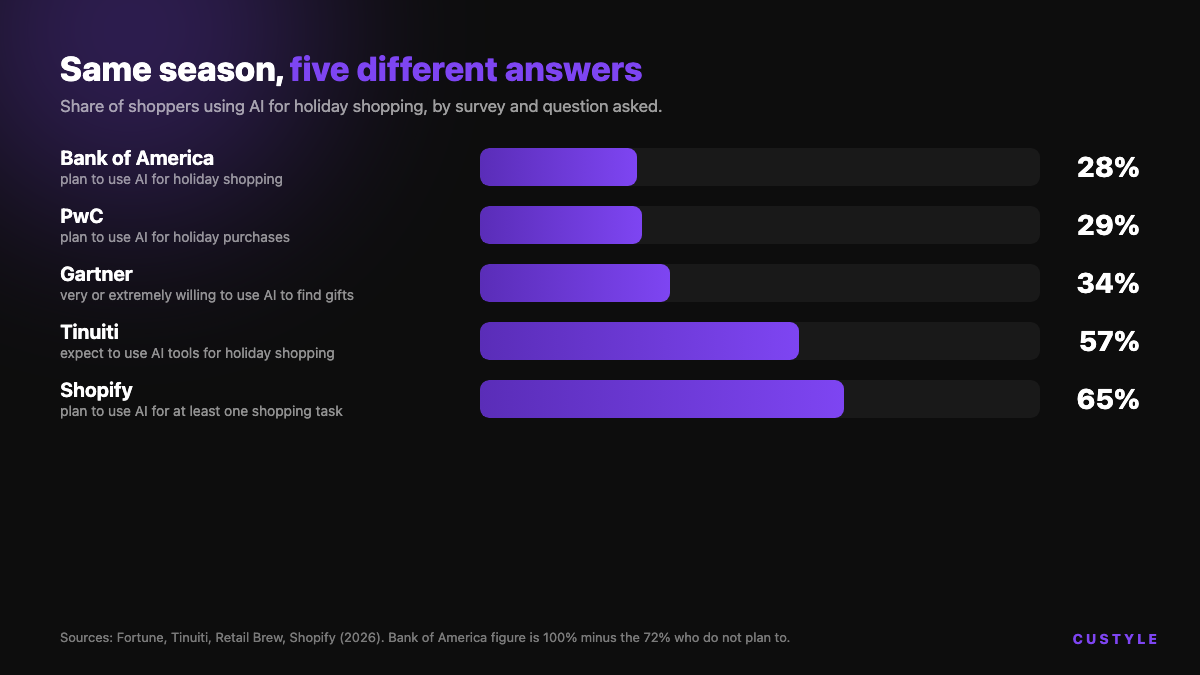
| Source | Who was asked | Finding |
|---|---|---|
| Bank of America, reported by Fortune (Nov 14, 2026) | Americans; sample not stated | 72% do not plan to use AI tools for holiday shopping, up from 49% in 2025 |
| PwC, cited by Tinuiti | Not stated | 29% plan to use AI for holiday purchases, up from 22% |
| Gartner, reported by Retail Brew | 1,004 U.S. consumers, August 2026 | 34% are "very" or "extremely willing" to use AI to find holiday gifts |
| Tinuiti (Nov 5, 2026) | 1,000 U.S. holiday gift buyers | 57% expect to use AI tools, versus 58% last year |
| Shopify 2026 Global Holiday Retail Report | Not stated | 65% plan to use AI for at least one shopping task |
That range runs from 28% to 65%. Same season, same country, more than double.
Three things explain most of it.
The question changes the answer. "Plan to use AI for holiday shopping" is a big commitment. "At least one shopping task" is a low bar. Asking a chatbot to compare two mugs counts for one and not the other.
The asker has a stake. A commerce platform and a bank frame the question differently. Neither is lying. Both are measuring what they care about.
Intent is not behaviour. Fortune's report notes the Bank of America survey measures intentions only. Meanwhile measured traffic keeps climbing.
So don't quote a single adoption number as the truth. Tinuiti's figure is flat year over year. Bank of America's is falling. Adobe's traffic is rising. All three can be right at once.
AI Is a Research Layer
Here is the finding that matters most for sellers.
Gartner found that shoppers who use AI for holiday inspiration consult 4.48 sources on average. Shoppers who don't use AI consult 3.24. That comes from Retail Brew's coverage of the survey.
AI users look in more places, not fewer. The assistant is not replacing the shopping trip. It is adding a step to it.
Quotable: Shoppers who use AI for holiday inspiration consult an average of 4.48 sources, compared with 3.24 for those who don't, according to Gartner's August 2026 survey of 1,004 U.S. consumers.
What people do with these tools backs that up. In Tinuiti's survey, the top uses were product searches at 26%, finding deals at 25%, and comparing products at 23%. In Bank of America's, 17% compare prices and 14% look for gift ideas or inspiration.
Buying is another matter. Shopify's holiday report says only one-third of shoppers trusted an AI agent to buy on their behalf. Checkout inside a chat exists. Most people still finish on a store's own site.
For you, this splits the problem in two. Getting mentioned is the new part. Closing the sale is the old part, and it still happens on your page.
Gifting Is the Hard Case
Gifts are where shoppers push back hardest.
Among people who won't use AI, Bank of America found 37% say it "takes away the personal aspect of gift giving." Another 42% cited personal or ethical reasons. And 26% said they don't trust AI recommendations.
That first objection is worth sitting with. People don't mind a machine comparing prices. They mind a machine choosing what says "I know you."
Look at how that plays out among people who do use AI. Shopify reports that 71% of regular AI users are more likely to choose an indie brand this year than last. And 81% are choosing more products because they feel personal, intentional or considered.
That is one platform's own survey, so hold it loosely. But the direction makes sense. An assistant can surface a thousand generic options in a second. Generic stops being a shortcut. The thing made for one person stands out more, not less.
Quotable: The top emotional objection to AI gift shopping is that it "takes away the personal aspect of gift giving," cited by 37% of non-users in Bank of America's 2026 survey.
How Assistants Find Products
No AI company publishes a ranking formula. Anything that claims exact weights is guessing.
What's left is a set of signals that sources broadly agree on. Treat them as direction, not rules.
- Structured product data. Price, availability, images and reviews in a format a machine can read.
- Product feeds. Shopify says its Catalog structures product data so agents can read it, and its Agentic Storefronts place products in ChatGPT, Google and Muse.
- Mentions elsewhere. Gift guides, editorial roundups and community threads. A model reads what others say about you.
- Crawler access. If you block AI crawlers, you may be invisible to them.
Vendor studies disagree on how much feeds matter versus ordinary product pages. Until that settles, do both.
The merchant stories in Shopify's report are more useful than any formula. Stanley 1913 saw five times as many AI-referred U.S. orders as the same period last year. Cottonique saw AI-referred sales rise 276%.
Their advice is plain. Describe the customer's problem in everyday language, because shoppers describe needs in their own words. And since agents compare on price first, write down why your product is worth it. Put that where an agent can find it.
If you're new to the wider shift, start with what agentic commerce is.
Why Specific Merch Wins
Go back to the Land Rover dad.
That prompt has no search volume. No keyword tool will ever show it. But it has a clear best answer, and a model will try to find one.
This is good news for niche merch. A shirt for people who restore old trucks is a weak match for "funny dad shirt." It is a strong match for a long, specific question. The more detail in the prompt, the better the odd, specific product looks.
There is a catch. The assistant has to know your product fits. That only happens if your page says so.
Here is where a lot of merch stores lose. Many sell the same blank products with the same supplier description. "Unisex heavy cotton tee, classic fit." A model reading fifty of those has nothing to tell them apart.
So say what only you can say:
- Who it's for. "For the friend who names their sourdough starter."
- What moment it's for. Birthday, retirement, team trip, inside joke.
- What's actually made for them. The name, the date, the drawing, the reference.
- Why it costs what it costs. One honest sentence.
Write it the way a shopper would ask for it. That is the language the prompt arrives in.
Quotable: A long gift prompt has no keyword volume but a clear best answer, which favors niche merch whose product page states exactly who it is for.
For seasonal ideas built this way, see our guide to AI Christmas gift merch.
Your AI Discovery Checklist
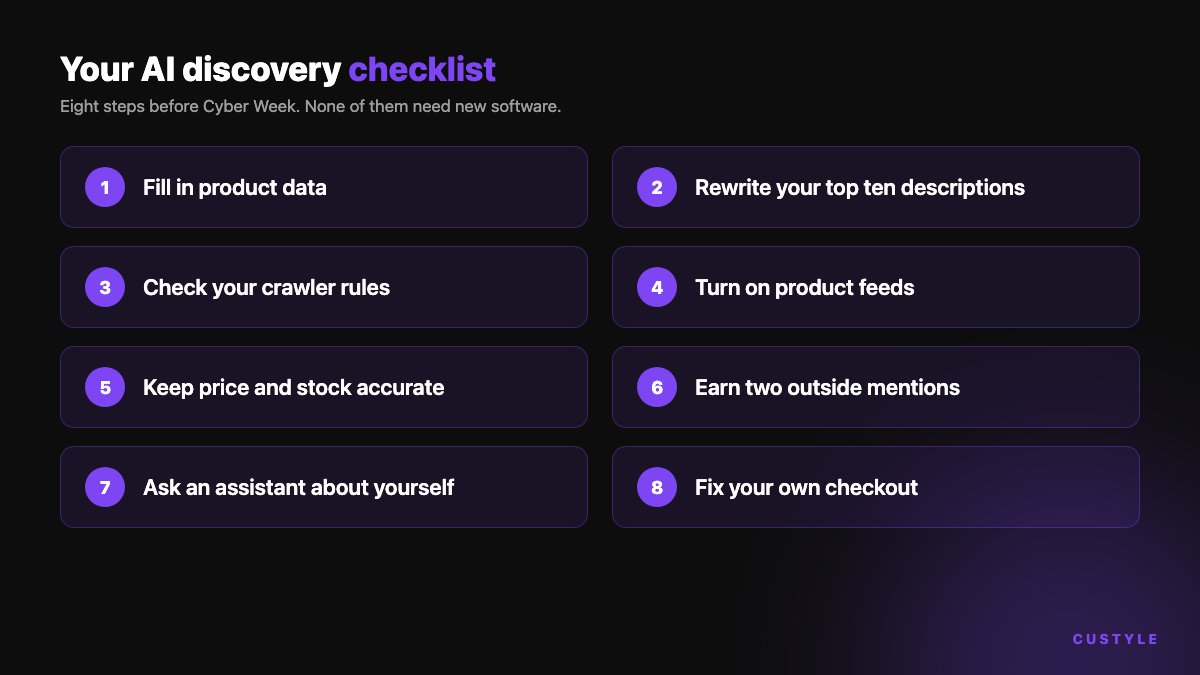
Run this before Cyber Week. None of it needs new software.
- Fill in product data. Price, stock, size range, images and reviews on every page.
- Rewrite your top ten descriptions. Add who it's for and what moment it's for.
- Check your crawler rules. Make sure you're not blocking AI search crawlers by accident.
- Turn on feeds where your platform offers them. It's usually a setting, not a project.
- Keep price and stock accurate. Stale data is a reason to skip you.
- Earn two outside mentions. A gift guide, a newsletter, a community thread.
- Ask an assistant about yourself. Type the prompt your buyer would. See who shows up.
- Fix your own checkout. Most shoppers still finish there.
The last one is easy to forget. Discovery gets you into the conversation. Your page still has to earn the order.
Creators selling to their own audience can go deeper in agentic commerce for creators.
When Nothing in the Catalog Fits
Follow the gift prompt to its end and something interesting happens.
The more specific the request, the less likely a ready-made product answers it. A dad, a 1972 Series III, and a joke about rust. At some point the right product doesn't exist yet.
AI shopping agents work on the finding side. They search what's already been made. The other half is the making side: turning that same description into a real product.
That's the category Custyle.ai works in, as an AI Merch Agent. You describe the vibe and a crew of AI specialists turns intent into a design made for merch. We've written about the difference between an AI shopping agent and an AI Merch Agent if you want the full picture.
To be clear about what we don't know: we have no data showing that assistants send shoppers to made-to-order products at scale. Nobody has published that yet. What the data does show is shoppers describing what they want in more detail than ever. That detail is exactly what making something needs.
What to Do Now
AI search shopping discovery is real, growing and smaller than the headlines suggest. Adobe's 130% is growth on a small base. The adoption surveys range from 28% to 65%. Most shoppers still buy on a store's own site.
The durable part is the behaviour. People now describe a person and ask for an answer. Sellers whose pages speak that language get found. Write for the prompt, keep your data clean, and make things worth choosing.
FAQ
What is AI search shopping discovery?
AI search shopping discovery is when a shopper finds products by asking an AI assistant, such as ChatGPT or Google Gemini, a question in plain language. The assistant replies with a short list of suggestions. Shoppers mostly use it to search, compare and find deals, then buy on a retailer's site.
How many shoppers use AI for holiday shopping in 2026?
It depends on the survey. Bank of America found 72% of Americans don't plan to use AI for holiday shopping. Tinuiti found 57% of U.S. gift buyers expect to. Shopify reports 65% plan to use AI for at least one shopping task. Question wording explains most of the gap.
Is AI traffic to online stores actually growing?
Yes. Adobe forecasts AI traffic to U.S. retail sites will rise 130% year over year for the 2026 holiday season, measured by shoppers clicking a link from an AI tool. That is a growth rate, not a share of total traffic. Growth was 693.4% the season before.
How do I get my merch recommended by ChatGPT?
No AI company publishes a ranking formula. The signals most sources agree on are complete product data, a product feed where your platform offers one, mentions in gift guides and community threads, and letting AI crawlers read your site. Describe who each product is for in plain language.
Do shoppers let AI agents check out for them?
Mostly not yet. Shopify's 2026 holiday report says only one-third of shoppers trusted an AI agent to buy on their behalf. Bank of America and Tinuiti both show comparing prices and searching for products as the main uses. Checkout still usually happens on the store's own site.
Ready to make something?
Turn your ideas into real merch with AI. No design skills needed.
Start with a vibeArron Young
Founder, Custyle · Nov 14, 2026·12 min read
Further Reading
Explore all →
Same Idea, Better Prompt: 10 Before-and-After AI Merch Prompts
10 AI merch prompt examples, each written twice: the vague version, the sharper one, and the single decision that changes what you get back.
Read more →
Branded Merch for Small Businesses: AI-Designed Tees, Mugs & Totes Without an Agency
Small business branded merch no longer needs an agency or a 48-piece minimum. See what tees, mugs and totes return, what they cost, and a 7-step plan to start with one piece.
Read more →
Streamer Merch with AI: From Twitch Emote to Hoodie in an Afternoon
Your emote is 112 pixels. A hoodie front needs about 3,000. Here's the afternoon streamer merch design workflow, from rights check to sample order.
Read more →
Agent-to-Agent Commerce: When the Buyer's AI Talks to the Maker's AI
Agent to agent commerce got real rails in 2026, but every protocol assumes the seller is a catalog. Here's what changes when the seller's AI has to make the thing.
Read more →