Behind the Scenes: How One Custyle Product Goes from Prompt to Box

Custyle Picks
Reviews & Comparisons · Aug 16, 2026·9 min read
Behind the Scenes: How One Custyle Product Goes from Prompt to Box
TL;DR: The Custyle product workflow runs your idea through 14 steps and 9 AI specialists — taste-reading, concept work, artwork, product matching, placement, previews, and quality scoring — before a single thread is touched. Then one physical piece gets made, checked, and shipped to your door. Nothing exists until you want it.
In this guide:
- What Happens When You Hit Send
- Step 1: Your Taste Gets Read
- Step 2: The Idea Gets Sharper
- Step 3: Directions, Not Guesses
- Step 4: The Artwork Takes Shape
- Step 5: Matched to the Right Product
- Step 6: See It Before It's Real
- From Checkout to Your Door
- Why One Piece at a Time Matters
- FAQ
What Happens When You Hit Send
Type a prompt. Get a box. Sounds like magic — it isn't. It's a pipeline.
The Custyle product workflow takes your idea through 14 digital steps before anything physical happens. Nine AI specialists — the Crew — each own one part of the job. One reads your taste. One sharpens the concept. One draws. One figures out how to build it. The rest handle form, layout, previews, and scene.
Then the physical side kicks in: payment, production, quality check, shipping. One piece, made for you, tracked to your door.
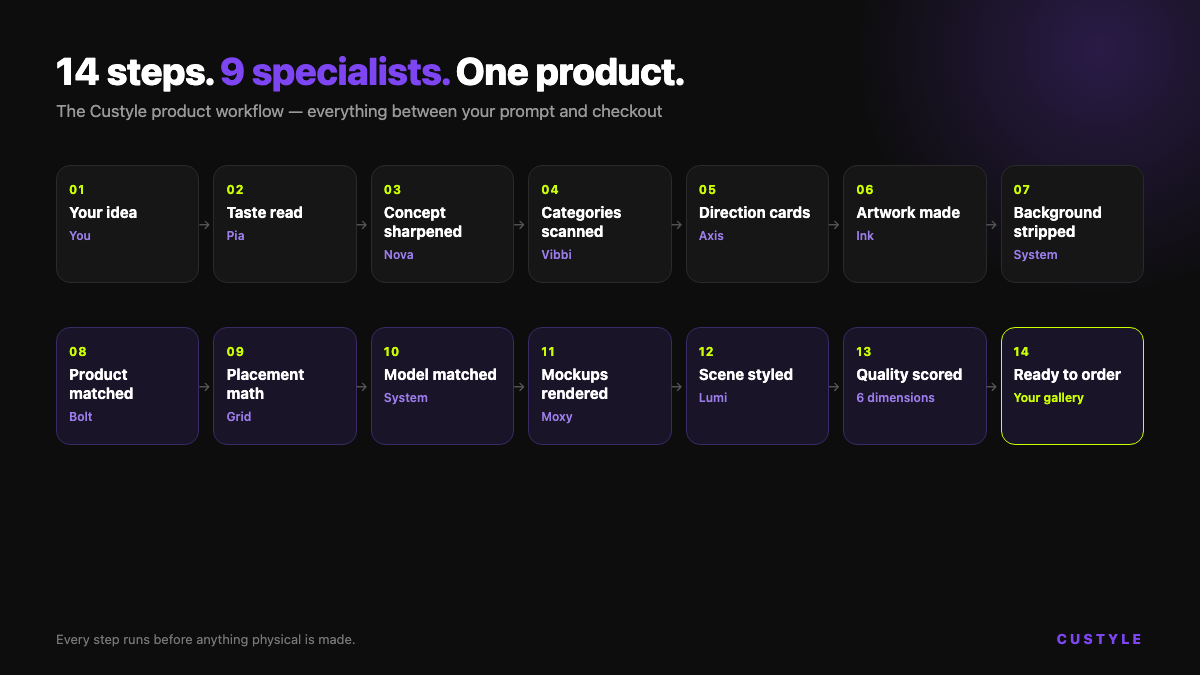 The full digital pipeline — every step runs before anything physical is made.
Most people picture "AI merch" as a picture slapped on a shirt. The real answer: it's closer to a small studio running a full creative brief on your behalf. This guide walks through every step — the visible ones and the invisible ones. If you've ever wondered what happens between "send" and "shipped," this is for you.
Step 1: Your Taste Gets Read
Every product starts with intent, not a template.
Drop an image, describe a mood, or just type what's on your mind. Pia — the Crew's preference reader — picks up your style, color leanings, fit, and budget. Not with a giant form. With a few sharp questions, generated on the fly for your specific idea.
Why this matters: the biggest failure mode in custom merch isn't bad printing. It's a design that technically matches your words but misses your taste. Reading preferences first means the pipeline works for your taste, not an average of everyone's.
And people care about that fit. According to Demand Sage, 54% of consumers globally will pay more for products that reflect their individuality. For clothing specifically, Customcy puts willingness to pay extra above 81%. Taste is the product.
Step 2: The Idea Gets Sharper
Loose prompts don't ship. Sharp ones do.
Nova, the concept shaper, takes what you gave and extracts the theme, the keywords, and the "wow twist" — the one element that makes the design feel intentional instead of generated. "My cat, but cool" becomes a real creative direction: attitude, style era, color story.
At the same time, Vibbi — the Crew's design lead — scans product categories that fit the idea. Here's a detail most people never see: when your idea could work across several categories, the system runs parallel tracks. A full pipeline per category, all at once, streaming results back as they land. Your one prompt might quietly become three competing product concepts.
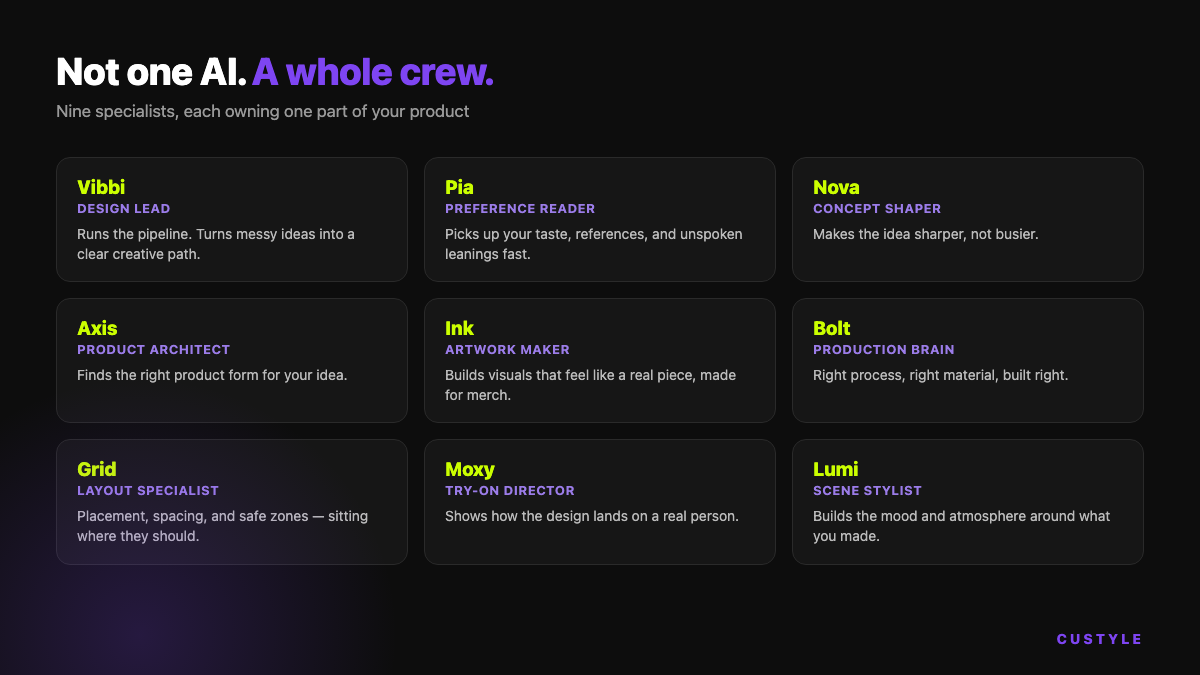 Nine specialists, one team — each owns a different part of your product.
Step 3: Directions, Not Guesses
Before any final artwork, Axis — the product architect — lays out 2–3 concept direction cards. Each one is a distinct take: different style, different energy, different product form.
This step exists for one reason: choice beats luck. A single AI generation is a coin flip. Curated directions turn the coin flip into a decision you make. You pick the direction that clicks. The pipeline commits to it.
Step 4: The Artwork Takes Shape
Now Ink gets to work. The artwork maker turns the chosen direction into a print-ready illustration — built through text-to-image or image-to-image generation, tuned for merch rather than for screens.
That "for merch" part carries real weight. A design that looks great on a phone can fall apart on fabric: wrong contrast, hairline details that vanish, colors that shift in production. Ink builds with the physical output in mind.
Then comes an invisible step: background removal. The artwork gets stripped clean so it can sit on a product like it belongs there — no white box, no rough edges. You'd only notice this step if it didn't happen.
Step 5: Matched to the Right Product
Here's where the Custyle product workflow splits from every image generator you've tried.
Bolt — the production brain — decides how the thing should actually be built. Fabric, weight, fit, color compatibility: Bolt matches your design against real product templates and picks the one that will carry it best. Not the most popular blank. The right one.
Grid — the layout specialist — does the placement math. Print areas have hard limits and safe zones. Grid calculates the size and position where your design sits exactly where it should — centered where centering works, offset where offset looks better, never bleeding into a seam.
You see none of this. That's the point. You feel it later, when the product arrives and just looks right. Quality you can feel, not specs you have to read.
Step 6: See It Before It's Real
Nothing gets made blind. Three preview layers stand between artwork and checkout:
- Model matching. The system picks a fitting model template for your product type.
- Mockups. Moxy, the try-on director, renders shop-grade product images of your piece.
- Scene shots. Lumi, the scene stylist, builds lifestyle imagery — your design on a body, in a mood, with atmosphere.
Then the pipeline grades itself. Every product gets scored across 6 quality dimensions before it lands in your gallery. Weak results get caught here, not at your door.
Only after all 14 steps does the product appear in your gallery — orderable, previewed, already vetted. Want to tweak it first? The edit workflow lets you regenerate the artwork, switch products, or redo the scene without starting over.
Curious how this looks from the user's side? See how it works from the first prompt onward.
From Checkout to Your Door
The digital half is done. The physical half is shorter — four stages — but it's where your product becomes an object.
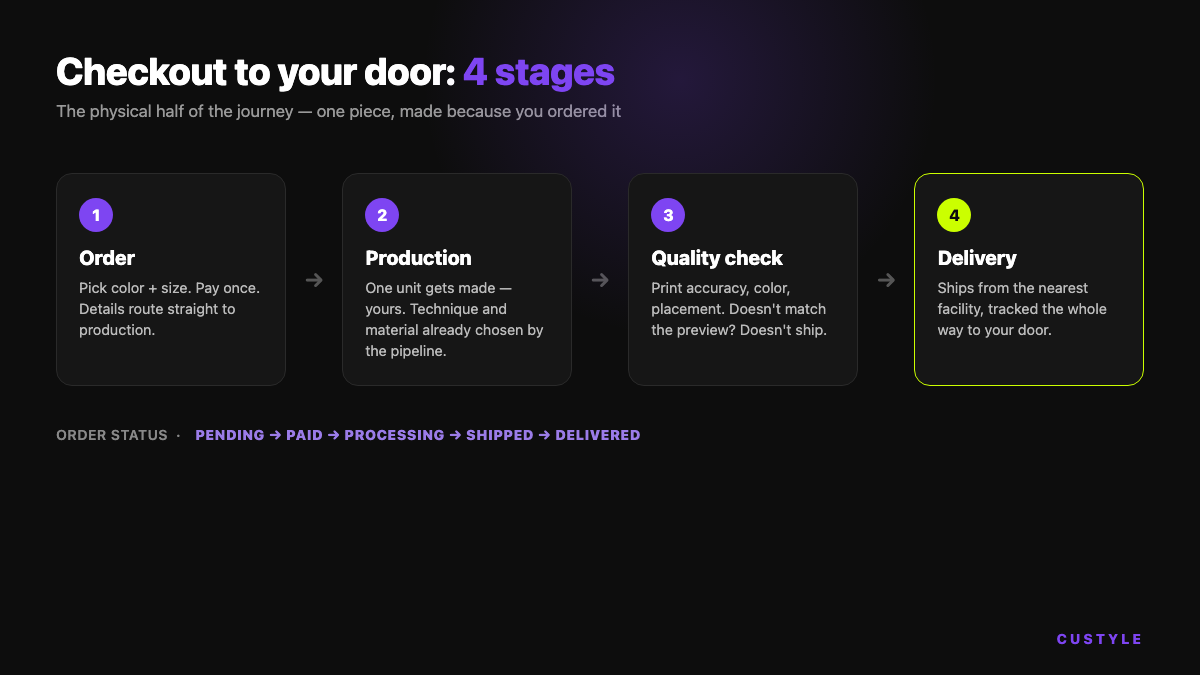 Four stages between checkout and your door — every one visible in your order status.
1. Order. Pick your variant — color and size — and check out. Payment runs through Stripe. Your order status moves from pending to paid, and the details route straight to production.
2. Production. One unit gets made. Yours. Modern single-piece printing produces full-color, high-detail work with no setup run — which is exactly why one-off custom pieces are viable at all. Industry-wide, single-piece garment printing carried about 44% of all custom-print production in 2025, per Mordor Intelligence. Custyle's pipeline picked the technique and material back in Step 5 — production just executes the call Bolt already made.
3. Quality check. Before packing, the piece gets inspected: print accuracy, color fidelity, placement. If it doesn't match what you previewed, it doesn't ship.
4. Shipping. The piece leaves the nearest production facility with tracking attached. Your order status walks through processing, shipped, delivered — and you can watch each step.
From prompt to box, the entire journey is one continuous chain. No warehouse in the middle. No pallet of extras. Just your piece, moving.
Why One Piece at a Time Matters
Making products only after someone wants them isn't just a business model. It's the answer to fashion's ugliest number.
The fashion industry discards roughly 92 million tonnes of textile waste every year, according to Printful's textile waste analysis. Up to 21% of newly made garments never sell at all. They're produced on a guess, and the guess misses.
On-demand production flips the order of operations. Fibre2Fashion reports that made-to-order models cut total production waste by 30–50%. Every Custyle piece exists because one specific person wanted it. The buyer comes first; the product follows.
The market is voting the same way. The global on-demand custom product market sits around $15 billion in 2026 and is projected to reach roughly $46 billion by 2031 — about 25% growth per year, per Mordor Intelligence. And per Marketing Charts, one in five consumers will pay up to 20% more for goods made to their taste.
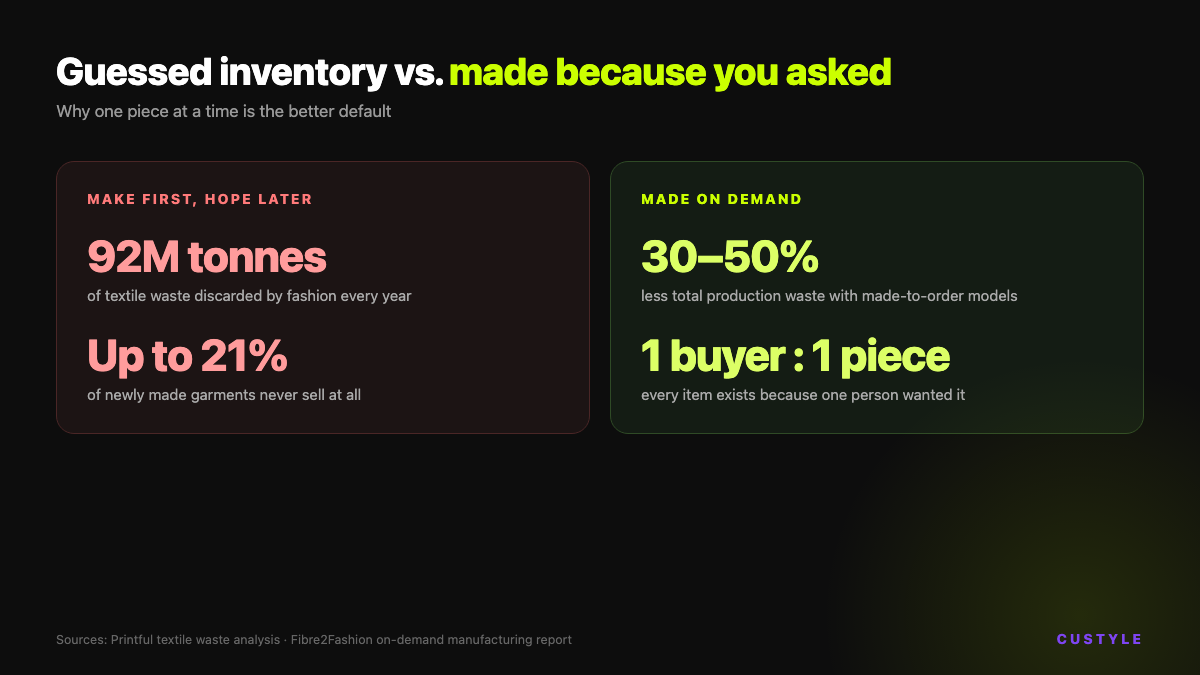 The numbers behind one-piece-at-a-time production.
Guessed inventory is the old default. Made-because-you-asked is the new one.
FAQ
How long does the whole process take?
The digital side — from prompt to a previewed, orderable product — runs in minutes. The physical side takes longer: your piece is made individually after you order, checked, then shipped with tracking. Total time depends on your product type and location, but every stage is visible in your order status.
Is each product really made individually?
Yes. Nothing is pre-made or pulled from a warehouse. Your order triggers production of exactly one unit, built with the technique and material the pipeline chose for your specific design. That's also why there are no minimum orders — the first piece is the only piece.
What if the design doesn't fit the product?
The pipeline prevents that before you ever see a preview. Bolt matches your design to product templates by fabric, fit, and color, and Grid calculates placement within the product's real print limits and safe zones. Anything that fails the 6-dimension quality score gets caught before checkout.
Can I change something after seeing the preview?
Yes. The edit workflow lets you regenerate the artwork, switch to a different product, redo the mockup, or restyle the scene — without restarting from your original prompt. Adjust until it clicks, then order.
Do I need design skills to use Custyle?
No skills needed. You describe the vibe — a feeling, a meme, a photo, a reference — and the Crew handles direction, design, build decisions, and previews. Your job is taste. The pipeline's job is everything else.
Your Move
Now you know what sits between a prompt and a box: 9 specialists, 14 steps, one quality gate, and a single piece made because you asked for it.
The Custyle product workflow exists so you don't have to think about any of it. Describe the vibe. Watch the previews land. Order the one that clicks.
Ready to make something?
Turn your ideas into real merch with AI. No design skills needed.
Start with a vibeCustyle Picks
Reviews & Comparisons · Aug 16, 2026·9 min read
Further Reading
Explore all →
Inside Moxy & Lumi: How Custyle Stages Your Product Before You See It
Moxy and Lumi are the presentation layer of the Custyle Crew — Moxy shows how your merch lands on a real person; Lumi builds the mood, context, and atmosphere around what you made.
Read more →
Creator Merch Case Study: How to Build a Merch Line in One Afternoon
A creator merch case study you can copy: real benchmarks (0.5–2% conversion, $68 AOV), an hour-by-hour afternoon build, and a fill-in template for your first drop.
Read more →
Inside Axis & Grid: Custyle's Form-and-Composition Crew
Axis and Grid are the structure layer of the Custyle Crew — Grid gets composition, spacing, and placement right; Axis finds the right product form your idea should live on.
Read more →
Inside Bolt: The Production Brain That Picks Materials Without Asking
Bolt is the AI production brain of the Custyle Crew — the agent that picks the process, material, and build quality for every design. Here is how.
Read more →