From NikeID to AI Agents: A Short History of Mass Customization

Arron Young
Founder, Custyle · Nov 17, 2026·13 min read
TL;DR: The history of mass customization runs through four eras. Factories learned to build to order in the 1980s and 1990s. Brands like Nike added option menus from 1999. Print on demand made one-off printing routine after 2005. AI agents now try to replace the menu with a plain-language brief. Each era fixed one bottleneck and exposed the next.
The history of mass customization is shorter than you'd think. The term is from 1987. The first famous shoe builder is from 1999. The idea that you could just describe what you want is a few years old.
One pattern holds across all of it. Every era solved one hard problem. Then the next problem showed up.
First the factory couldn't make one of something. Then the factory could, and you had to fill in a long form. Then printing one piece got easy, and you still needed a design. Now AI is taking a swing at that last part.
This piece is for you if you make merch, sell it, or write about where commerce is heading. It names dates and sources. It also marks where the record is thin.
Contents
- What Mass Customization Means
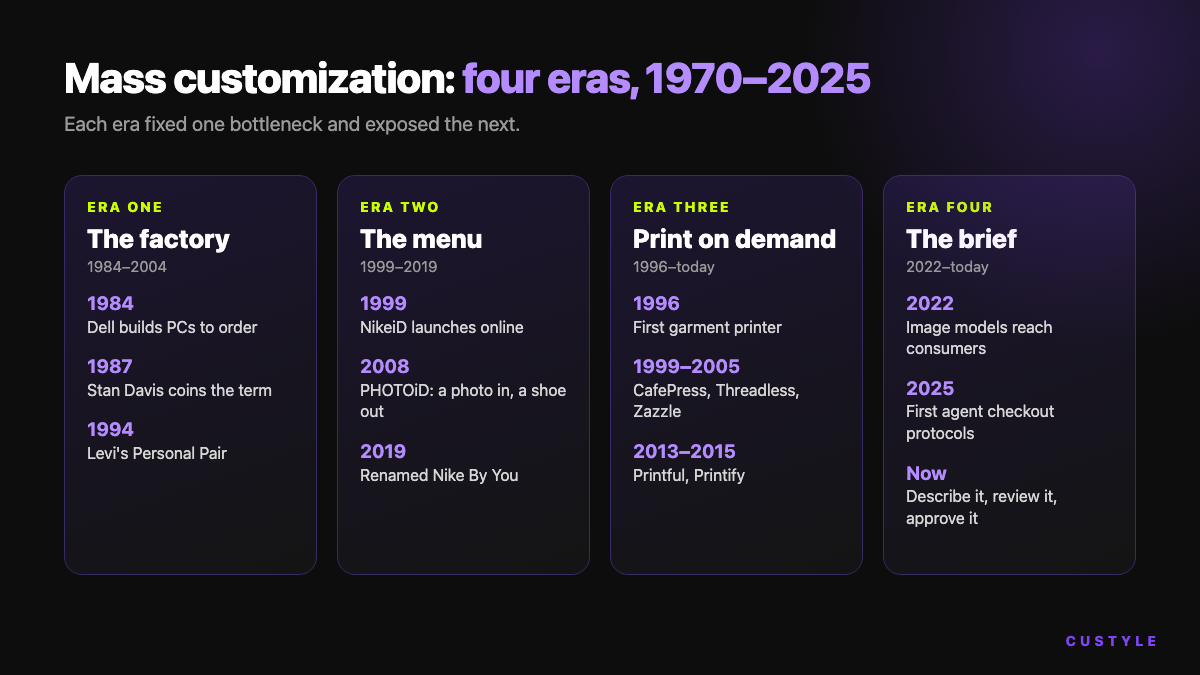
- The Timeline at a Glance
- Era One: The Factory Problem
- Era Two: The Menu Problem
- Era Three: Print on Demand
- Era Four: The Brief
- What Forty Years Keep Teaching
- FAQ
What Mass Customization Means
Mass customization is making goods for individual buyers at close to mass-production cost. The standard academic wording comes from Mitchell Tseng and Jianxin Jiao in 2001: "producing goods and services to meet individual customers' needs with near mass production efficiency."
The idea is older than the name. Alvin Toffler sketched it in Future Shock in 1970. Stan Davis named it in his 1987 book Future Perfect. His term was "mass customizing."
Davis had a simple argument. The Industrial Revolution made standard goods cheap. New technology would make variety cheap too.
B. Joseph Pine II turned the idea into a business playbook. His book Mass Customization: The New Frontier in Business Competition came out in 1993. By the mid-1990s the phrase was a management buzzword, according to Automation World.
The four faces
In January 1997, James Gilmore and Pine published "The Four Faces of Mass Customization" in Harvard Business Review. It split the idea into four approaches:
- Collaborative. The company works with you to define the product. A shoe builder is the classic case.
- Adaptive. You get one standard product and adjust it yourself. Programmable lighting is the usual example.
- Cosmetic. The product is standard. The presentation changes, like your name on the pack.
- Transparent. The company tailors the product without telling you.
Most of this history is about the first one. Collaborative is where the company has to understand what you want. That turned out to be the hard part.
The Timeline at a Glance
| Year | What happened | Why it matters |
|---|---|---|
| 1970 | Alvin Toffler anticipates the idea in Future Shock | The concept exists before the tools do |
| 1984 | Michael Dell founds PC's Limited, later Dell | Computers assembled to each buyer's choices |
| 1987 | Stan Davis coins "mass customizing" | The idea gets a name |
| 1993 | Joseph Pine publishes Mass Customization | The idea gets a playbook |
| 1994 | Levi's starts Personal Pair | Made-to-measure jeans in stores |
| 1996 | First commercial direct-to-garment printer | Printing one shirt becomes possible |
| 1997 | Gilmore and Pine publish "The Four Faces" | The idea gets a map |
| 1999 | NikeiD launches online; CafePress is founded | You choose options on a website |
| 2000 | Threadless is founded | The crowd picks the designs |
| 2004 | Levi's custom jeans program ends | The first big retreat |
| 2005 | Zazzle launches; new garment printers arrive | One-off printing spreads |
| 2013 | Printful is founded; Bain measures the gap | Demand is real, usage is low |
| 2015 | Printify is founded | One-off printing plugs into any store |
| 2019 | NikeiD becomes Nike By You | The menu era gets a rebrand |
| 2022 onward | Image models reach consumers | Artwork can start from a sentence |
| 2025 | First agent checkout protocols ship | Agents begin to place orders |
Era One: The Factory Problem
The first question was blunt. Can a factory make one of something without going broke?
Dell builds to order
Michael Dell said yes in 1984. He founded PC's Limited from his room at the University of Texas at Austin. The company became Dell Computer Corporation in 1987.
Dell sold computers straight to buyers. It assembled each unit to the options that buyer picked. You chose the parts. Dell built that machine.
The model worked because a PC is modular. Swapping a hard drive doesn't change the case. Dell's website took off in 1996 and 1997, and the option list moved online with it.
Levi's measures every customer
Jeans were harder. In 1994, Levi Strauss launched Personal Pair, a made-to-measure program for women's jeans. A store clerk took your measurements and typed them into a computer. You couldn't order online or by phone.
The press loved it. In September 1998, Fortune reported that Levi's had run the program for four years. It was about to relaunch as Original Spin, with more options and men's jeans.
It ended in 2004. A 2014 Retail Dive review said the program "never really took off." Reorders were difficult. Levi's didn't use it to gather feedback or build loyalty.
Read that list again. None of it is about sewing. The factory could make your pair. The system around you couldn't remember you.
Levi's custom jeans program ran for about ten years and ended in 2004. The reported causes were hard reorders and unused customer feedback, not production limits.
Era Two: The Menu Problem
The web fixed the store visit. You could now choose options at home. That created a new problem: the menu itself.
NikeiD puts the menu online
Nike launched NikeiD online in 1999. The first version was small. It offered a narrow range of materials and colors. It also had a short text field, so you could put a personal ID on the shoe.
Then it grew:
- 2005. Agency R/GA rebuilt the site. A Times Square billboard let people design a shoe from their phones.
- 2007. Nike opened physical NikeiD studios, including one in London.
- 2008. Nike PHOTOiD let you send a phone photo. Software pulled two main colors and proposed a shoe.
- 2012. An iPhone app arrived.
- 2019. NikeiD was renamed Nike By You.
Nike has never published a clear sales figure for the service, so this piece won't guess one.
PHOTOiD deserves a second look. Every other version asked you to specify a shoe. PHOTOiD asked you for a photo. You gave it a vibe, and it gave you a proposal. That was 2008. Hold onto that thought.
What the numbers said
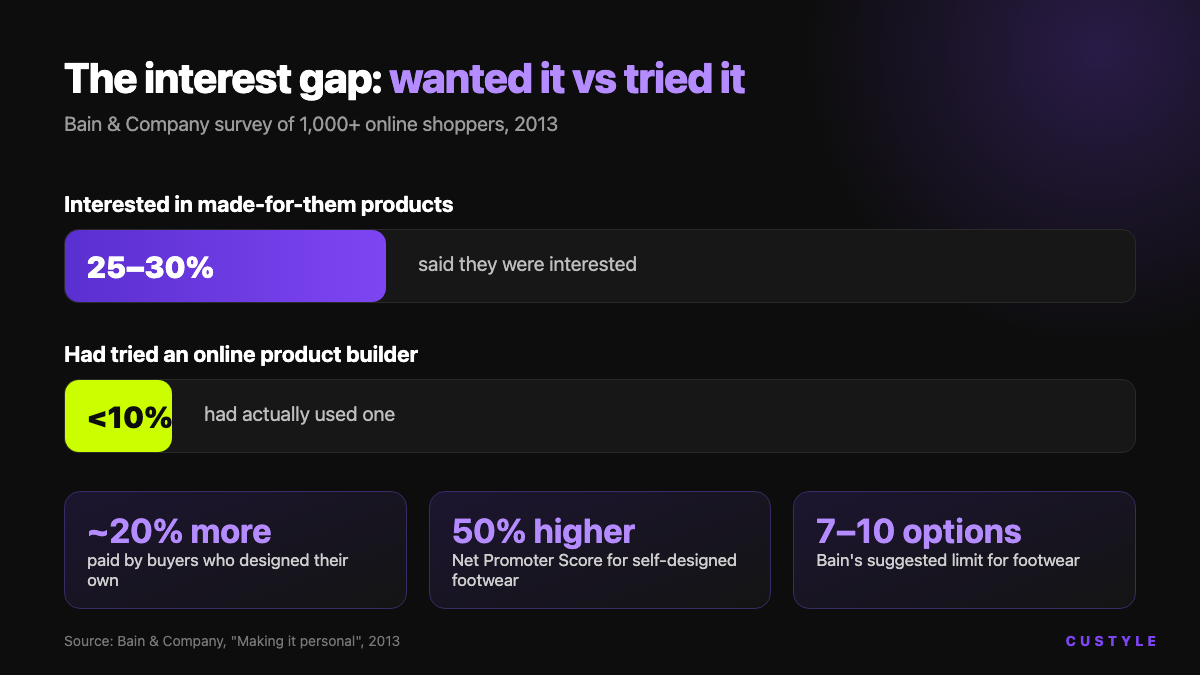
By 2013 there were dozens of online builders. Shoes, bikes, suits, bags, speakers. Bain & Company surveyed more than 1,000 online shoppers that year and published the results.
The findings were good news and bad news:
- Fewer than 10% of shoppers had tried an online product builder.
- Between 25% and 30% said they were interested.
- Buyers who did design their own paid about 20% more than for standard versions.
- Footwear buyers who designed their own shoes gave a Net Promoter Score 50% higher.
So the people who made it through loved the result. Most people never started.
Bain's advice explains why. For footwear, it suggested offering just 7 to 10 design options. More choice wasn't better. It was homework.
Bain also found that interest dropped fast when shoppers feared being stuck with something they disliked. A blank menu puts all the risk on you.
In Bain & Company's 2013 survey, 25% to 30% of online shoppers wanted made-for-them products, but fewer than 10% had ever used a product builder.
Adidas saw the same thing from the inside. Bain quotes executive Harm Ohlmeyer: "The bigger opportunity was in the design, aesthetic and user-generated content." The value was in taste, not in fit settings.
Era Three: Print on Demand
While big brands built menus, a quieter shift happened in printing.
Printing one becomes normal
Traditional shirt printing needs setup for every design. That makes one shirt expensive and a thousand shirts cheap. Direct-to-garment printing flipped that. It prints straight onto a finished shirt, with no setup per design.
Trade sources credit the first commercial machine, the "Revolution," to Matthew Rhome in 1996. In 2005, Brother and Kornit released new machines, and white ink made dark shirts practical, according to Printful's history of the field.
The platforms arrive
The businesses came in waves:
- 1999. CafePress let anyone upload a design and sell it on a shirt or mug.
- 2000. Threadless started with $1,000. Its community scored designs, and the winners got printed.
- 2005. Zazzle launched in Redwood City, California.
- 2013. Printful was founded and connected to Shopify the same year.
- 2015. Printify was founded in Latvia.
Publishers disagree on market size. IMARC Group puts the 2025 global print-on-demand market at $11.38 billion. Straits Research says $12.39 billion. Their growth forecasts run from about 20% to 25% a year. Treat those as estimates, not outcomes.
What it changed, and what it didn't
Print on demand split the design from the blank. Nike had to plan a whole shoe line around options. A print shop takes a stock hoodie and adds your art after you order.
That made a batch of one routine. No minimums. No warehouse of unsold stock for the seller.
It also set a clear limit. Your choices live inside the print area. The cut, the fabric and the hardware stay standard. And the model assumed something big: you arrive with a finished design.
Most people don't have one. The menu problem was gone. The blank-canvas problem took its place.
Print on demand made single-item production routine by separating the design from the blank product. It assumed the buyer already had artwork.
Era Four: The Brief
This is the newest era, and the least settled.
Image models reached everyday users around 2022. For the first time, artwork could start from a sentence. You no longer needed design software to get a first draft.
An AI Merch Agent builds on that. You describe your intent in plain words. The agent proposes artwork, the right product and a layout. You review it before anything gets made.
In Gilmore and Pine's terms, this is still collaborative. The company still works with you to define the product. The change is the interface. A conversation replaces the menu.
Remember PHOTOiD. In 2008 it took a photo and proposed a shoe. Today's agents do the same move with far more range. They start from your taste, not from a spec sheet.
Custyle.ai, the AI Merch Agent platform, works this way. A crew of specialist agents splits the job, from reading your intent to picking the right product. → Related: what intent-driven manufacturing means
Agents that buy
A second strand is checkout. In September 2025, OpenAI launched Instant Checkout in ChatGPT on the Agentic Commerce Protocol, built with Stripe. In January 2026, Shopify and Google announced the Universal Commerce Protocol.
Early results look mixed. Trade coverage reported thin merchant uptake in early 2026. Forecasts for agent-led shopping by 2030 range from hundreds of billions to trillions of dollars. A spread that wide tells you nobody knows yet.
What AI doesn't change
Keep your feet on the ground here. Four things hold:
- The catalog still sets the limits. Real fabrics, real colors, real print areas.
- A mockup isn't a product. You see it before it's real, and you still approve it.
- Made after order doesn't mean zero waste. Blanks, samples and returns still exist upstream.
- AI didn't invent made-for-you goods. People commissioned one-off work long before software.
The honest claim is narrow. AI lowers the effort between an idea and a reviewable design. That was the step most people never got past. → Related: eight open questions on the future of custom merchandise
What Forty Years Keep Teaching
The history of mass customization repeats three lessons. Use them as a checklist before you trust any new tool, including an AI one.
1. Fewer choices, better outcomes. Bain's 7 to 10 options beat endless menus. A good agent should narrow things for you. Check whether it asks sharp questions or dumps fifty variations.
2. Memory matters more than machinery. Levi's could make the jeans and still lost you at the reorder. Check whether a tool remembers your taste the second time.
3. Fear of a bad result kills orders. Bain saw interest collapse when returns looked hard. Check that you can see the real product, the price and the return terms before you pay.
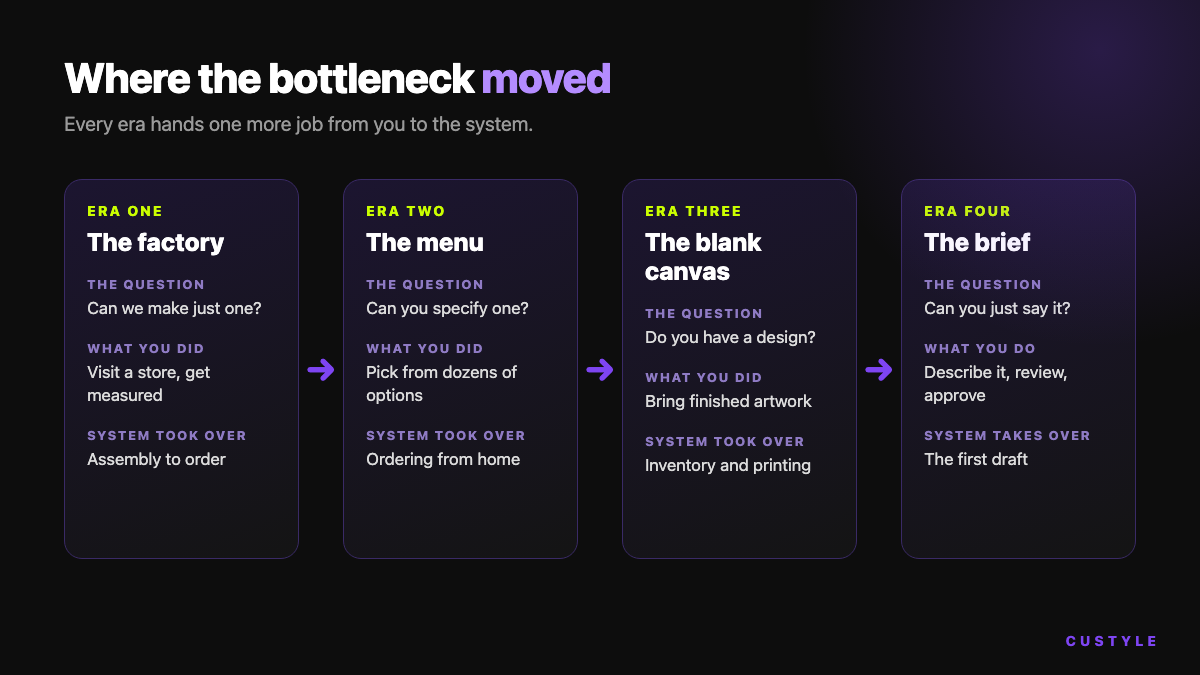
One more pattern is worth naming. Each era moved work from you to the system. Dell took over assembly. Print shops took over inventory. Agents are trying to take over the first draft.
What stays yours is the taste. Nobody else knows why that inside joke belongs on a tote bag.
Each era of mass customization moved one job from the buyer to the system. First assembly, then inventory, and now the first draft of the design.
FAQ
Who coined the term mass customization?
Stan Davis coined "mass customizing" in his 1987 book Future Perfect. Alvin Toffler had anticipated the idea in Future Shock in 1970. B. Joseph Pine II made it a business strategy with his 1993 book Mass Customization: The New Frontier in Business Competition, published by Harvard Business School Press.
What was the first example of mass customization?
There's no single agreed first. Dell is the most cited early case. Founded in 1984, it assembled each computer to the buyer's chosen options. In clothing, Levi's Personal Pair program began offering made-to-measure women's jeans in stores in 1994. Nike's online shoe builder, NikeiD, followed in 1999.
Why did early mass customization programs fail?
Most failed around the customer, not in the factory. Levi's custom jeans ended in 2004 after roughly ten years. Reports blamed hard reorders and unused feedback. Bain's 2013 survey found fewer than 10% of shoppers had tried a product builder, though up to 30% were interested.
Is print on demand a form of mass customization?
Partly. Print on demand makes each item after it's ordered, so a batch of one is normal. But only the printed design changes. The blank product, its cut and its fabric stay standard. It fits the definition for decoration, not for the product itself.
What do AI agents change about mass customization?
They change the starting point. Earlier systems asked you to pick from menus or upload finished art. An AI agent starts from a plain-language brief and proposes a design and product for review. The catalog, the approval step and production limits stay the same.
When did NikeiD become Nike By You?
Nike renamed NikeiD to Nike By You in 2019, twenty years after the service launched online in 1999. The service still lets you choose colors and materials on selected shoes. Nike has not published a clear sales figure for it.
Ready to make something?
Turn your ideas into real merch with AI. No design skills needed.
Start with a vibeArron Young
Founder, Custyle · Nov 17, 2026·13 min read
Further Reading
Explore all →
AI Merch Glossary: 40 Terms from Agentic Commerce to Intent-Driven Manufacturing
40 AI merch terms in plain English: agentic commerce, ACP, UCP, MCP, intent-driven manufacturing, DTG, print files and more. One-sentence definitions first, sources linked.
Read more →
What Is Generative Merch? A Working Definition and Examples
Understand AI-generated artwork on physical merchandise, how it relates to POD and custom design, and what dated vendor examples do—and do not—demonstrate.
Read more →
Inside Ink: From Concept to Artwork You Can Review
Meet Custyle’s Artwork Maker and learn what to inspect: lettering, linework, palette and file detail. Keep approved artwork separate from product presentations.
Read more →
How AI Merch Works: Brief, Artwork, Product and Order
Understand the layers between an AI design idea and physical merchandise. Separate generation, file preparation, product configuration, previews and an actual order.
Read more →