AI Merch Glossary: 40 Terms from Agentic Commerce to Intent-Driven Manufacturing

Custyle Lab
Research & Guides · Nov 16, 2026·16 min read

TL;DR: This AI merch glossary defines 40 terms in plain English. It covers six groups: the category itself, agents and protocols, AI discovery, AI design, production models, and print techniques. Each entry gives you a one-sentence definition first, then what it means for your merch. Protocol definitions quote the official pages. Custyle's own terms are marked as working definitions.
AI merch borrows words from three worlds at once. Software people say "agent" and "protocol." Print people say "DTG" and "bleed." Retail people say "SKU" and "deadstock."
You shouldn't need three dictionaries to make one hoodie.
Custyle Lab wrote this AI merch glossary to put all of it in one place. Other glossaries exist. Print-on-demand platforms define print terms. Protocol sites define agent terms. Custyle Lab found none that joins both halves.
This page is for you if you make merch, sell it, or write about it. Skim the cheat sheet. Jump to a term. Come back when a new acronym shows up.
Contents
- The Cheat Sheet
- Category Terms
- Agents and Protocols
- AI Discovery Terms
- AI Design Terms
- Production Models
- Print Techniques and Files
- How to Use This AI Merch Glossary
- FAQ
A–Z index: Agent2Agent · Agent Payments Protocol · Agentic commerce · Agentic Commerce Protocol · AI agent · AI merch · AI Merch Agent · AI shopping agent · Batch size of one · Creative brief · Custyle Crew · Deadstock · Direct-to-film · Direct-to-garment · Embroidery · Generative design · Generative engine optimization · Generative merch · Human authorship · Image model · Intent · Intent-driven manufacturing · llms.txt · Made to order · Mandate · Mass customization · Minimum order quantity · Mockup · Model Context Protocol · Multi-agent system · Orchestrator · Print file · Print on demand · Prompt · Prompt-to-product · Sublimation · Template · Universal Commerce Protocol · Upscaling · Zero-click buying
The Cheat Sheet
Short on time? These ten terms carry most conversations about AI merch.
| Term | One-line meaning |
|---|---|
| AI merch | Physical merch whose design was made with AI |
| AI Merch Agent | AI that takes your idea all the way to a delivered product |
| Agentic commerce | An AI agent shops, designs or buys for you |
| Intent-driven manufacturing | Products made because you meant them to exist |
| Generative merch | Design generated for your order, then made once |
| ACP / UCP | Open rules for agents and stores to do business |
| MCP | The plug that connects AI apps to outside tools |
| Print on demand | Nothing is printed until an order exists |
| DTG / DTF | Two ways to print a design onto a garment |
| Print file | The production-ready version of your design |
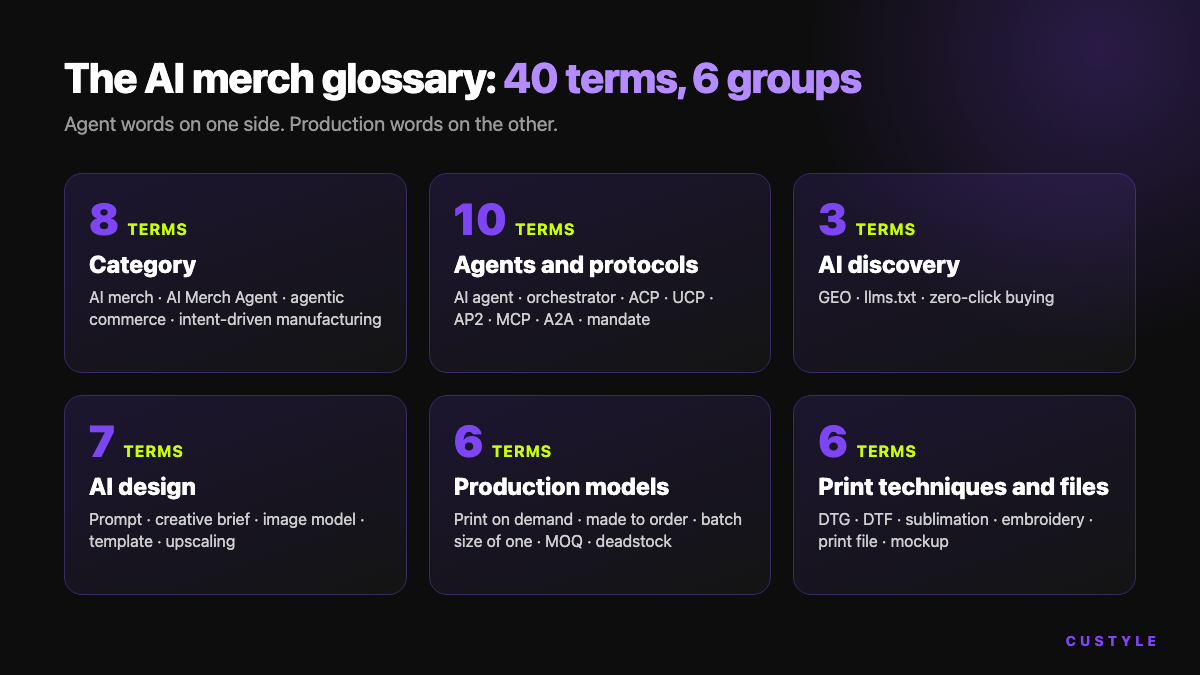 Forty terms, six groups. Agent words sit on one side. Production words sit on the other.
Category Terms
These eight terms name the space itself. Several are Custyle's working definitions. No standards body has defined them yet.
AI merch
AI merch is physical merchandise whose design was created with AI. It's the umbrella term. It covers everything from an AI image dropped onto a tee to a product built end to end by agents. The stricter terms below sit inside it.
AI Merch Agent
An AI Merch Agent is an AI system that handles the full path from your intent to design, production and delivery. You describe what you want. The agent handles the artwork, the right product, the right technique and shipping. Custyle.ai created the category. "MerchAgent" is the short form. → Related: what is an AI merch agent
Agentic commerce
Agentic commerce is commerce where an AI agent shops, designs or buys on a person's behalf. Custyle's consumer-first definition goes further. It calls agentic commerce the delegation of the complete shopper function to an agent acting for one person. You set the taste, the budget and the limits.
The money is real. Bain estimates US agentic commerce "could reach $300 to $500 billion by 2030." That's roughly 15% to 25% of US e-commerce. → Related: what is agentic commerce
Intent-driven manufacturing
Intent-driven manufacturing is a production model where AI translates a person's expressed intent into a finished design and a manufacturable product, made one at a time. Nothing exists before the intent does. Not the inventory. Not even the design.
The short version: forecast-driven manufacturing guesses, demand-driven manufacturing waits, intent-driven manufacturing listens. → Related: what is intent-driven manufacturing
Generative merch
Generative merch is physical merchandise whose design is generated by AI from a person's intent, at the moment of ordering, and produced one at a time. It passes three tests. The design was generated, not picked. It came from intent, not a template. It was made after someone wanted it. → Related: what is generative merch
Intent
Intent is the outcome you mean, as opposed to the exact instruction you typed. An order points at a product that already exists. An intent describes one that doesn't yet. "A hoodie that feels like my band's new album" is intent. "Size M, black" is an order.
Prompt-to-product
Prompt-to-product is the full path from a typed or uploaded idea to a purchasable physical item. It names the whole chain, not just the picture. A tool that stops at an image is prompt-to-picture. → Related: prompt to product
Custyle Crew
The Custyle Crew is a nine-character AI system, with each member responsible for one stage of turning an idea into real merch. Vibbi leads. Pia reads your taste. Nova sharpens the concept. Ink draws. Axis picks the product. Grid places the art. Bolt picks how to build it. Moxy and Lumi show you the result. → Related: meet the Custyle Crew
Agents and Protocols
Agents need shared rules to talk to stores, tools and banks. Those rules are the protocols. Definitions in quotes come from each protocol's official site, read on November 16, 2026.
AI agent
An AI agent is software that takes a goal, plans the steps and uses tools to act. A chatbot answers. An agent does. Ask a chatbot for hoodie ideas and you get a list. Ask an agent and you get a hoodie.
AI shopping agent
An AI shopping agent finds and buys products that already exist. It searches catalogs, compares options and checks out for you. An AI Merch Agent differs in one way. It doesn't stock products. It creates them after you say what you want.
Multi-agent system
A multi-agent system splits one job across several specialized AI agents. One agent reads intent. Another draws. Another handles production. Each stays good at one thing. The Custyle Crew is a multi-agent system with nine members.
Orchestrator
An orchestrator is the lead agent that decides which specialist handles which step. It hears the whole request, routes the work and reports back. In the Custyle Crew, that's Vibbi. Vibbi doesn't make the merch. Vibbi makes sure the right specialists do.
Agentic Commerce Protocol (ACP)
The Agentic Commerce Protocol is "an open standard for programmatic commerce flows between buyers, AI agents, and businesses." Stripe and OpenAI developed it. It's open source under the Apache 2.0 license, per agenticcommerce.dev. It covers physical goods, digital goods and subscriptions. Its core job is agent-initiated checkout.
Universal Commerce Protocol (UCP)
The Universal Commerce Protocol calls itself "the common language for platforms, agents, and businesses." Its co-developers include Google, Shopify, Etsy, Amazon, Microsoft and Stripe, per ucp.dev. It ships with support for AP2, A2A and MCP built in. Think of UCP as the wide road. The next three terms are lanes on it.
Agent Payments Protocol (AP2)
The Agent Payments Protocol is "an open protocol for the emerging Agent Economy," built for payments made by agents. It started at Google. Standards work now continues in FIDO Alliance working groups, per ap2-protocol.org. AP2 answers one hard question. How does a store know you approved what your agent just bought?
Mandate
A mandate is a verifiable record of what you allowed an agent to buy and pay. AP2 defines two. A Checkout Mandate captures the items and purchase details. A Payment Mandate authorizes payment against a specific payment method. Each can start "open," holding your limits, such as a budget. Each "closes" on one final cart and amount.
Model Context Protocol (MCP)
The Model Context Protocol is "an open-source standard for connecting AI applications to external systems." Its own site compares it to "a USB-C port for AI applications," per modelcontextprotocol.io. Anthropic introduced it in November 2024. MCP is how an agent reaches a catalog, a calendar or a print supplier.
Agent2Agent (A2A)
Agent2Agent is "an open protocol enabling communication and interoperability between opaque agentic applications." In plain words, it lets agents built by different companies talk to each other. It began at Google and now sits under Linux Foundation governance, per a2a-protocol.org. MCP connects an agent to tools. A2A connects an agent to other agents.
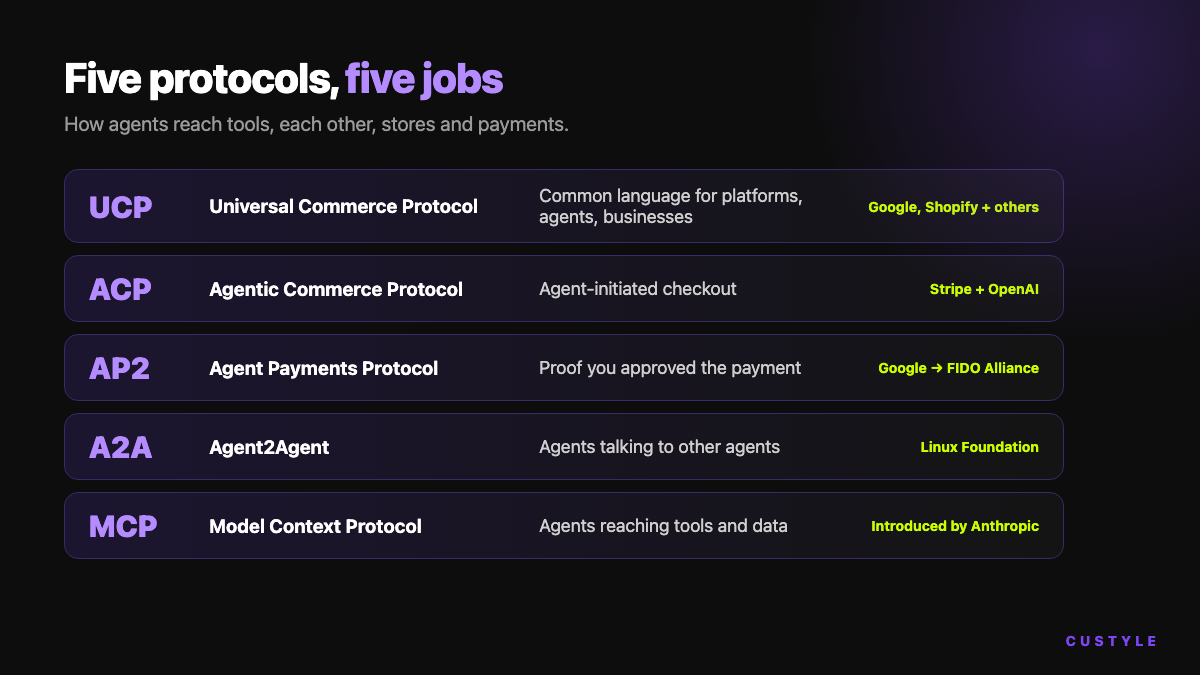 Five protocols, five jobs. None of them replaces the others.
AI Discovery Terms
Agents can only buy what they can find. These three terms cover how products and pages get found by AI.
Generative engine optimization (GEO)
Generative engine optimization is the practice of shaping content and product data so AI systems can retrieve, cite and recommend it. Some call it answer engine optimization, or AEO. It's an industry term, not a formal standard. Clear definitions and sourced numbers tend to get cited. This AI merch glossary is built that way on purpose.
llms.txt
llms.txt is "a proposal to standardise on using an /llms.txt file to provide information to help agents use a website." Jeremy Howard published the proposal on September 3, 2024, per llmstxt.org. It's voluntary. Think of it as a short guide a site writes for AI readers.
Zero-click buying
Zero-click buying is a purchase completed inside an AI interface, without a visit to the store's own site. You ask, the agent finds, you confirm, it's bought. For sellers, the product page matters less. The product data matters more.
AI Design Terms
These seven terms cover the creative half. They explain why a nice AI picture isn't yet a product.
Prompt
A prompt is the plain-language instruction you give an AI model. It can be a sentence, a photo or both. A prompt is what you typed. Intent is what you meant. Good systems read the second from the first.
Creative brief
A creative brief is the structured version of your intent: style, palette, subject, tone and audience. "A retro sunset vibe for a beach trip crew" becomes a warm palette, a vintage look and casual apparel. The brief guides everything made after it.
Image model
An image model is AI that generates pictures from text or reference images. It makes pictures for screens. Merch lives on fabric, ceramic and steel. That gap is why a raw AI image often prints badly. → Related: how AI merch actually works
Template
A template is a pre-made design with a few editable slots, such as a name or a photo. It's fast and safe. It's also the same layout everyone else gets. Generative merch starts from your intent instead, so the design itself is new.
Generative design
Generative design is an engineering term for AI that produces many design options from goals and constraints. Autodesk uses it for things like machine parts. It's about shape, strength and cost. Don't confuse it with generative merch, which is about artwork on things you wear and carry.
Upscaling
Upscaling is using AI to enlarge an image by adding pixels. It helps a small file reach print size. It can't invent real detail. Upscale a flawed image and you enlarge the flaws. Clean first, then upscale.
Human authorship
Human authorship is the legal test for whether a work can be protected by copyright in the US. The U.S. Copyright Office released Part 2 of its AI report on January 29, 2025. It found that AI outputs can be protected "only where a human author has determined sufficient expressive elements." Prompts alone don't qualify. This is general information, not legal advice.
Production Models
These six terms describe when and why a product gets made.
Print on demand (POD)
Print on demand is a model where a product is printed only after an order exists. No stock sits in a warehouse. One unit is a complete order. Research firms put the market at an estimated $13–15 billion in 2026, according to Grand View Research and Straits Research. Print on demand still needs a finished design first. → Related: AI merch vs print on demand
Made to order
Made to order means production starts after the purchase, not before. Print on demand is the print-based version. The term also covers cut-and-sew, engraving and 3D printing. The trade-off is simple. You wait a few days. Nothing gets wasted.
Batch size of one
Batch size of one means a production run that makes a single unit. Machine-tool maker DMG MORI uses the phrase for one-off manufacturing. It's the factory-floor fact that makes personal merch possible. Without it, one hoodie for one person can't exist.
Mass customization
Mass customization is the industry's term for one-off products made at near mass-production efficiency. In practice it usually means adjusting a pre-designed product. Pick a color. Add a name. Intent-driven manufacturing starts earlier, before the design exists.
Minimum order quantity (MOQ)
Minimum order quantity is the smallest order a manufacturer will accept. Traditional custom merch often asks for dozens or hundreds of units. On-demand production has no minimums. You can order one.
Deadstock
Deadstock is inventory that was made and never sold. It's what forecasting leaves behind when the guess is wrong. On-demand models avoid it by design. A product nobody asked for never gets made.
Print Techniques and Files
You never have to pick a technique yourself. Good systems choose for you. But these six terms explain why the same design looks different on different products.
Direct-to-garment (DTG)
Direct-to-garment is a digital method where an inkjet printhead sprays ink straight onto fabric, and heat sets it. It's most common on cotton, according to Printful. It handles full-color art and photos well. The ink soaks into the fibers, so the print feels soft.
Direct-to-film (DTF)
Direct-to-film prints a design onto a special film, then heat-presses it onto the product. The ink sits on top of the fabric instead of soaking in. That makes it work on cotton, polyester, blends and dark colors. The feel is slightly smoother and more film-like.
Sublimation
Sublimation uses heat to turn dye into gas, which bonds into polyester fibers or coated surfaces. It's how all-over prints and photo mugs get made. Color runs edge to edge and won't crack. It doesn't work on cotton or dark fabric.
Embroidery
Embroidery is a design stitched into the product with thread by a machine. It suits caps, polos and jackets. Artwork must first be "digitized," which means converted into stitch paths. Gradients and tiny details don't survive. Bold, flat shapes do.
Print file
A print file is the production-ready version of a design, with enough pixels, printable colors and a clean transparent background. It's a different object from a screen image. Three numbers and ideas sit inside it:
- DPI. Dots per inch. Print size times DPI gives the pixels you need. Printful recommends 300 DPI for most files.
- RGB vs CMYK. Screens mix light. Printers mix ink. Ink reaches fewer colors, so neon shades shift.
- Transparent background. The design is cut out, so no box prints around it.
Do the math on a 1024 × 1024 AI image. Stretched across a 12-inch shirt front, it lands near 85 DPI. That prints soft and blocky.
Mockup
A mockup is a rendered preview of your design on the product before it's made. A flat mockup shows placement. A virtual try-on shows the product on a person. Both exist for one reason. You should see it before it's real.
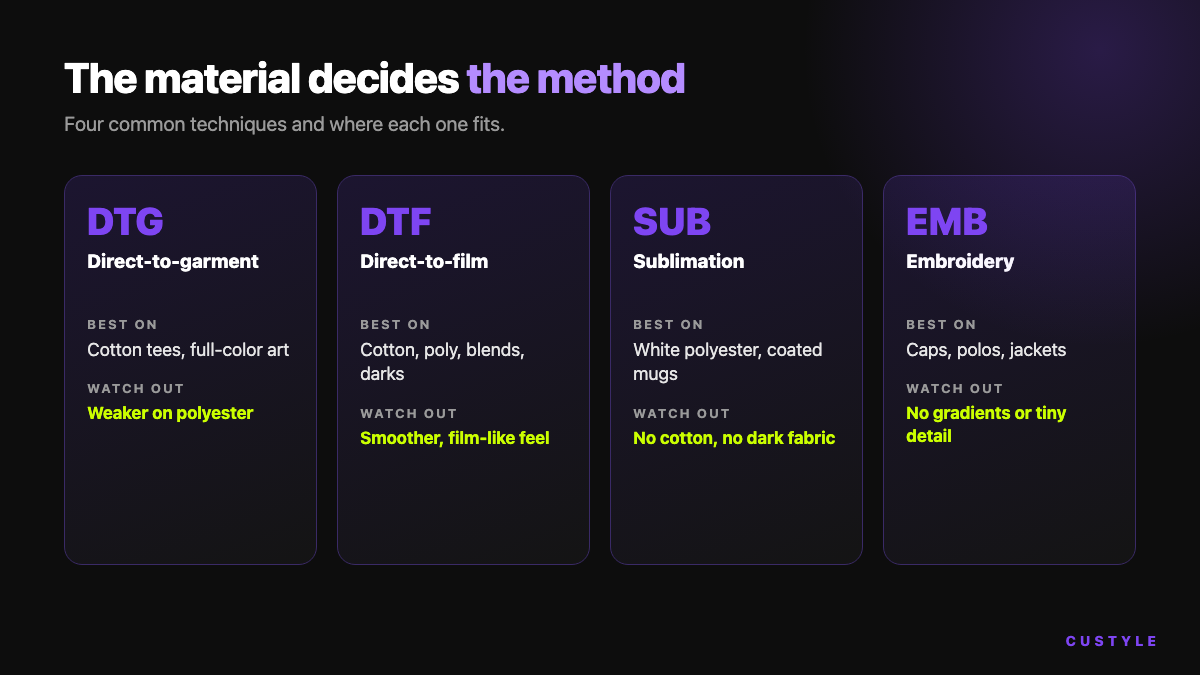 The material decides the method. The design decides the rest.
How to Use This AI Merch Glossary
Use it three ways.
Reading about agentic commerce? Start with Agents and Protocols. Learn MCP, ACP and UCP first. Most news coverage assumes you know them.
Making your first piece? Read Print Techniques and Files. Then run this quick check before you order:
- Is your design sharp at full print size?
- Does it have a transparent background?
- Are the colors printable, with no pure neon?
- Does the detail level suit the product?
- Have you seen a mockup on the real product?
Planning to sell? Read Human authorship twice. Then check each tool's commercial-use terms.
With an AI Merch Agent, most of that checklist happens for you. At Custyle, Bolt picks the technique and Grid handles placement. You describe the vibe. The crew turns it into the right product, built the right way.
This AI merch glossary will grow. The category is young, and new terms land every quarter. Custyle Lab updates this page when definitions change at the source.
FAQ
What is AI merch?
AI merch is physical merchandise whose design was created with AI. It ranges from an AI image printed on a tee to a product built end to end by AI agents. The stricter term, generative merch, means the design was generated from your intent for that specific order, then made one at a time.
What is the difference between ACP and UCP?
Both are open standards for agent-led shopping. The Agentic Commerce Protocol, from Stripe and OpenAI, centers on agent-initiated checkout. The Universal Commerce Protocol, co-developed by Google, Shopify and others, describes itself as a common language for platforms, agents and businesses. It builds in AP2, A2A and MCP support.
Is AI merch just print on demand?
No. Print on demand describes when a product gets printed: after an order exists. It still needs a finished design first. AI merch describes how the design gets made: with AI. An AI Merch Agent combines both. The design and the production each happen after you say what you want.
What does DTG mean in merch?
DTG stands for direct-to-garment. It's a digital printing method where an inkjet printhead sprays ink straight onto fabric, and heat sets it. It's most common on cotton and handles full-color artwork well. For polyester, blends and dark garments, direct-to-film or sublimation often fits better.
Who defines these AI merch terms?
It depends on the term. Protocols such as ACP, UCP, AP2, MCP and A2A are defined on their official sites. Print terms come from long industry use. Newer category terms, such as AI Merch Agent, generative merch and intent-driven manufacturing, are Custyle Lab's working definitions. No standards body has defined them yet.
Custyle.ai is the AI Merch Agent for self-expression. Describe a vibe — a memory, a meme, an aesthetic — and a crew of nine AI specialists turns it into real merch. No design skills. No minimums.
Ready to make something?
Turn your ideas into real merch with AI. No design skills needed.
Start with a vibeCustyle Lab
Research & Guides · Nov 16, 2026·16 min read
Further Reading
Explore all →
From NikeID to AI Agents: A Short History of Mass Customization
Mass customization in four eras: Dell and Levi's built to order, NikeiD added the menu, print on demand made one-offs routine, and AI agents now start from a plain brief.
Read more →
What Is Generative Merch? A Working Definition and Examples
Understand AI-generated artwork on physical merchandise, how it relates to POD and custom design, and what dated vendor examples do—and do not—demonstrate.
Read more →
Inside Ink: From Concept to Artwork You Can Review
Meet Custyle’s Artwork Maker and learn what to inspect: lettering, linework, palette and file detail. Keep approved artwork separate from product presentations.
Read more →
How AI Merch Works: Brief, Artwork, Product and Order
Understand the layers between an AI design idea and physical merchandise. Separate generation, file preparation, product configuration, previews and an actual order.
Read more →