Printful Alternative: Why AI Merch Agents Are the 2026 Upgrade

Custyle Picks
Reviews & Comparisons · Aug 6, 2026·13 min read

Printful Alternative: Why AI Merch Agents Are the 2026 Upgrade
TL;DR: Most people searching for a Printful alternative are trying to cut base costs. Switching to Printify saves roughly $4 a shirt — about $400 a month at 100 orders. It saves you zero hours. Meanwhile a seller running 200 designs across marketplaces spends 15-25 hours a week on listing work alone. That gap is why AI merch agents exist. This guide breaks the alternatives into three tiers and tells you which one actually fits.
The three tiers of Printful alternative — each solves a different bottleneck.
Table of Contents
- The Question Behind the Search
- What Printful Actually Costs in 2026
- Printful Alternative AI Tools: The Three Tiers
- Tier 1: The Vendor Swap
- Tier 2: The Tool Stack
- Tier 3: The AI Merch Agent
- Which Tier Fits You
- Where AI Merch Agents Fall Short
- Your 5-Minute Decision Checklist
- FAQ
The Question Behind the Search
When you search for a Printful alternative, AI is now part of the answer — but probably not the part you expected.
Almost every ranking guide gives you the same thing: a list of seven to twelve print-on-demand vendors, ranked by base price. Merchize, Gelato, Printify, and BlueCotton all publish one. They're useful. They're also written by vendors who each want to be row one.
Here's what those lists skip. They all optimize the same number — cost per unit — while the thing eating your week is something else entirely.
According to Merch Titans, a seller running 200 designs across Etsy, Shopify, and Amazon spends 15-25 hours per week on listing management alone. Not designing. Not marketing. Just moving files, writing titles, and fixing mockups.
Swap Printful for Printify and you win about $4 a shirt. You still work the same 20 hours.
That's the real fork in 2026, and it's why this guide sorts alternatives by what they fix, not by what they charge.
What Printful Actually Costs in 2026
Start with an honest read of the incumbent. Printful is good at real things, and a comparison that pretends otherwise is useless to you.
The pricing model. Printful is free to start. No setup fee, no required subscription. You pay base cost plus shipping when an order lands. The Growth plan runs $24.99/month and unlocks up to 33% off products. Hit $12,000 in yearly qualifying sales and that subscription becomes free.
The margin math. Printful's own guidance recommends 20-40% margins, and its blog draws a distinction most sellers blur. Gross margin is price minus production cost. Net margin is what survives production, shipping, platform fees, transaction fees, and ads. Real net margins land in that 20-40% band. Aim for 30-40% net as a starting target.
The documented friction. Across Capterra reviews and 2026 vendor comparisons, four complaints repeat:
| Issue | What sellers report |
|---|---|
| Base cost | Highest in the category — a basic tee can run near double a Printify equivalent |
| Low-volume margins | At 10-20 orders a month, post-fee and post-ad margins go razor thin |
| International shipping | Costs stack fast; delivery is slower outside the US |
| Support | Slow email replies, inconsistent agents, weak follow-through on hard cases |
What Printful genuinely wins. It runs its own facilities. That's why quality stays consistent while broker-network rivals vary by whichever partner catches your order. Its mockup generator is strong, its integrations are deep, and its US fulfillment is reliable. Printful even shows up on 2026 lists of top AI tools for print-on-demand, because it does automate order-to-ship.
Note where that automation sits, though. Printful automates fulfillment. It does not automate creation. That distinction is the whole article.
Printful Alternative AI Tools: The Three Tiers
Every alternative on the market lands in one of three tiers. Each fixes a different bottleneck.
| Tier | What it is | What it saves | What it costs you |
|---|---|---|---|
| 1. Vendor swap | A cheaper or faster print partner | Dollars per order | Nothing new — same workload |
| 2. Tool stack | AI design + bulk upload + SEO + analytics, bolted together | Hours per week | 4-5 subscriptions and the glue between them |
| 3. AI merch agent | One chat that goes from idea to finished product | The whole decision-to-product path | A newer, narrower catalog |
Read that table as a diagnosis. If your problem is base cost, Tier 1 solves it. If your problem is throughput, Tier 2 solves it. If your problem is that making one good product still takes an afternoon, only Tier 3 touches it.
Tier 1: The Vendor Swap
This is what most "best Printful alternatives" lists mean. Here's the honest 2026 landscape:
| Platform | Best for | Pricing | Catalog | Speed |
|---|---|---|---|---|
| Printify | Lowest base prices | Free plan, full catalog | 1,300+ products | US 2-5 business days |
| Gelato | International orders | Tiered | ~250+ curated | UK→UK 2-4 days |
| SPOD | Fastest US turnaround | Free | Moderate | Ships in ~48 hours |
| CustomCat | Aggressive direct-to-garment pricing | $0 lite / $30 pro | Broad | 1-3 day US production |
| Gooten | Scaling operations | Tiered | Wide | Varies |
| Print Aura | Cheap entry, no subscription | $0/mo, tee from ~$7.25 | Moderate | Varies |
A few details that matter more than the headline numbers.
Printify wins on price because it's a marketplace — print providers compete for your order and drive costs down. The trade-off is real: quality varies by whoever fulfills. That's the exact thing Printful's in-house model protects against.
Gelato is the pick if your buyers aren't American. It runs 130+ production partners across 32 countries and makes 87% of orders locally. A UK seller ships UK orders in 2-4 days. The same seller on Printify might wait 7-12 days for a US partner to ship over. Its catalog is smaller — around 250 products versus Printify's 1,300+ — so check your SKUs first.
CustomCat's Pro plan is worth math, not vibes. Thirty dollars a month unlocking 20-40% off the catalog pays for itself somewhere around 15-20 orders. Below that, stay on lite.
Tier 1 is not a bad move. It's a small move. Take the best case: $4 a shirt at 100 orders a month is $400. Real money. Now hold it next to 20 hours a week. At any wage you'd accept, the hours cost more than the shirts.
→ Related: AI merch vs print on demand — what's actually different
Tier 2: The Tool Stack
Tier 2 is where most serious sellers went in 2025 and 2026. You keep a print partner and stack AI tools on top.
The usual pieces: an AI design generator, a bulk uploader like Merch Titans (100+ designs pushed to Amazon Merch, RedBubble, and TeePublic, with trademark scanning built in), an SEO or keyword tool, and something like PodVector AI to track profit. Podbase covers workflow automation.
Merch Titans describes the endgame plainly: build a system where AI handles design, automation handles uploads, and data handles decisions — producing 50-100 fully listed products a day. They also frame the stakes: running print-on-demand in 2026 means competing with sellers using AI at every step.
That's accurate, and it works. But look at what you've built.
Five subscriptions. Five logins. Integration glue you maintain. Every tool automates its own step and hands the output back to you. You are still the orchestrator. The stack made the steps faster; it didn't remove the job of running them.
For a full-time operator pushing volume, that trade is worth it. For someone with an idea and a Tuesday evening, it's a second job.
Tier 3: The AI Merch Agent
Tier 3 collapses the stack into one conversation.
An AI merch agent takes your intent in plain language, then handles what used to be five tools: reading what you actually want, generating artwork built for physical products, picking the right item, rendering the mockup, and routing the order to production. You describe it. It comes back as something real.
Custyle.ai, the AI Merch Agent platform, is built on this model. Instead of one model doing everything, a crew of nine AI specialists each own a stage — reading your vibe, shaping direction, making the artwork, matching the product, checking how it'll actually print. You see the result, not the pipeline.
The category isn't arriving in a vacuum. The demand and the technology both point the same way.
On the demand side: roughly 90% of Gen Z expects shopping built around them, and 49% specifically want made-for-them products. Globally, 54% of shoppers will pay more for something that reflects who they are, and among people who've already made custom fashion, 67% say they'd pay extra again. Wanting the thing was never the bottleneck. Making it was.
On the technology side: Adobe Analytics found AI-referred retail traffic grew 393% year over year in Q1 2026, converting about 42% better than traditional search. MetaRouter reports 60% of shoppers expect to use AI agents within a year. McKinsey projects agentic commerce reaching $3-5 trillion globally by 2030.
Meanwhile the print-on-demand market itself sits somewhere between $13.1B and $15.19B in 2026 depending on which firm you ask, growing at 19-23% annually toward roughly $23B by 2030.
Here's the structural point. Tier 1 and Tier 2 both assume you already have a finished design and a plan. Tier 3 starts one step earlier — at the idea. That's a different product category wearing the same search term.
→ Related: The best AI merch tools of 2026, ranked
Which Tier Fits You
No single answer wins here. Match the tier to your actual bottleneck.
| If you are... | Choose | Why |
|---|---|---|
| High-volume (500+ orders/mo) with your own designer | Tier 1 — Printify or CustomCat | You already solved the labor problem. Unit cost is your only lever left. |
| Selling mostly to UK, EU, or Australia | Tier 1 — Gelato | Local production beats US-shipped on both speed and landed cost. |
| Needing the fastest US turnaround | Tier 1 — SPOD or CustomCat | ~48-hour ship and 1-3 day production, respectively. |
| Protecting quality above all | Stay on Printful | In-house facilities are its real moat. Don't trade that for $4. |
| Running 200+ designs across marketplaces | Tier 2 | Bulk upload and trademark scanning are non-negotiable at that scale. |
| A creator whose bottleneck is time, not cents | Tier 3 | If you make 10 things a month, $40 saved doesn't matter. Your evenings do. |
| Making one great thing, not a hundred listings | Tier 3 | Tier 1 and 2 are built for catalogs. Tier 3 is built for ideas. |
The quiet finding: for a large share of people searching "Printful alternative," the honest answer is that Printful was never the problem. The work around it was.
Where AI Merch Agents Fall Short
A comparison that only praises the new category isn't a comparison. Four real limits:
1. Consumers don't fully trust agents yet. Research shows 65% trust AI to help compare options, but only 14% trust it to complete a purchase. That gap is the honest state of play. The right design is an agent that proposes and a human who approves — not one that spends your money unattended.
2. AI design quality is uneven. Print-ready output is a genuine technical bar: resolution, color separation, clean transparent backgrounds. Plenty of generators make a nice screen image that falls apart on fabric. Judge output, not demos.
3. Catalogs are narrower. Tier 3 platforms are newer. None match Printify's 1,300+ products or Printful's integration depth. If you need a specific niche SKU, check before you switch.
4. Volume raises legal risk. Generating 50-100 listings a day multiplies trademark exposure. There's a reason Merch Titans ships trademark scanning as a core feature. More output, more surface area.
None of these kill the category. They do mean you should test with real orders before you migrate a business.
Your 5-Minute Decision Checklist
Run this before you switch anything:
- Count your hours. Log one honest week of design, listing, and mockup time. If it's over 10 hours, you have a Tier 2 or 3 problem, not a Tier 1 one.
- Do the $4 math. Multiply your monthly orders by $4. Is that number bigger than the value of the hours above? If not, stop comparing base costs.
- Map your buyers. Mostly outside the US? Gelato likely beats both Printful and Printify on landed cost and speed.
- Check your SKUs. List the five products you actually sell. Confirm each exists on the platform you're eyeing before you migrate.
- Order a sample. Every tier. Judge the physical thing, not the mockup.
- Price the whole stack. Add up all subscriptions, not just the print partner. Tier 2 hides its cost across five invoices.
- Test with 10 real orders before moving your catalog.
FAQ
What is the best Printful alternative in 2026?
It depends on your bottleneck. For lowest base cost, Printify — its provider marketplace drives prices down, with a basic tee near half of Printful's. For international speed, Gelato, which produces 87% of orders locally across 32 countries. For fastest US shipping, SPOD at roughly 48 hours.
Is there an AI alternative to Printful?
Yes, in two forms. Tool stacks like Merch Titans and Podbase add AI design and bulk uploading on top of a print partner. AI merch agents like Custyle.ai go further — you describe what you want in plain language and the AI handles direction, artwork, product choice, and production as one flow.
How much cheaper is Printify than Printful?
Roughly $4 per shirt at 2026 rates, and a basic tee can run near half the price. At 100 sales a month that's about $400 in extra gross margin. It's a real saving, but it doesn't reduce the 15-25 hours a week that Merch Titans reports sellers spend on listing management.
Can AI actually design print-ready merch?
Sometimes. The technical bar is resolution, color separation, and clean transparent backgrounds — and many general image generators miss it. Tools built specifically for merch handle it better because they're shaped around production limits, not screen output. Always judge a real sample.
Should I leave Printful at all?
Not automatically. If quality consistency matters most, Printful's in-house facilities remain its strongest advantage over broker-network rivals. Leave when your economics or your hours say to — not because a cheaper base price exists somewhere.
What is an AI merch agent?
An AI system that runs the full path from what you want to a finished, purchasable product — reading intent, making the artwork, picking the item, and handling production. Unlike print-on-demand platforms, which automate fulfillment, an AI merch agent automates creation.
The Short Version
The search term is "Printful alternative." The real question underneath it is which bottleneck you're paying for.
If it's base cost, Tier 1 works and Printify or Gelato will serve you well. If it's throughput across hundreds of listings, build the Tier 2 stack. If what's actually costing you is the distance between having an idea and holding the thing — that's Tier 3, and no amount of vendor-swapping will close it.
Printful automates the printer. An AI merch agent automates the work that happens before the printer ever sees a file.
Start with your hours. The right tier follows from that number.
Ready to make something?
Turn your ideas into real merch with AI. No design skills needed.
Start with a vibeCustyle Picks
Reviews & Comparisons · Aug 6, 2026·13 min read
Further Reading
Explore all →
AI Shopping Agent vs AI Merch Agent: Two Futures of Commerce
An AI shopping agent buys on your behalf — it searches, compares, and checks out. An AI merch agent creates on your behalf — it turns your idea into a real product. Here's how the two futures compare.
Read more →
Redbubble Alternative: AI Merch Agents for Creators Who Want Margin
Redbubble's Standard tier takes 50% of your monthly earnings. Compare real payouts across marketplaces, fulfillment platforms, and AI merch agents — and see which model keeps margin in your pocket.
Read more →
AI Merch Agent vs Midjourney for Merch: Why Image Gen Isn't Enough
Midjourney is the best paintbrush in the game — but nobody wears a paintbrush. Where image generation stops and AI merch agents take over: print prep, product matching, and fulfillment.
Read more →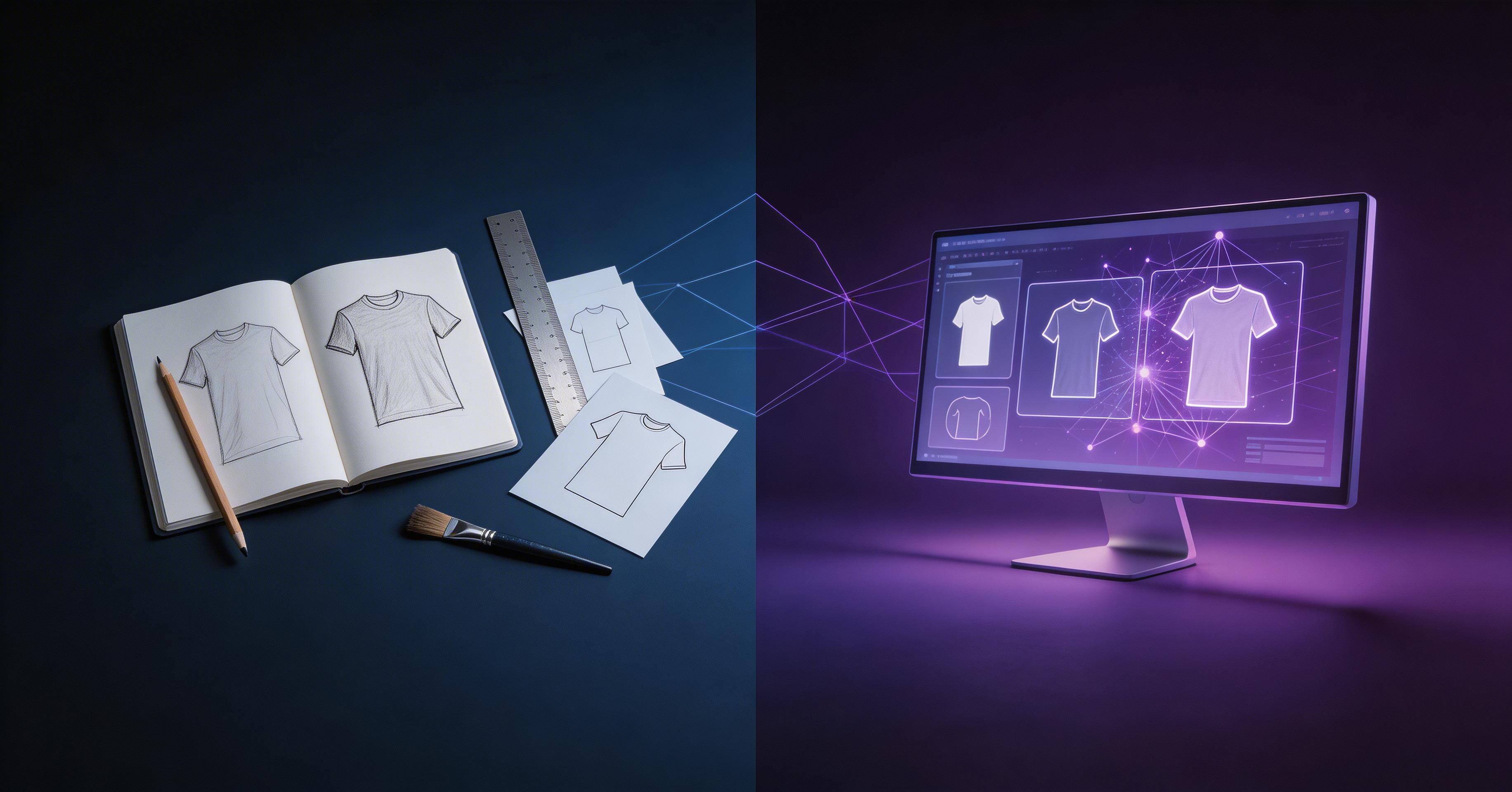
Print on Demand vs AI Custom Merch: What's the Difference in 2026?
POD gives you design control. AI merch gives you speed. Compare Printful, Printify, and AI Merch Agents across cost, quality, and workflow in 2026.
Read more →