Who Owns an AI-Designed T-Shirt? Copyright, Trademarks & Merch in the AI Era

Custyle Lab
Research & Guides · Nov 23, 2026·13 min read
TL;DR: In the US, a design made purely from a prompt has no copyright owner. You can still sell it, but you can't stop others from copying it. AI-generated design copyright attaches only to what you add: your own drawing, your text, your edits, your arrangement. Trademark works differently. Your shop name and logo can be protected whether or not AI drew them. For merch sellers, infringing someone else's rights is a bigger risk than losing your own.
You typed a prompt. The AI made a great shirt graphic. You put it on a tee and sold 40 of them. Then a copy shows up in another shop.
Can you make them take it down? Usually, no. Not if the AI made the whole design.
This guide is for anyone selling merch with AI art on it. Think Etsy sellers, creators, small brands, and band or podcast shops. It covers the law as of November 2026, mostly in the US, with notes on the UK, EU and China.
This is general information, not legal advice. For registration or brand decisions, talk to an IP attorney.
Contents
- AI design copyright: the short answer
- Four layers of rights
- What the Copyright Office says
- The cases that drew the line
- Where your authorship starts
- Trademark plays by different rules
- Your AI tool's terms
- The bigger risk: infringing others
- Marketplace and EU rules
- A seller's checklist
- FAQ
AI Design Copyright: The Short Answer
Nobody owns the copyright in a design that AI generated on its own. Under US law, copyright needs a human author. A prompt alone doesn't make you one.
That doesn't make the design illegal to sell. It means the design is closer to public domain. You can print it. So can anyone else.
You can own the parts you made yourself. Hand-drawn linework, your own slogan, real edits, a deliberate layout of several elements. Those human contributions can carry copyright, even when AI made the rest.
Copyright follows the human creative work you can see in the final design, not the prompt that started it.
Four Layers of Rights
Most confusion comes from treating "ownership" as one question. For a shirt, it's four questions.
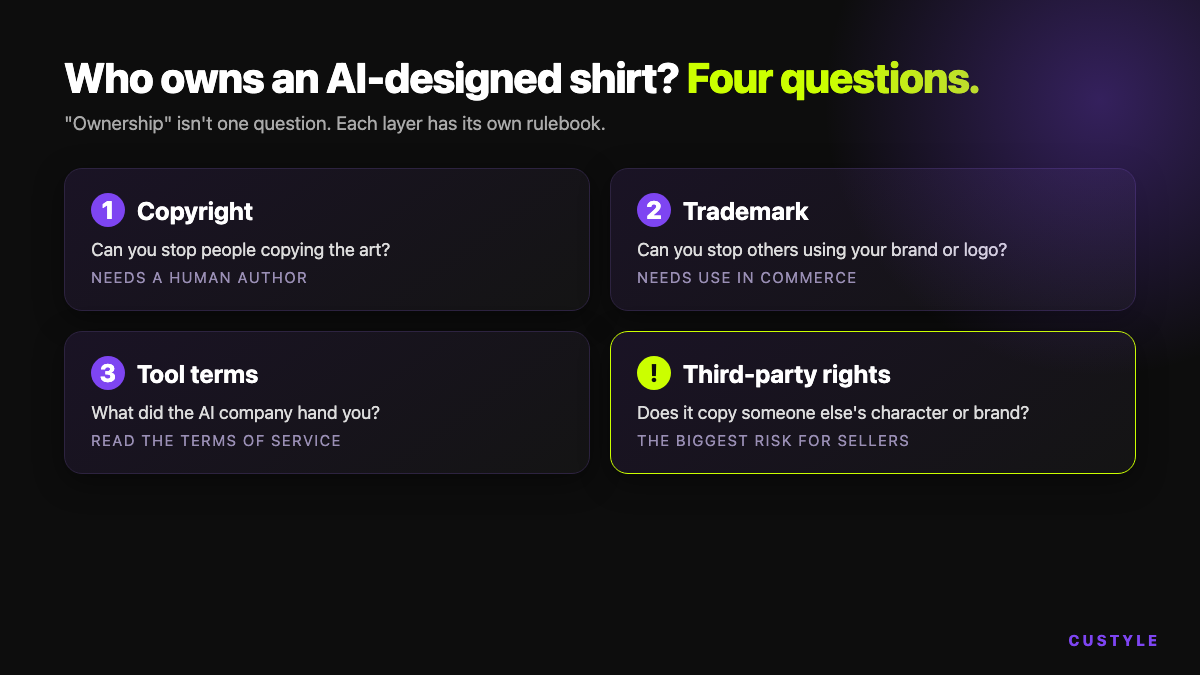
| Layer | The question | Who decides |
|---|---|---|
| Copyright | Can you stop people copying the art? | Copyright law, human authorship |
| Trademark | Can you stop people using your brand name or logo? | Trademark law, use in commerce |
| Tool terms | What did the AI company give you? | The tool's terms of service |
| Third-party rights | Does the design copy someone else's work or brand? | Their copyright and trademark |
Keep these separate and most of the fog lifts. A design can be yours under the tool's terms, unprotected by copyright, and still infringe a studio's character. All at once.
What the Copyright Office Says
The US Copyright Office set out its position in Copyright and Artificial Intelligence, Part 2: Copyrightability, released January 29, 2025. It drew on more than 10,000 public comments.
The core points:
- Human authorship is required. Copyright needs enough human creativity. The Office decides case by case.
- Prompts alone don't count. Purely AI-generated output from a prompt lacks human authorship. The Office treats prompts as instructions. The system, not you, decides the final expression.
- Your perceptible work counts. Your expression that shows up in the output can be protected. So can creative selection, arrangement or modification of AI material.
- No new law needed. The Office said existing law handles these questions and recommended no legislation.
Registration follows the same logic. Under March 2023 Federal Register guidance, you must disclose AI-generated material that is more than de minimis. You exclude it from your claim and describe what you made. The Office has cancelled at least one registration that left AI images out.
The Cases That Drew the Line
Five disputes shape the current picture.
Thaler v. Perlmutter (US). Stephen Thaler tried to register art credited to his AI system, with no human author. The D.C. Circuit said no on March 18, 2025: the Copyright Act requires a human author. The Supreme Court declined to hear the appeal on March 2, 2026, so that ruling stands. Thaler claimed zero human contribution, so the court never said how much human work is enough.
Zarya of the Dawn (US). Kris Kashtanova made a comic book with Midjourney images. In February 2023, the Copyright Office kept protection for the human-written text and the selection and arrangement of text and images. It excluded the Midjourney images themselves. It found one Photoshop-edited image still didn't show enough human expression. The Office noted that Midjourney output can't be predicted by the user. That makes it different from tools like a camera or a brush.
Allen v. Perlmutter (US). Jason Allen's Théâtre D'opéra Spatial won a state fair art prize. The Office says he ran at least 624 Midjourney prompts, then upscaled and cleaned up in Photoshop. It still refused registration. Allen sued in federal court in Colorado. As of November 2026, the case is fully briefed but undecided, per a Congressional Research Service sidebar. This is the case to watch on "how much human work is enough."
Getty Images v. Stability AI (UK). On November 4, 2025, the UK High Court rejected Getty's main copyright claim. It found the Stable Diffusion model doesn't store or reproduce Getty's images. Getty won a narrow trademark point, though. Some outputs from older model versions reproduced Getty's watermark. The judge called the findings "both historic and extremely limited." The lesson for sellers: AI output can carry someone else's mark.
Li v. Liu (China). The Beijing Internet Court went the other way in November 2023. It held a Stable Diffusion image was protected because the person shaped prompts and settings and chose the result. That person was the author. So the answer depends on where you sell.
Where Your Authorship Starts
Think of it as a spectrum. The more of the final design you made yourself, the more you can protect.
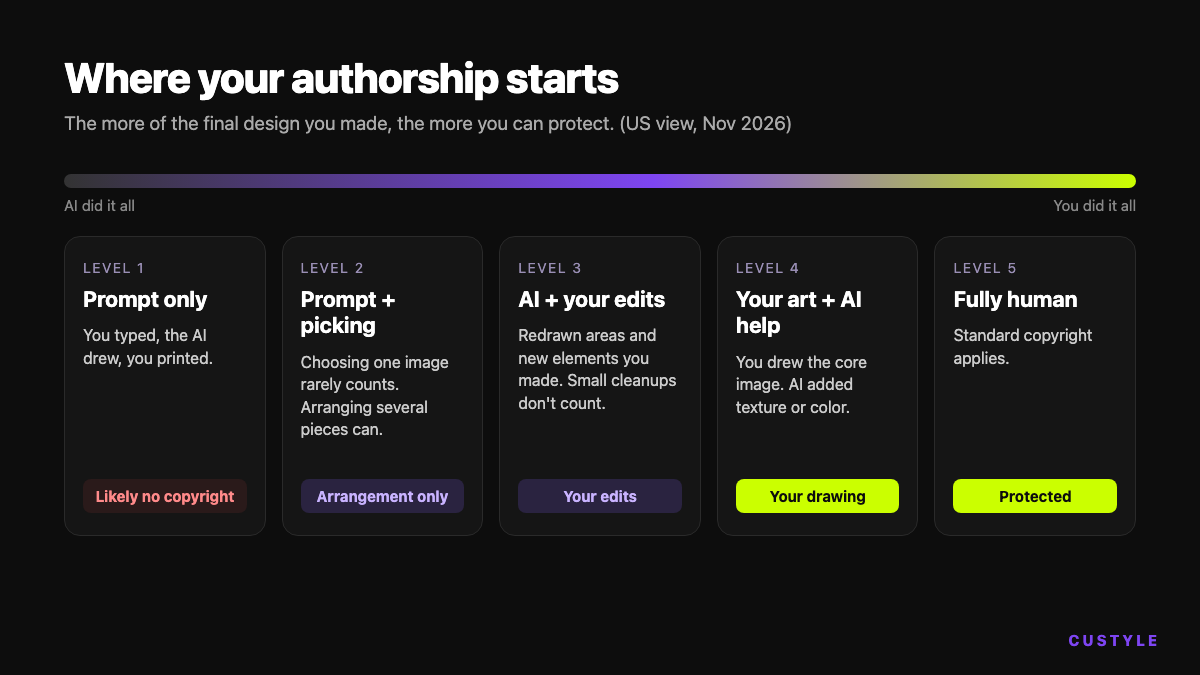
- Prompt only. You typed, the AI drew, you printed. Likely no copyright in the US.
- Prompt plus picking. You generated many options and chose one. Picking one image usually isn't enough. Arranging several pieces into a composition can be.
- AI plus your edits. You redrew areas, changed composition, added hand-made elements. Your visible changes can be protected. Small cleanups probably aren't.
- Your art plus AI help. You drew the main image and used AI for texture or color. Your drawing stays yours.
- Fully human-made. Standard copyright applies.
Text is the easy win. A slogan you wrote is your text. Very short phrases usually aren't copyrightable at all, though. That's where trademark comes in.
Keep a paper trail. Save sketches, layered source files, edit history and prompt logs. If you ever need to show what you made, that record does the work.
Trademark Plays by Different Rules
Trademark protects a brand name or logo that tells buyers who made a product. It doesn't ask who drew it. It asks whether the mark is distinctive, used in commerce on real goods, and not confusing with someone else's mark.
So an AI-made logo can still become a registered trademark. Law firm commentary broadly agrees there's no human-authorship test for trademarks. Confirm the details with the USPTO or an attorney before filing.
Two catches matter for merch:
- A design on the front of a shirt is usually decoration, not a trademark. Trademark protects your shop name or the small logo on the sleeve or tag. It won't stop someone copying a big graphic.
- AI can echo existing marks. Ask for "a sporty swoosh logo" and you may get something too close to a famous one. The Getty watermark ruling shows output really can reproduce a third party's mark.
For brand protection, trademark your shop name and logo. Don't count on copyright in AI art to protect your brand.
Your AI Tool's Terms
Your AI tool's terms of service decide what the company hands you. They can't create copyright the law doesn't recognize.
- OpenAI assigns you its rights in output. That assignment only covers whatever rights exist.
- Midjourney lets paying subscribers own their images, with plan requirements for larger companies. Midjourney also keeps a broad license to use what you make. Free-tier terms have differed.
Three things to check in any tool's terms, including ours:
- Commercial use. Is selling merch allowed on your plan?
- Who else can use it. Does the company keep a license to your images?
- Indemnity. Some business plans cover IP claims. Most consumer plans don't.
Terms change. Read the current version before a product launch, not the one you remember. Compare how image generators and merch tools differ in → Related: AI merch agent vs Midjourney.
The Bigger Risk: Infringing Others
Losing protection for your own design is annoying. Infringing someone else's rights can get your listings pulled, your shop suspended, or you sued.
The live example is Disney and Universal v. Midjourney, filed in 2025. The studios argue that the tool's output reproduces their famous characters. Midjourney says its training is fair use. The case is still pending as of November 2026. Whatever happens, a shirt showing a studio's character is the seller's problem, not just the tool's.
Avoid these in prompts and outputs:
- Characters. Cartoon, game, anime or film characters you don't hold a license for.
- Logos and brand names. Sports teams, fashion houses, beverage brands.
- Real people. Celebrity faces and names can raise right-of-publicity claims.
- "In the style of" living artists. Style alone usually isn't protected, but marketplaces flag it, and close copies get taken down.
- Watermarks and signatures. If a stray logo or signature shows up in the output, regenerate.
Run a reverse image search on any design you plan to sell at volume. It takes a minute.
Marketplace and EU Rules
Platforms add their own rules on top of the law.
- Etsy files seller-prompted AI creations under "Designed by a seller" and requires you to disclose the use of AI. Normal copyright and trademark takedowns still apply.
- Redbubble and Amazon Merch on Demand don't ban AI art outright, based on public guidance. Standard IP, copycat and quality reviews apply. Check each platform's current policy page before you list.
In the EU, the AI Act's Article 50 transparency rules have applied since August 2, 2026. They require marking AI-generated content and labeling deepfakes. Most duties fall on the companies that build and deploy AI systems, not on each shirt. Fines reach €15 million or 3% of worldwide turnover. EU copyright also centers on the author's own intellectual creation, so purely generated art is weak there too.
A Seller's Checklist
Run this before you list an AI-assisted design.
- Know your layer. Is your value in the art, the brand, or both?
- Add yourself where it matters. For designs you want to own, add your own drawing, text or real edits.
- Save your process. Sketches, layered files, prompts, edit history.
- Screen for third parties. No characters, logos, celebrities or watermarks. Reverse image search.
- Check your tool's terms. Commercial use, retained license, indemnity.
- Disclose where required. Etsy, and anywhere else a platform asks.
- Protect the brand. Consider a trademark for your shop name and logo.
- Register carefully. If you register a copyright, disclose and exclude the AI material.
- Treat pure AI art as non-exclusive. Price and plan as if others could copy it.
The best protection for a merch brand is a name buyers trust and a steady stream of new designs. Copyright on one graphic matters less than people think.
How Custyle Fits
Custyle.ai is an AI Merch Agent. You describe a vibe, and an AI crew turns it into a design built for a real product. You shape the result through rounds of revision: what to keep, what to change, which words go on it, where things sit. Those choices are your intent, and they're worth recording.
Custyle doesn't grant copyright, and no AI tool can. What it does is get the design right for merch, so you can spend your time on the parts that are truly yours. See how that works in → Related: prompt to product, or browse the range in → Related: AI custom products.
FAQ
Who owns the copyright to an AI-generated t-shirt design?
In the US, nobody, if AI generated the whole design from a prompt. The Copyright Office and the D.C. Circuit both require a human author. You own copyright only in the parts you made yourself, such as your own drawing, original text, meaningful edits or a creative arrangement of elements.
Can I sell merch with AI-generated designs?
Yes. Copyright law doesn't stop you selling AI art. Your tool's terms must allow commercial use, and the design must not copy someone else's characters, logos or likeness. Platforms like Etsy also require you to disclose AI use. The catch is that others can usually copy a purely AI design too.
Can I copyright an AI design if I edit it in Photoshop?
Possibly, for your edits. The Copyright Office protects human modifications that show creative expression. Small cleanups usually aren't enough: in the Zarya of the Dawn decision, one Photoshop-edited image still didn't qualify. Substantial redrawing, new hand-made elements or a new composition stand a better chance.
Can an AI-generated logo be trademarked?
Generally, yes. Trademark law protects source identifiers, not creative authorship. A logo can be registered if it's distinctive, used in commerce on your goods, and not confusingly similar to an existing mark. Check that AI didn't echo a famous logo, and confirm the filing with the USPTO or an IP attorney.
Is it legal to use "in the style of" prompts for merch?
Style by itself usually isn't protected by copyright. But outputs that closely copy a specific artwork, character or living artist's signature work can infringe. Marketplaces often flag them. Selling under an artist's name raises extra issues. The safer route is describing the mood, colors and techniques you want, not naming a living artist.
So, Who Owns It?
Back to the copied shirt. If AI drew the whole thing, nobody owns the copyright, and you can't stop the copy. If you drew, wrote or meaningfully reworked parts of it, those parts are yours. Your brand name can be yours either way, through trademark.
AI-generated design copyright for merch comes down to one rule. Own what you add, protect your brand, and don't borrow anyone else's. Ready to make something with your own taste in it? Start with a vibe → custyle.ai
Ready to make something?
Turn your ideas into real merch with AI. No design skills needed.
Start with a vibeCustyle Lab
Research & Guides · Nov 23, 2026·13 min read
Further Reading
Explore all →
From NikeID to AI Agents: A Short History of Mass Customization
Mass customization in four eras: Dell and Levi's built to order, NikeiD added the menu, print on demand made one-offs routine, and AI agents now start from a plain brief.
Read more →
AI Merch Glossary: 40 Terms from Agentic Commerce to Intent-Driven Manufacturing
40 AI merch terms in plain English: agentic commerce, ACP, UCP, MCP, intent-driven manufacturing, DTG, print files and more. One-sentence definitions first, sources linked.
Read more →
What Is Generative Merch? A Working Definition and Examples
Understand AI-generated artwork on physical merchandise, how it relates to POD and custom design, and what dated vendor examples do—and do not—demonstrate.
Read more →
Inside Ink: From Concept to Artwork You Can Review
Meet Custyle’s Artwork Maker and learn what to inspect: lettering, linework, palette and file detail. Keep approved artwork separate from product presentations.
Read more →